A due diligence checklist is a list of every document, record, and check you need to review before you buy, invest in, or partner with a business, organized so nothing gets missed and everyone knows who owns what. A complete one covers six areas:
Download our free due diligence checklist (Excel). It has all six areas, with owner, reviewer, status, and due-date tracking built in, and a summary tab that updates as you go.
The process typically takes one to two months for a small business and can run six months or longer for a complex one. A structured checklist keeps that time from going to chasing documents nobody tracked.
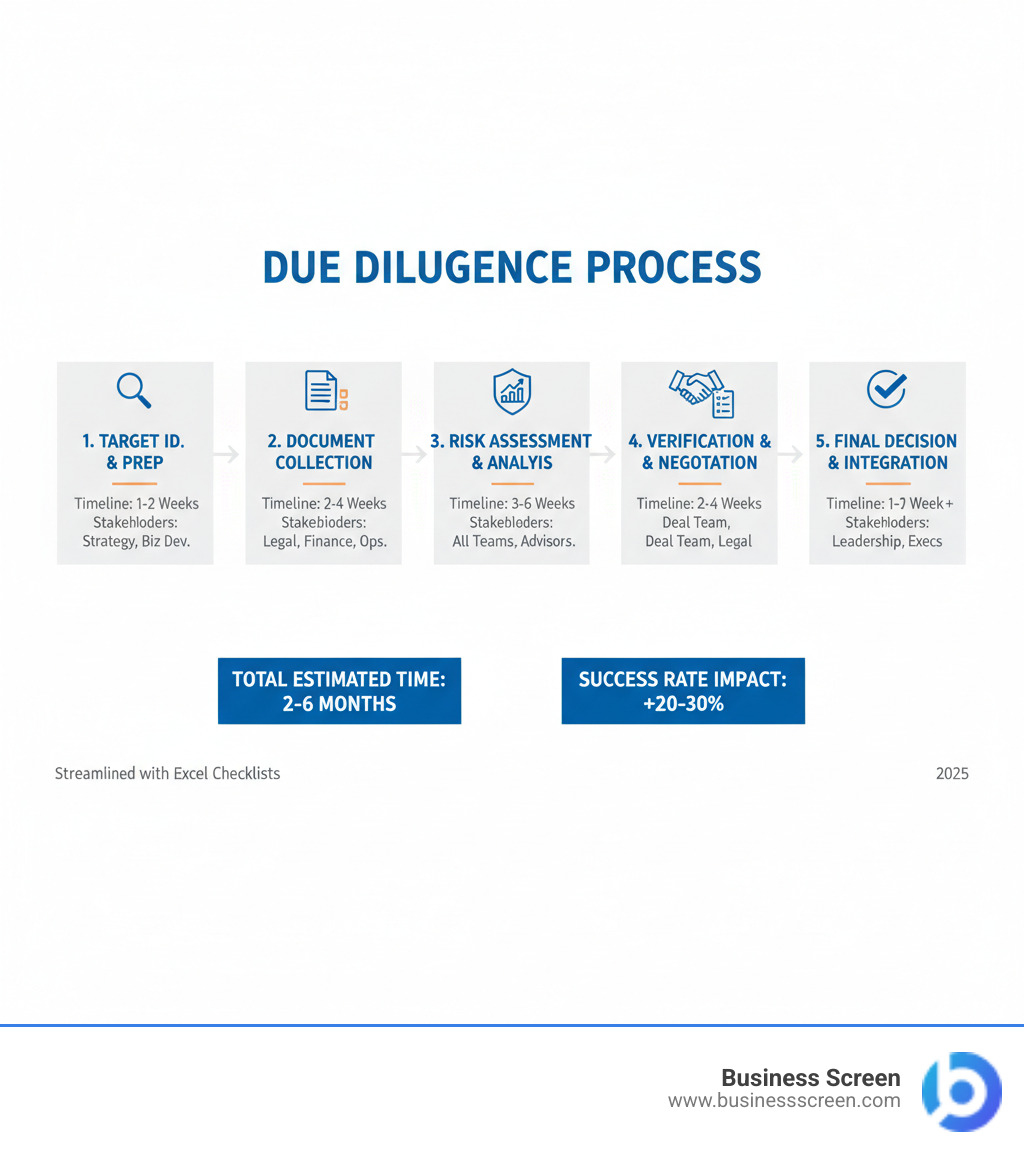
Due diligence is a systematic investigation of a business before a transaction. It’s the difference between taking the seller’s word and checking for yourself. In mergers and acquisitions, that means a close review of the target’s assets, liabilities, contracts, and risks.
The stakes are real. Studies cited in Harvard Business Review put the share of acquisitions that fall short of expectations at somewhere between 70% and 90%. The authors trace much of that to strategy: buying the wrong company for the goal behind the deal. A checklist won’t fix strategy. What it prevents is the other kind of miss: the lawsuit, lien, or contract clause nobody asked about until after closing.
For a deal-specific framework, see our M&A Due Diligence: The Ultimate Guide & Checklist.
A checklist points you at the places problems usually hide:
Spotting these early gives you room to negotiate terms, adjust the price, or walk away. Our guide to 9 Due Diligence Red Flags covers what each one signals.
Sellers who work through the checklist before a buyer does tend to get a smoother process:
Each area answers a different question about the business. Skipping one leaves a gap the others won’t fill. The Excel template covers all six, with what to look for on each item.

Financial diligence tells you whether the numbers hold up. Key items:
Legal diligence confirms the company is properly formed and free of hidden liabilities. Key items:
This area looks at how the business actually makes money. Key items:
This area covers the people and the obligations that come with them. Key items:
This area confirms the company owns what drives its value. Key items:
Most checklists stop at the documents the seller provides. This area covers what the public record says about the company and the people who run it, which the seller’s documents won’t show. Key items:
These are the searches we run at Business Screen. Our article on why a business background check should cover principals too explains why the people matter as much as the entity.
A checklist only helps if the team actually works from it. These practices are built into the template:

Every deal needs some tailoring. A software company’s diligence leans on intellectual property, cybersecurity, and data privacy. A manufacturer’s leans on environmental liabilities, equipment condition, and the supply chain. Real estate deals focus on title, zoning, and environmental assessments; our Commercial Real Estate Due Diligence Guide & Checklist covers those.
To customize, ask of every item: is this critical for this deal? Adjust for an asset purchase versus a stock purchase, and add rows for anything specific to the industry.
A pre-built template saves the setup time on every deal, keeps teams consistent, and reminds you of items that are easy to forget. It’s a starting point, not a finished product, so expect to add and remove rows.
Due diligence is a team effort, so the checklist needs to work as a shared tool:
A checklist organizes what you ask for. It can’t confirm that what you received is accurate, or surface what nobody handed over: an undisclosed lawsuit, a lien filed last month, a principal’s history at a previous company.

A virtual data room (VDR) holds the documents securely, with access controls, Q&A, and an audit trail of who viewed what. The checklist tracks what you’ve requested and reviewed; the data room holds the files themselves.
The documents in a data room come from the seller. Our investigators work from the public record instead:
Buyers use the checklist to find problems before closing. Sellers use it to prepare, anticipating what a buyer will ask for and fixing issues in advance. That second approach, sometimes called reverse due diligence, tends to make the process faster and support the sale price.
For a small to mid-sized business, typically one to two months. For a larger or more complex company, three to six months or longer. Size, deal structure, and how quickly documents are available drive the timeline. A seller with documents ready in a data room can shorten it considerably.
Not before a signed nondisclosure agreement (NDA). After that, release documents in stages: high-level information first, then more detailed records as the buyer’s interest firms up. A virtual data room lets the seller control access and keep a record of who saw what.
Six areas: financial; legal and corporate; operational and commercial; human resources; intellectual property and assets; and background and public records. Our free Excel template includes 61 items across all six.
A good checklist covers the financial, legal, operational, people, and asset sides of a business, plus what the public record says about the company and its principals. The template gives you the structure. What it can’t do is confirm that what you were told is true, which is where public-record checks on the company and the people behind it come in.
If you’d like help with the background and public records side of your checklist, hit Get Started below and our team will walk through what makes sense for your deal.