



You have a company in front of you. It might be a vendor about to get access to your systems, a contractor bidding on work, a borrower weeks from funding, or a partner someone wants to sign. The question on the table is whether the business checks out.
That question is easy to ask and harder to answer well, because the useful version of it is more specific. What are you actually trying to find out, and how much would it cost you to be wrong? A one-off order from a small supplier and a five-year exclusive distribution agreement deserve very different amounts of work, and running the same check on both wastes effort on one and underserves the other.
So the first move is not picking a tool. It is deciding what the check has to establish. Everything after that follows from the answer.
Start with the corporate record. Pull the registration from the Secretary of State in the state of formation and confirm the entity is active and in good standing, check the registered agent and address, and note the formation date. Match the legal name against whatever name appears on the contract or the invoice, because those often differ.
Here is the part that trips people up. Registration is easy to obtain and nearly everyone has one. The Census Bureau counted 531,423 business applications filed in June 2026 alone, seasonally adjusted. Confirming that a company is registered tells you a filing was accepted. It does not tell you the business operates, has revenue, or is run by people you would want to do business with.
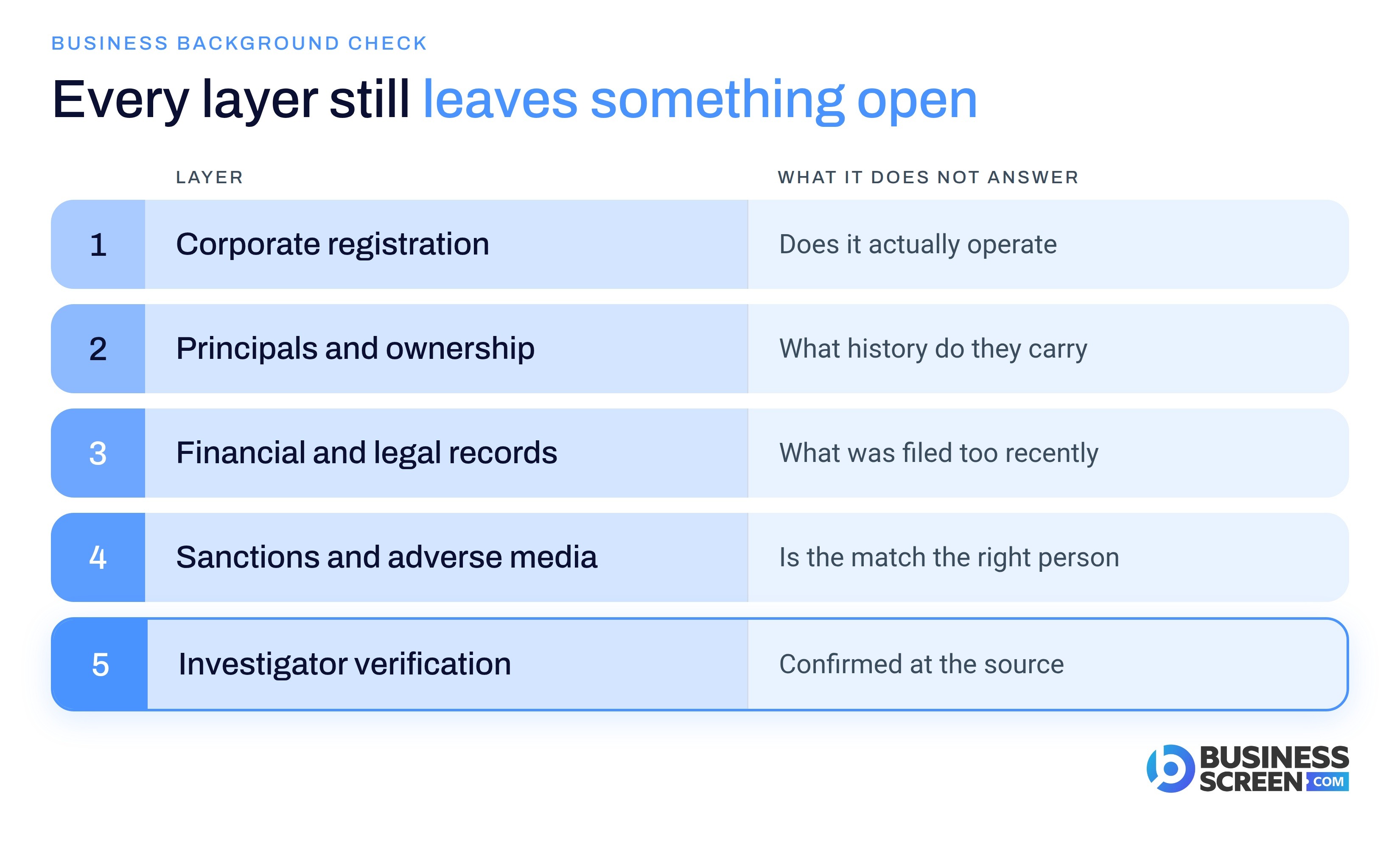
That gap between verified existence and verified legitimacy is the whole reason the rest of the process exists. Entity and identity verification closes part of it, and the full picture of what know your business (KYB) verification confirms covers where that layer stops.
An entity is a legal wrapper. The people operating inside it carry the history that usually matters to your decision.
Pull the officers and directors from corporate filings, then work out who actually controls the company. Registration records name whoever was listed at filing, which is not always the person running things. Layered holding structures and nominee arrangements can put distance between the name on the paperwork and the person with real control, and beneficial ownership records have limits that are worth knowing before you rely on them.
Consider what entity age actually tells you. A company formed eight months ago has almost no record to search, and a check on the entity alone will come back thin and read as clean. The person who formed it may have been operating in the same industry for thirty years, through four previous companies, two of which left behind judgments and a bankruptcy. All of that history is findable. None of it is attached to the new entity. Screening only the company would have returned nothing at all.
That is the argument for principal-level diligence in a sentence. Patterns live with people: prior businesses that failed the same way twice, litigation that follows the operator from entity to entity, judgments that never attached to whatever company is in front of you now. Skipping this is the most common gap we see, which is why it is worth understanding why a business check should cover principals too.

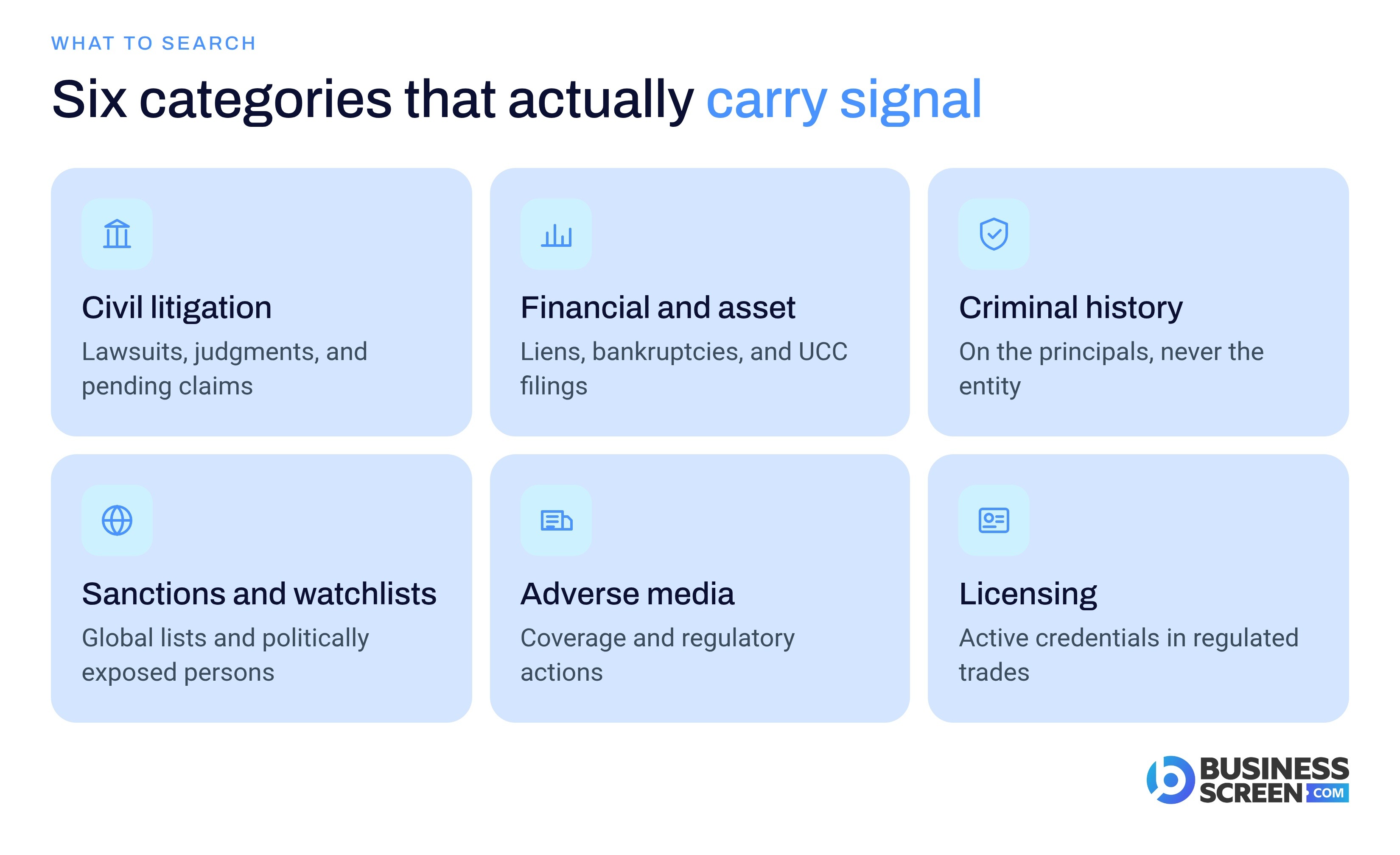
With the entity confirmed and the people identified, the search work falls into a handful of categories. Which of them matter depends on the relationship you are entering and what it would cost you if it went badly.
Civil litigation. Lawsuits, judgments, and pending claims at county, state, and federal level. A civil records search surfaces disputes with suppliers, customers, and former partners, which often say more about how a company operates than anything in its marketing.
Financial and asset records. Bankruptcies, tax liens, Uniform Commercial Code (UCC) filings, and property records. These financial risk signals are the clearest read on whether a business is under strain. Reading liens and judgments correctly matters as much as finding them, since a single mechanics lien and a pattern of unpaid tax obligations mean very different things.
Criminal history on the principals. Relevant when the individuals carry personal exposure in the deal, such as a guarantor on a loan or a controlling owner in an acquisition. This applies to the criminal history of the people, never the entity.
Sanctions and watchlists. Screening against global sanctions and politically exposed person lists. Necessary for cross-border relationships and regulated industries, though what a sanctions screen actually verifies is narrower than most people assume.
Adverse media. Negative coverage, regulatory actions, and reputational signals. Useful, and also the category most prone to false positives, which is why separating signal from noise is its own discipline.
Licensing. In regulated trades, confirming an active license or certification is often the fastest disqualifier available.
Most business background checks are database searches. Aggregators collect records from courts and registries, and a provider queries that collection. For a lot of situations that is genuinely sufficient.
The limits show up in three predictable places.
Recent filings may not have arrived yet. Records move from a courthouse or registry into a commercial database on a lag that can run weeks or months, so a search today can miss something filed last quarter. Coverage is uneven, and rural and smaller county courts often do not feed electronic databases at all. And common names produce collisions, which means a clean result on a common name is weaker evidence than a clean result on an unusual one.
This is not theoretical. A private lender came to us on a $500,000 loan where the borrower had come back clean in their usual screening. Our investigators found more than $1 million in tax liens filed in the preceding 60 days, too recent to have reached any database. The deal did not fund.
The practical takeaway is that "no records found" and "verified clean" are different statements, and it is worth knowing what a clean check can still miss before you treat one as the other.
All of that is a genuine research project for a single counterparty, and the part that trips people up is not the searching. It is confirming that each record found belongs to your subject rather than to someone with a similar name, and going to the courthouse or registry directly when the database copy is stale or missing. Most teams are not doing this once. They are doing it for every vendor they onboard, every borrower in the pipeline, every contractor bidding on work.
This is the work we take on. Our investigators run the searches, pull records at the source when a database will not do, verify each hit against identifiers so you are not handed a list of possible matches to sort out yourself, and write up what was found in plain language with the supporting documents attached. You get a finding you can act on and file, rather than raw output you have to interpret.
Because the situations vary so much, that work comes at three depths rather than one.
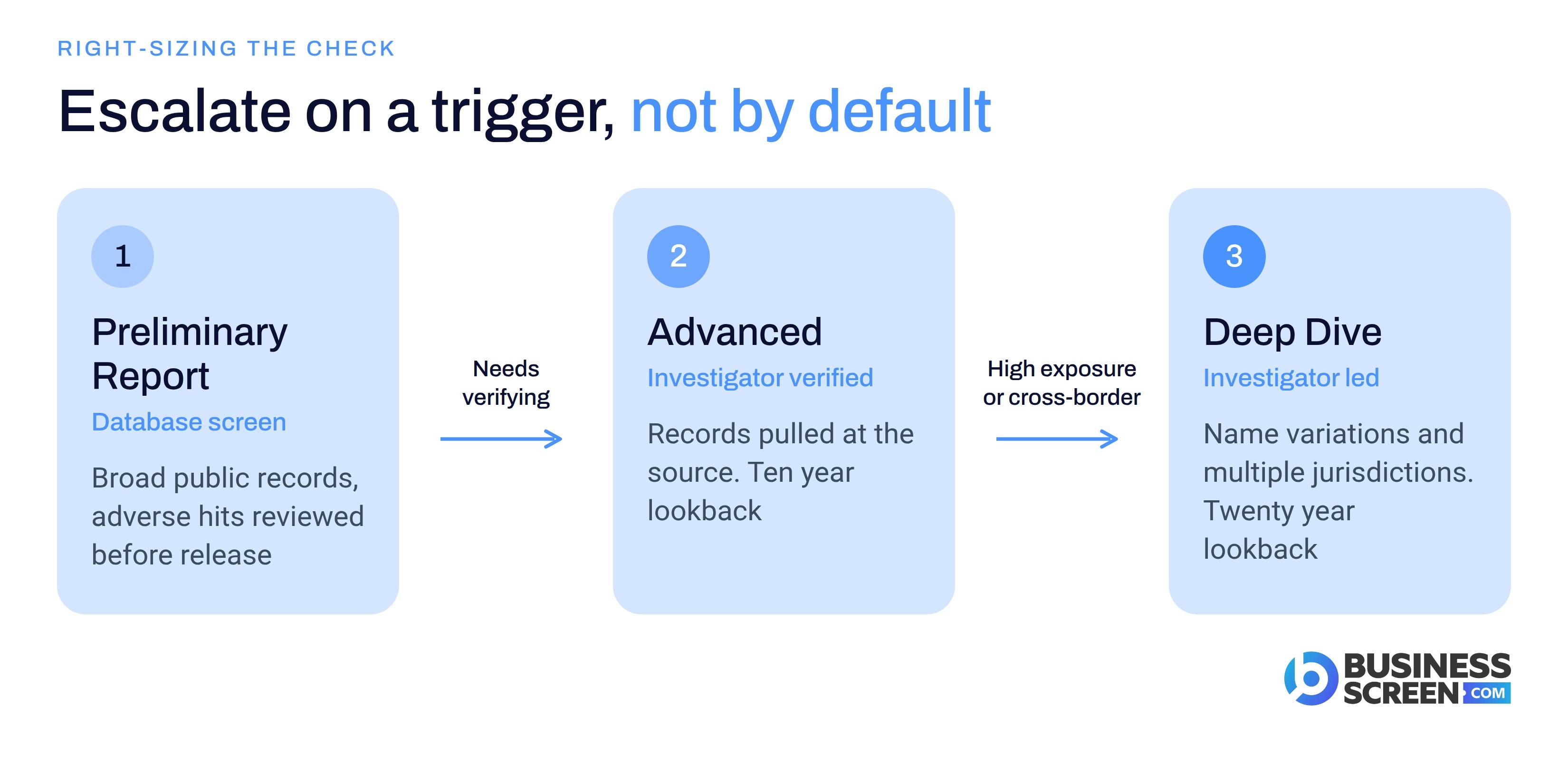
A Preliminary Report is the database screen, covering broad public records quickly, with an investigator reviewing anything adverse before it reaches you. It suits routine screening where the exposure is limited and volume is high.
Advanced is where investigators go to work. Records get pulled from the source rather than a database copy, every hit is confirmed to the correct subject, and the lookback runs ten years on the legal name.
Deep Dive extends that to twenty years, works through name variations including previous names and trade names, and runs live searches across multiple jurisdictions rather than one. This is where large transactions, acquisitions, and relationships you cannot easily exit belong.
The triggers for moving up are usually obvious once you look for them. The dollar amount is significant, something in the first screen needs verifying, the counterparty operates across borders, or the relationship will run for years. Deciding when to escalate is worth doing deliberately rather than defaulting to the deepest option every time, and the lighter answer is frequently the correct one. Teams onboarding vendors at volume and lenders working against a funding timeline both tend to find that the tiering matters more than any individual search, because it is what keeps diligence from becoming the thing everyone waits on.
Interpretation is where good diligence separates from box-checking, and it is the step most often skipped.
Dismissed civil cases are not the same as adverse judgments. Old records may have aged past relevance. A lien that has been released tells a different story than one still outstanding. A single lawsuit at a company with two thousand employees is noise, while three suits from suppliers at a company with twelve employees is a pattern.
What you want at the end is not a pile of records. It is a clear read on what was found, what it means, and what supporting documentation sits behind it, which is roughly what a decision-ready report should look like. If you are working out where in your process this belongs at all, when a diligence investigation actually starts is a useful companion to this piece.
One last thing worth planning for. A background check describes a business as of the day you ran it. For relationships that continue past closing, point-in-time screening and ongoing monitoring answer different questions, and knowing which one you need is part of scoping the work.

Everything above is mechanics. The judgment is in matching the work to what the relationship actually puts at risk, and that answer moves from one counterparty to the next.
If you would rather have that work run for you, or you have a specific counterparty in front of you and want help scoping the right depth, fill out the form below and our team will walk through it with you.







.png)
