Services

Criminal Records Check

Standard criminal background checks follow employment screening rules that limit what can be reported and to who. When the check is for a deal, a partnership, or an investment, those rules are working against your due diligence.

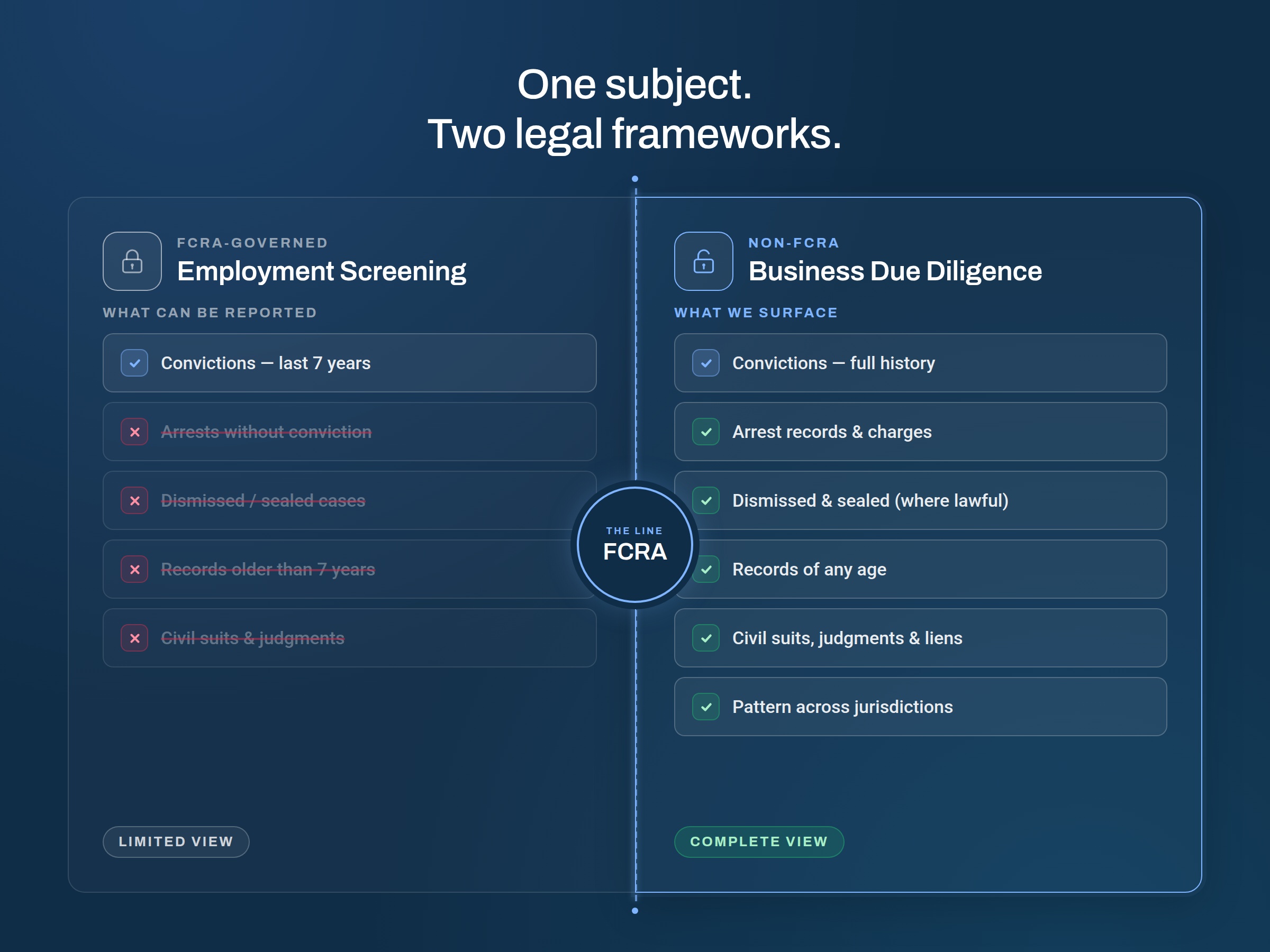
Side-by-side comparison of FCRA-governed employment screening versus non-FCRA business due diligence, showing what each framework can and cannot report — including restrictions on arrests, dismissed cases, older records, and civil suits under FCRA versus full access to all of those under non-FCRA.

When a Clean Record Puts Your Next Deal at Risk

A background check on criminal history is a standard part of most due diligence workflows. But not every check is built for every situation, and the gaps aren’t always obvious until after the decision has been made.

Most criminal background checks follow the Fair Credit Reporting Act (FCRA), a framework designed for employment decisions. FCRA checks require consent from the subject, can’t report dismissed records, and limit non-conviction history to seven years in most states. In a hiring context, those rules serve a clear purpose. In business due diligence, they create blind spots.

Employment Screening Rules That limit your criminal Background check

FCRA was built to protect job applicants. When you’re evaluating a borrower, partner, or vendor, those protections can work against you. Here’s what gets left out of a standard FCRA criminal background check.

Consent Required Before Screening

FCRA checks require written authorization from the person being screened. In business due diligence, requiring consent from a potential partner or borrower may not be feasible.

Seven-Year Look Back on Non-Convictions

Non-conviction records older than seven years can't be reported under FCRA. A dismissed fraud case from year eight disappears from the report entirely, regardless of relevance.

State-Level Reporting Restrictions

Beyond the federal seven-year rule, individual states restrict reporting of arrests that didn't lead to conviction. In some states, even pending cases are excluded entirely.

Adverse Action Process Required

FCRA mandates a formal adverse action workflow: pre-adverse notice, waiting period, and final notice. In due diligence, that process doesn't map to the decision being made.
Consider a private lender evaluating a borrower requesting bridge financing. A standard FCRA background check could return a clean result. Even a national criminal database search would miss the dismissed fraud charge from nine years prior that falls outside the seven-year lookback, or an active case in a neighboring county that hasn’t reached any national index. A non-FCRA investigation would surface both.

How Direct-Source Verification Changes Your Criminal Record Due Diligence

Instead of a filtered, time-limited snapshot, you get a complete criminal record picture with no lookback restrictions and no suppression of non-conviction history. Investigators trace the subject's identity, map every jurisdiction, and pull records directly from county courthouses and federal district courts.

Because our investigations are non-FCRA, none of the restrictions outlined above apply. You get verified findings with case numbers, charges, disposition status, and supporting court documents, each one confirmed to belong to your subject.

Trace identity data to identify all jurisdictions and name variations tied to the subject
Pull criminal records directly from county courthouses and federal district courts
Verify each potential match at the original source to eliminate false positives
Label findings with clear status: active, dismissed, pending, or resolved
Deliver plain-English summaries with docket sheets, case summaries, and supporting court documents

“The most in-depth background provider we’ve employed. Professional, always meets our SLA’s, and fantastic to work with.”

— Mike B.

From Automated Coverage to Live Courthouse Access

Criminal records live in different places depending on the jurisdiction, the court level, and the offense. These searches cover each one. Database-sourced options give you speed; investigator-sourced options give you verified findings pulled directly from the original court or registry.

Criminal Record Search - National Database

Aggregated search across state repositories and departments of correction for broad initial coverage and fast turnaround.
Individual
Database-Sourced

Sex Offender Search - National Database

Screens individuals against the national sex offender registry to identify active registrations across all 50 states. Returns registration status, offense classification, and reporting jurisdiction.
Individual
Database-Sourced

Criminal Record Search - County

A live county courthouse search for criminal records in the subject's jurisdiction. Investigators pull records at the source, catching recent filings and cases that automated tools miss.
Individual
Investigator-Sourced

Criminal Record Search - Federal

Federal district court criminal records, including white-collar charges, fraud cases, and interstate offenses. Available for both individual and company subjects at the Advanced and Deep Dive investigation tiers.
Company & Individual
Investigator-Sourced

Criminal Record Search - International

Criminal record investigations for subjects with international history, sourced through local investigator networks. Covers court records, national registries, and law enforcement records in foreign jurisdictions.
Individual
Investigator-Sourced

Screen at Scale Without Losing Investigator Depth

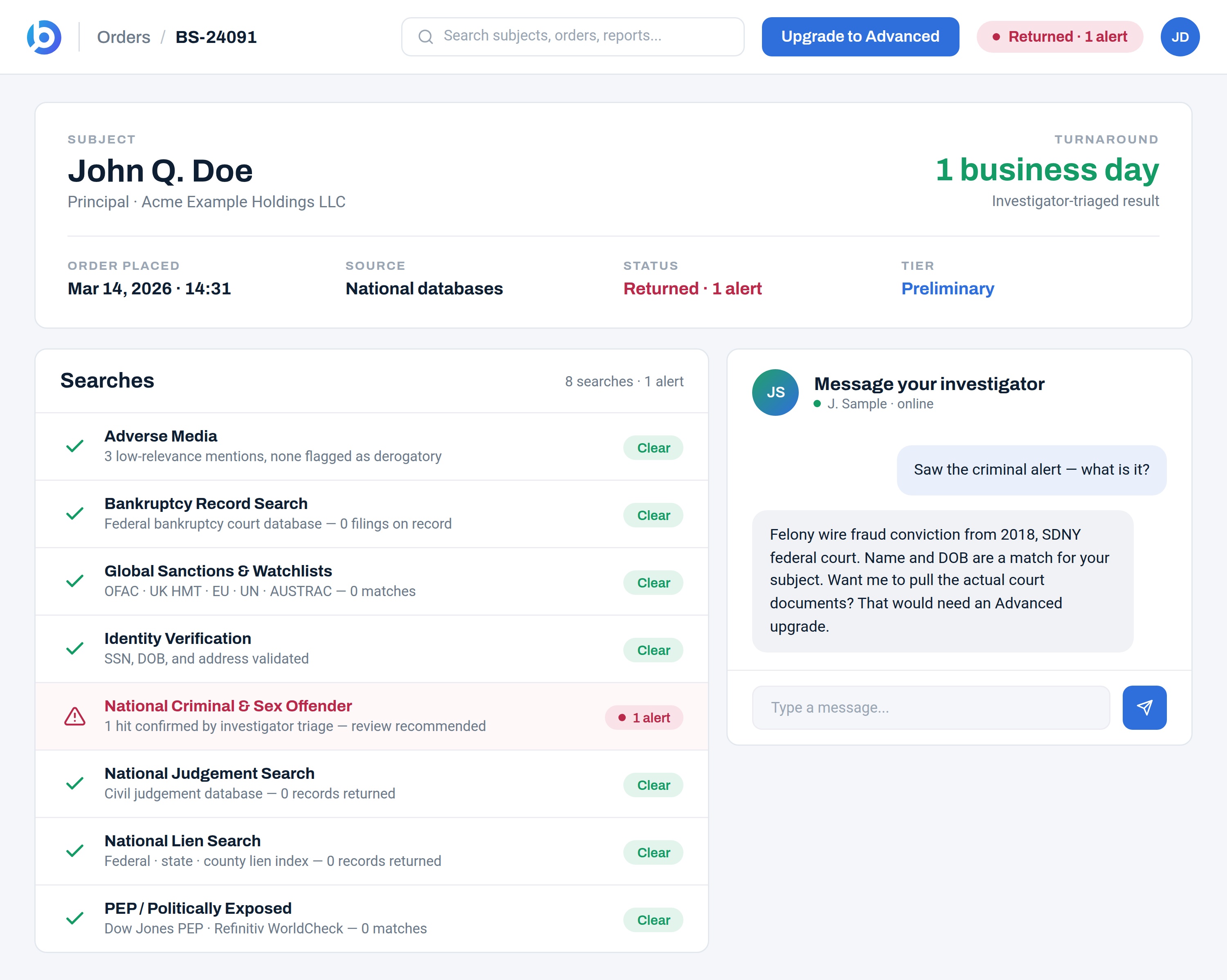
Message Your Investigator

Questions about a finding? Talk directly to the investigator who pulled the record, through the platform, at no extra cost.

Continuous Monitoring

Set automated re-screening intervals on any subject and get alerted when new criminal records appear.

Upgrade Path

Start Instant for a fast first read, then upgrade to Advanced or Deep Dive with one click. You only pay the credit difference.

White-Label Reports

Share criminal record reports with stakeholders or clients under your own brand at no additional cost.
BusinessScreen platform showing an order with a criminal record alert and an open investigator chat thread.

Three Ways to Investigate

Tailored solutions for customers, suppliers, partners, and deals, with the flexibility to add depth as needed.

💡 Start with Instant Due Diligent Searches and seamlessly upgrade to the next tier.
Upgrade easily

Instant ​Due Diligence Searches

Fast, affordable searches designed for high-volume needs and quick turnarounds.

Key Features
Identify Criminal Activity
Low cost per report
Ideal for routine or high-volume vetting

Advanced ​Due Diligence

A blend of automation and expert research for deeper insight and live updates.

Key Features
Human-sourced verification & insights
Access to hard-to-find records
Live updates for ongoing accuracy
Unlock more

Deep Dive ​Due Diligence Searches

Our most comprehensive investigation, covering multiple jurisdictions, names, and affiliations.

Key Features
In-depth research into people, companies, and affiliations
Multiple data sources across jurisdictions
Best for high-risk or high-stakes decisions

Check the Record Before You Close

For underwriting teams, risk managers, and compliance officers, criminal background screening is a standard part of due diligence. Results come back in under 2 minutes for Instant investigations, or in 2 to 3 business days when an investigator works the record.