Services

Financial Risk Assessment

Tax liens, bankruptcy filings, and UCC records don't always reach the databases that most financial risk assessments depend on. That gap between what's been filed and what's readily available is where deals go sideways.

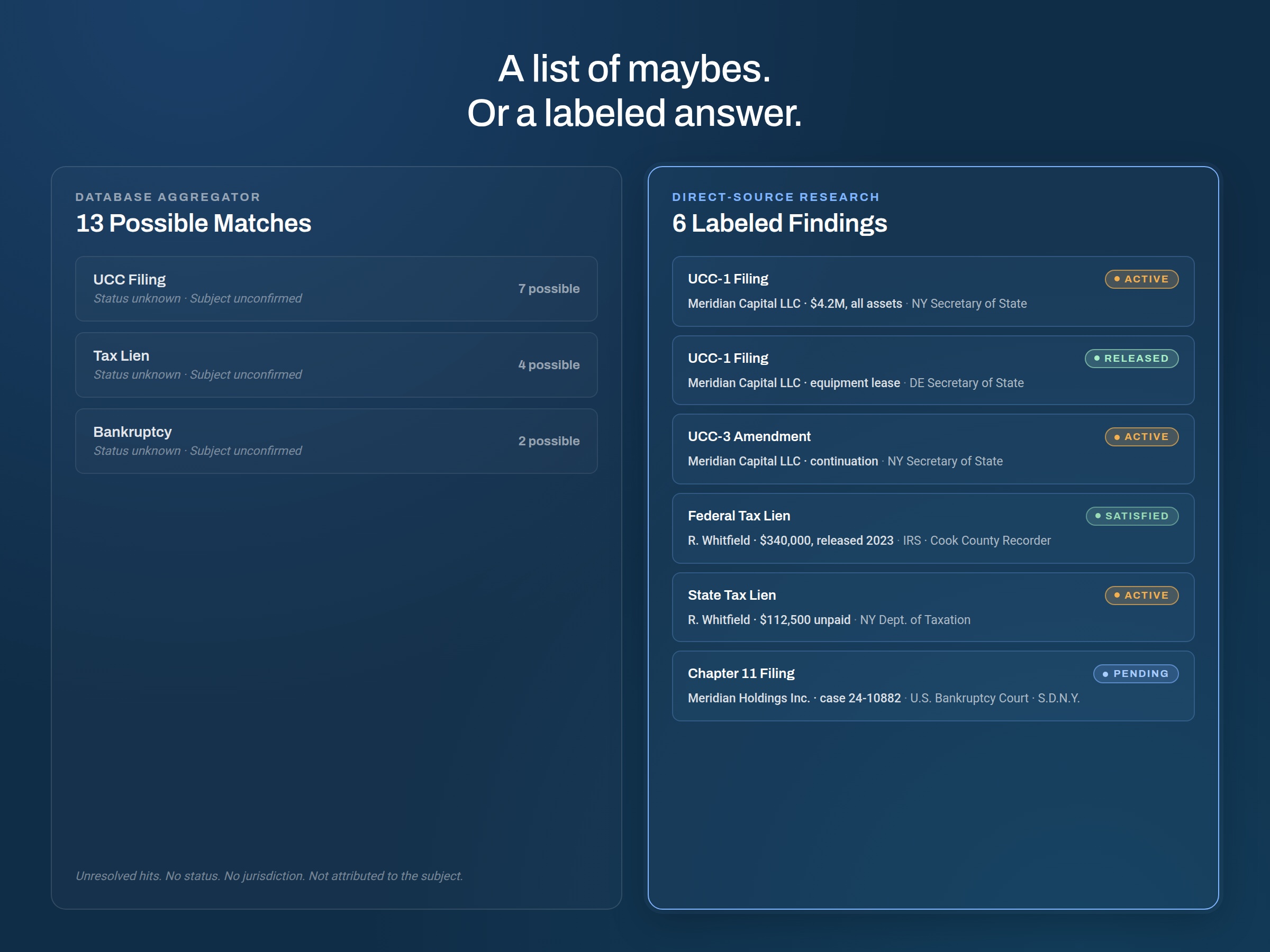
Two-panel comparison showing 13 unverified possible matches from a database aggregator versus 6 labeled direct-source findings — including active UCC filings, a satisfied federal tax lien, an active state tax lien, and a pending Chapter 11 bankruptcy — each confirmed and attributed to the subject.

When Financial Red Flags Surface Too Late

A company can pass a surface-level screen while carrying undisclosed tax liens, active Uniform Commercial Code (UCC) filings against its assets, or a recent bankruptcy that hasn’t reached public record databases yet. These financial signals often tell a different story than the one presented during negotiations.

By the time they surface, capital's already committed and terms are locked — and you're looking at a public record someone should have pulled at the source. A thorough financial risk assessment connects what a company or individual claims with what the financial record actually shows.

Where a Standard Lien or UCC Filing Search Could Leave Gaps

Many database screening tools serve a real purpose for fast financial checks at scale. But when timing, jurisdiction, and filing status all affect what shows up, database-level screening has real limitations worth understanding.

Delayed Record Indexing

Tax liens, judgement liens, and UCC filings can take weeks or months to appear in aggregated databases. A state tax lien filed last week may not surface in a database search today.

Incomplete Jurisdictional Coverage

Not all counties and states feed financial records into national databases at the same pace. Some rural jurisdictions may not report electronically at all.

Fragmented Filing Systems

Bankruptcies, liens, and judgments are filed across separate systems at federal, state, and county levels. A single database query may cover one layer but miss the others.

Unreliable Subject Matching

Common business names and individuals with similar identifiers can produce false positives or missed matches when automated matching logic is the only filter.
A private lender avoided a $500K deal after our investigators identified more than $1M in recent tax liens tied to a principal. The liens had been filed within the last 60 days, too recent for any database to have captured. A standard database lien search returned clean results; a live tax lien search at the source told a different story.

What Changes When Investigators Pull Lien and UCC Records at the Source

Rather than relying solely on third-party financial databases, our investigators pull records directly from federal courts, state tax authorities, county recorder’s offices, and Secretary of State filing offices. For a tax lien search, that means going to the jurisdiction where the lien was filed. For a UCC search, it means pulling from the state and county indexes where secured interests are recorded.

Each finding is verified against the correct subject, labeled by status (active, released, satisfied, or pending), and documented with supporting filings. What you get back is verified findings tied to the correct subject — lien certificates, UCC financing statements, and court documents included. Not a list of possible matches across multiple states that still needs someone to sort through them.

Pull tax & judgement lien records directly from federal, state, and county filing offices
Search UCC & fixture filings at the state and county level for active and lapsed records
Verify bankruptcy filings through federal court PACER records, not just database summaries
Confirm each finding belongs to the correct subject using multiple identifiers
Label every record by current status: active, released, satisfied, or pending
Include supporting documents & direct source evidence with each finding

“The data that we were able to gather from the first screening report alone was all I needed to see to know that Business Screen was the right technology for us. The report produced data that made it abundantly clear which route we needed to go, and we were able to make a confident decision regarding a potential client as a result, avoiding a potentially disastrous deal.”

— Drew M.

From Bankruptcy Searches to Business Credit Checks: What Each Investigation Uncovers

Our approach combines broad US database searches with investigator-sourced research across bankruptcy courts, county recorder’s offices, and state authorities. Each search below targets a different layer of the financial record.

Bankruptcy Record Searches

Covers Chapter 7, 11, and 13 filings through the U.S. bankruptcy court system, surfacing active and discharged cases. International coverage extends to insolvency proceedings abroad.
Company & Individual
Investigator-Sourced

UCC, Lien, & Judgment Record Search

Sweeps US databases for UCCs, liens, and civil judgments across multiple jurisdictions. Captures financial issues outside a company or individual's physical location that a targeted search could miss.
Company & Individual
Database-Sourced

Lien Search

Investigators pull IRS tax liens, state tax liens, and judgement liens directly from federal, state, and county filing offices. Each finding is verified to the correct subject with supporting documents.
Company & Invidivual
Investigator-Sourced

Business Credit Report

Covers payment history, credit score, trade lines, and financial health indicators across multiple credit bureaus. Complements lien and bankruptcy searches with commercial credit data.
Company
Database-Sourced

Property & Foreclosure Records

Surfaces real property ownership and foreclosure filings tied to a subject, revealing asset holdings, financial distress, or patterns of instability connected to real estate holdings.
Company & Individual
Database-Sourced

Financial Health Analysis

The subject provides a profit and loss statement and balance sheet; our team computes a financial health score to assess overall stability, cash flow risk, and likelihood of insolvency.
Company
Investigator-Sourced

Manage Financial Risk Investigations from one Dashboard

Message Your Investigator

Direct communication with the licensed investigator working your case, through the platform, at no extra cost.

Continuous Monitoring

Set automated re-checks on previously searched subjects and receive alerts when new liens, bankruptcies, or judgments appear.

Upgrade Path

Start with a database-level finance screen and escalate to investigator-sourced searches when findings need verification. Pay only the difference.

Cloud-Based Platform & API Integration

Submit financial risk searches individually, in bulk, or through a direct API connection.
BusinessScreen continuous monitoring dashboard showing automated re-screen history and an active alert for a watched subject.

Three Ways to Investigate

Tailored solutions for customers, suppliers, partners, and deals, with the flexibility to add depth as needed.

💡 Start with Instant Due Diligent Searches and seamlessly upgrade to the next tier.
Upgrade easily

Instant ​Due Diligence Searches

Fast, affordable searches designed for high-volume needs and quick turnarounds.

Key Features
Identify Criminal Activity
Low cost per report
Ideal for routine or high-volume vetting

Advanced ​Due Diligence

A blend of automation and expert research for deeper insight and live updates.

Key Features
Human-sourced verification & insights
Access to hard-to-find records
Live updates for ongoing accuracy
Unlock more

Deep Dive ​Due Diligence Searches

Our most comprehensive investigation, covering multiple jurisdictions, names, and affiliations.

Key Features
In-depth research into people, companies, and affiliations
Multiple data sources across jurisdictions
Best for high-risk or high-stakes decisions

Know the Full financial record before you commit

Don’t let a financial record be the reason a deal falls apart after the fact. A complete financial risk assessment can be in your hands in as little as 2 minutes to 3 business days, depending on the depth of investigation.