Use Cases

Legal Services

Transaction-level risk doesn’t always surface in a standard public records search service. Undisclosed litigation, recent liens filed in an outside jurisdiction, and international parties with sanctions exposure can emerge after closing and put your firm’s diligence work product under scrutiny.

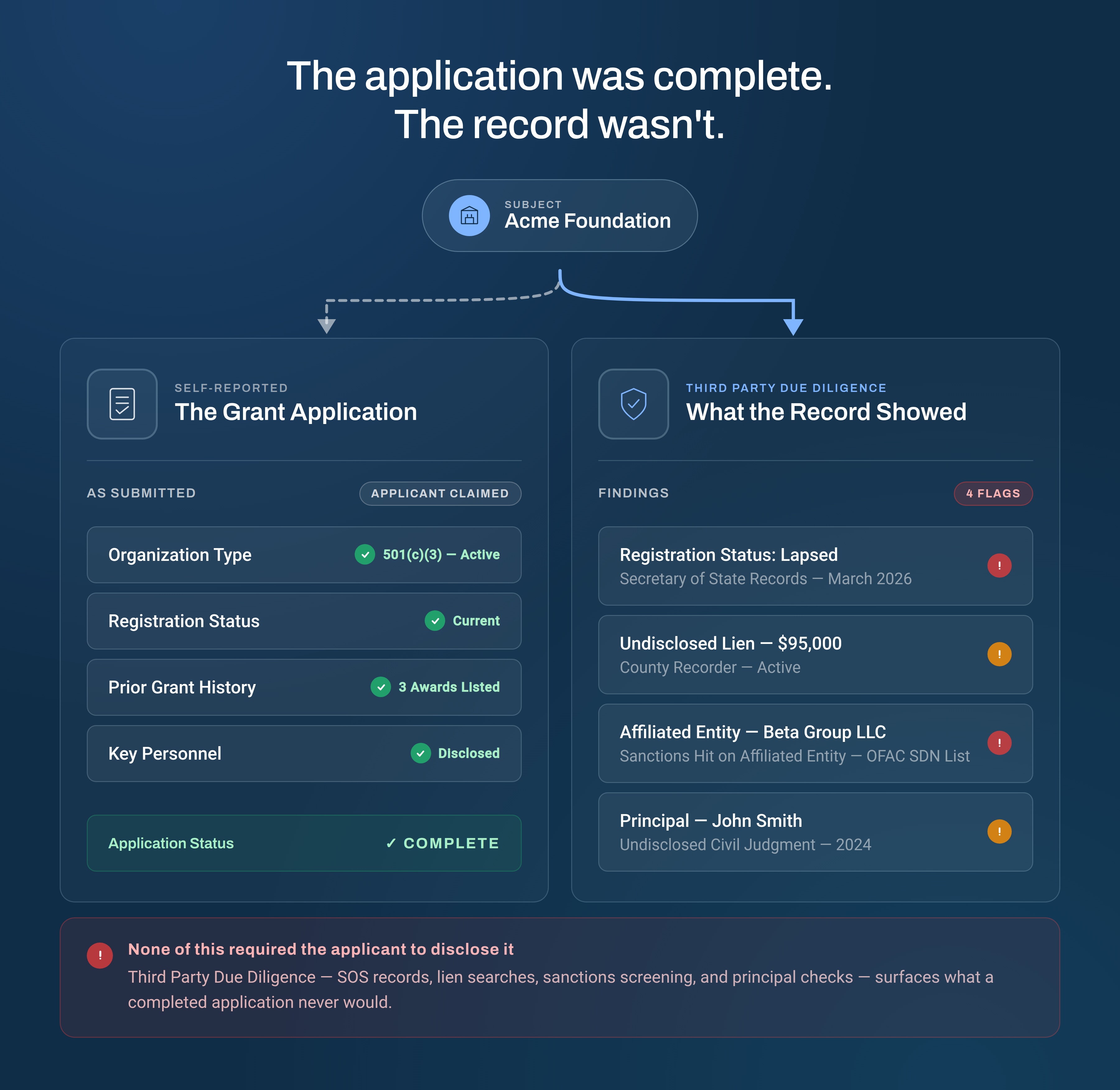
Two-panel comparison showing a completed grant application versus what independent verification found — including a lapsed registration, an undisclosed lien, a sanctions hit on an affiliated entity, and an undisclosed civil judgment.

When the Diligence Memo Becomes the Liability

When law firms, deal advisory practices, and Alternative Legal Service Providers (ALSPs) miss something in a due diligence investigation, the consequences land on the firm. A lien filed in a different state or a regulatory action too recent for databases to capture can surface after closing and reshape the engagement. The question shifts from what was found to what should have been found.

Firms invest in public records search services, database platforms, and in-house research to support their investigative due diligence process. But when subjects carry name variations or international exposure that standard domestic searches don’t reach, those tools may not surface the finding that matters.

Where a Standard Records Pull Could Leave Counsel Exposed

Many of the tools used for party research serve a real purpose in legal due diligence. But when a matter involves multiple parties, compressed timelines, or cross-border elements, gaps could remain.

x

Database Records Can Lag Behind Court Filings

Liens, judgments, and lawsuits filed in the last 30 to 60 days may not appear in aggregated databases, leaving recent filings undetected in a routine search.
x

Name Variations and DBA Mismatches Can Slip Through

A lawsuit filed under a DBA or trade name that doesn't match the searched entity could remain unlinked without investigator review, leaving relevant history out.
x

National Database Coverage Can Vary by Jurisdiction

Records in jurisdictions with delayed electronic reporting or manual filing systems may not surface in a national database pull, with gaps varying by state.
x

Unverified Results Can Require Significant Interpretation

Possible matches returned without verification and unlabeled case statuses create interpretation work that slows review and adds risk to the diligence file.
A legal services firm cut due diligence costs by 25% and halved the time spent sourcing court documents after replacing manual court runner workflows with Business Screen's investigator-led searches.

"The data that we were able to gather from the first screening report alone was all I needed to see to know that Business Screen was the right technology for us. The report produced data that made it abundantly clear which route we needed to go, and we were able to make a confident decision regarding a potential client as a result, avoiding a potentially disastrous deal."

— Drew M.

Source-Level Searches Built for Legal Due Diligence

Rather than relying solely on aggregated data, these searches pull records directly from courts, registries, and regulatory bodies at the source. For investigator-led searches, findings are written in plain English and supported by source documents for direct inclusion in client-facing diligence memos.

Identity Verification

Confirms the party on the transaction matches the person their record reflects, surfacing identity discrepancies and name variations before they compound.

Corporate Record Verification

Live Secretary of State pull confirms entity status, registered agent, and officers, validating the counterparty is organized as represented in deal documents.

Civil Record Search

Active lawsuits, judgments, and litigation history against parties and target entities surface disputes and patterns that can reshape deal terms or valuation.

Criminal Record Search

Criminal history at county and federal levels on executives or principals surfaces undisclosed charges and convictions creating reputational exposure.

Lien Search

Tax liens and encumbrances against parties or assets can alter deal economics and create post-closing liability reflecting on the firm's work product.

UCC Record Search

Secured creditor positions against a target's assets reveal encumbrances that may affect transaction structure, collateral priority, or deal terms.

Negative Media Search

Adverse press, regulatory enforcement, and reputation risk on parties may not appear in court records but can affect deal viability and client exposure.

Global Sanctions & Watchlists

Screens sanctions, PEP, and AML lists before cross-border or regulated transactions where compliance exposure is a concern. Covers 80+ sanction bodies.

Associated Business Risk Search

Parties operating through multiple entities can carry risk in a related business that flows into the transaction, exposing clients to undisclosed liability.

How Legal Teams Match Investigation Depth to the Matter

Legal matters range from preliminary party screening on a large transaction to multi-party international due diligence where every jurisdiction adds complexity. The right level of investigation depends on the stakes, the number of parties, and whether the matter crosses borders.

Preliminary Party Screening for a Multi-Party Transaction

Screen a large party list for criminal, sanctions, and financial flags before selecting subjects for deeper research.
Instant

Regulatory Enforcement Background Check

Screening a party or executive for regulatory actions, sanctions exposure, and adverse media in connection with a compliance-sensitive matter.
Advanced

Target Company Due Diligence Investigation

Full-scope investigation of a target entity covering civil litigation, liens, bankruptcy, and adverse media across multiple jurisdictions.
Deep Dive

Executive Background Check for Transaction Principals

Comprehensive screening of key executives and guarantors including criminal, civil, financial, and media searches under all known name variations.
Deep Dive

Cross-Border Transaction with International Parties

International due diligence on foreign parties or beneficial owners requiring corporate records, sanctions screening, and multi-jurisdiction searches.
Deep Dive
Add-on

Three Ways to Investigate

Tailored solutions for customers, suppliers, partners, and deals, with the flexibility to add depth as needed.

💡 Start with Instant Due Diligent Searches and seamlessly upgrade to the next tier.
Upgrade easily

Instant ​Due Diligence Searches

Fast, affordable searches designed for high-volume needs and quick turnarounds.

Key Features
Identify Criminal Activity
Low cost per report
Ideal for routine or high-volume vetting

Advanced ​Due Diligence

A blend of automation and expert research for deeper insight and live updates.

Key Features
Human-sourced verification & insights
Access to hard-to-find records
Live updates for ongoing accuracy
Unlock more

Deep Dive ​Due Diligence Searches

Our most comprehensive investigation, covering multiple jurisdictions, names, and affiliations.

Key Features
In-depth research into people, companies, and affiliations
Multiple data sources across jurisdictions
Best for high-risk or high-stakes decisions

Tools That Keep Pace with Deal Timelines

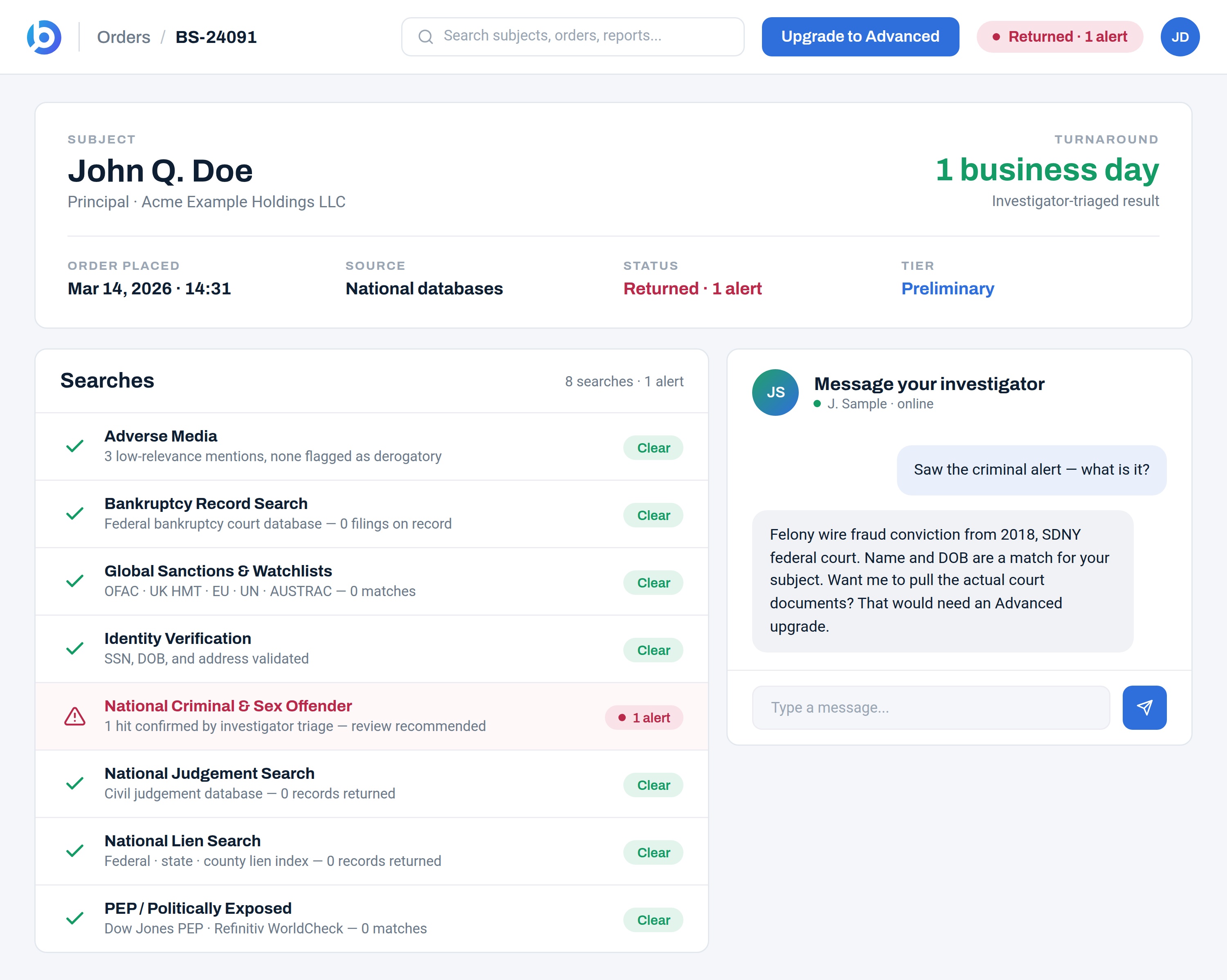
Message Your Investigator

Direct communication with the licensed investigator working your case, through the platform, at no extra cost.

White-Label Reports

Reports deliver under your firm's branding with source documents for direct use in client-facing deliverables.

Share Order Link

Send a secure link to collect subject details from clients or counterparties before the investigation begins.

Continuous Monitoring

Automated re-checks on investigated parties at configurable intervals. Alerts your team when new records appear.
BusinessScreen platform showing an order with a criminal record alert and an open investigator chat thread.

Investigate the Record Before You Advise the Client

Deal counsel, legal operations teams, and ALSP research groups use Business Screen to investigate parties, executives, and target entities before the memo reaches the client. Run a preliminary screen in under 2 minutes or put an investigator on the matter for findings delivered in 2 to 3 business days.