Use Cases

Commercial Lending & Specialty Finance

The gap between what borrowers disclose and what’s actually been filed against them is where deals go sideways. Tax liens, civil judgments, and regulatory actions that haven’t reached a database yet create exposure that standard screening won’t flag.

Two-panel comparison showing a clean loan application versus the filed record, revealing a large IRS tax lien, an active civil judgment, a UCC filing, and an affiliated entity bankruptcy — all filed within 90 days.

What Borrowers Can Hide When Lenders Screen for Speed

Speed determines who wins the deal, and some borrowers take advantage of it. Clean applications can mask undisclosed tax liens, active litigation, or regulatory actions that haven’t reached aggregated databases. For underwriting teams relying on standard commercial due diligence services, the gap between what’s been filed and what’s searchable is where exposure builds.

When limited partners and investors require defensible business due diligence as part of their reporting, a database check alone is not a sufficient answer. The question is whether your screening catches what matters before capital is committed.

Where a Standard Borrower Screen Could Leave You Exposed

Many of the screening tools used in lending serve a real purpose for fast, first-pass checks on borrowers and entities. But when a deal’s risk profile demands more than a database snapshot, there are gaps worth understanding.

x

Recently Filed Liens May Not Appear

Tax liens filed within the last 30 to 90 days often haven’t been indexed by commercial databases, leaving recent encumbrances invisible during underwriting.
x

Borrower History Across Multiple Jurisdictions Can Go Unchecked

Sponsors who have operated across multiple states may carry litigation or liens in counties that never get searched under a standard borrower screening.
x

Related Entities and Shell Structures May Stay Hidden

A borrower’s personal record may look clean while affiliated entities carry bankruptcies, judgments, or regulatory actions that standard tools don’t map.
x

Record Mismatches Can Flag the Wrong Borrower

Database tools match by name, but common names or similar business names can produce false matches, attaching someone else's record to a clean borrower.
A private lender avoided a $500,000 deal after Business Screen identified more than $1,000,000 in recent tax liens tied to a principal — liens not reflected in the databases the lender had been relying on.

"With Business Screen, doing our due diligence has never been easier, and gives our leadership the information we need to make bold, assured decisions for our growing business."

— Drew M.

The Due Diligence Investigation Behind a Defensible Underwriting File

Rather than relying solely on aggregated data, our licensed investigators go directly to courts, registries, and regulatory bodies to pull records at the source. For our Advanced and Deep Dive investigations, findings are reviewed by a licensed investigator, written in plain English, and supported by evidence pulled directly from the source.

Tax Identification Number (TIN) Verification

A borrower who can't pass a basic TIN match raises questions about entity legitimacy that should be resolved before any other screening begins.

Global Sanctions & Watchlists

Lenders with BSA obligations or investor reporting requirements need AML screening that covers sanctions, PEP lists, and denied-party designations.

Civil Record Search

Undisclosed litigation against a borrower or sponsor can signal financial distress or a pattern of legal exposure that affects repayment risk.

Lien Search

Tax and judgement liens filed in the last 30 to 90 days rarely reach databases before underwriting. Investigator searches go directly to filing offices.

Criminal Record Search

Fraud and financial crimes tied to borrowers or guarantors carry direct implications for loan performance and expose lenders to downstream liability.

UCC Record Search

Existing UCC filings against a borrower's assets affect collateral position. For ABL and factoring, knowing what's already claimed is foundational.

Associated Business Risk Search

Sponsors who control multiple entities can distribute risk across their corporate structure. This search maps connected businesses and surfaces liens, litigation, and bankruptcies.

Business Credit Report

Payment history, credit scores, and trade line data for the borrowing entity provide a financial baseline that complements the investigator-sourced searches in your full package.

How Private Lenders Right-Size Their Due Diligence Checking

Every deal carries a different risk profile, and the screening behind it should reflect that. These are some of the most common scenarios we see from lending teams, matched to the tier that fits the level of verification each one calls for.

Single-Borrower Fix-and-Flip Loan

One borrower, straightforward deal structure. Run a quick first-pass screen to flag obvious risks and escalate to investigator verification if needed.
Instant

DSCR or Mid-Size Bridge Loan

Borrower and guarantor requiring verified civil, criminal, and financial records. Add associated business risk screening to check connected entities.
Advanced
Add-on

Multi-Entity Bridge or Construction Loan

Multiple principals, entities, and jurisdictions. Full 20-year lookback covering name variations and dismissed cases across up to three locations.
Deep Dive
Add-on

Loan Broker or Correspondent Onboarding

Brokers introduce deals but are often unscreened. Investigate criminal, civil, and lien history before allowing them into your active deal pipeline.
Advanced

MCA or Factoring Applicant

High-volume, fast-payback lending where speed determines workflow. Screen the entity and principals with automated checks and escalate selectively.
Instant

Post-Closing Borrower Re-Verification

Borrowers screened before funding but never re-verified. Clear the backlog on active loans where the original diligence was limited or outdated.
Advanced

Three Ways to Investigate

Tailored solutions for customers, suppliers, partners, and deals, with the flexibility to add depth as needed.

💡 Start with Instant Due Diligent Searches and seamlessly upgrade to the next tier.
Upgrade easily

Instant ​Due Diligence Searches

Fast, affordable searches designed for high-volume needs and quick turnarounds.

Key Features
Identify Criminal Activity
Low cost per report
Ideal for routine or high-volume vetting

Advanced ​Due Diligence

A blend of automation and expert research for deeper insight and live updates.

Key Features
Human-sourced verification & insights
Access to hard-to-find records
Live updates for ongoing accuracy
Unlock more

Deep Dive ​Due Diligence Searches

Our most comprehensive investigation, covering multiple jurisdictions, names, and affiliations.

Key Features
In-depth research into people, companies, and affiliations
Multiple data sources across jurisdictions
Best for high-risk or high-stakes decisions

A Platform Built Around How Lending Teams Work

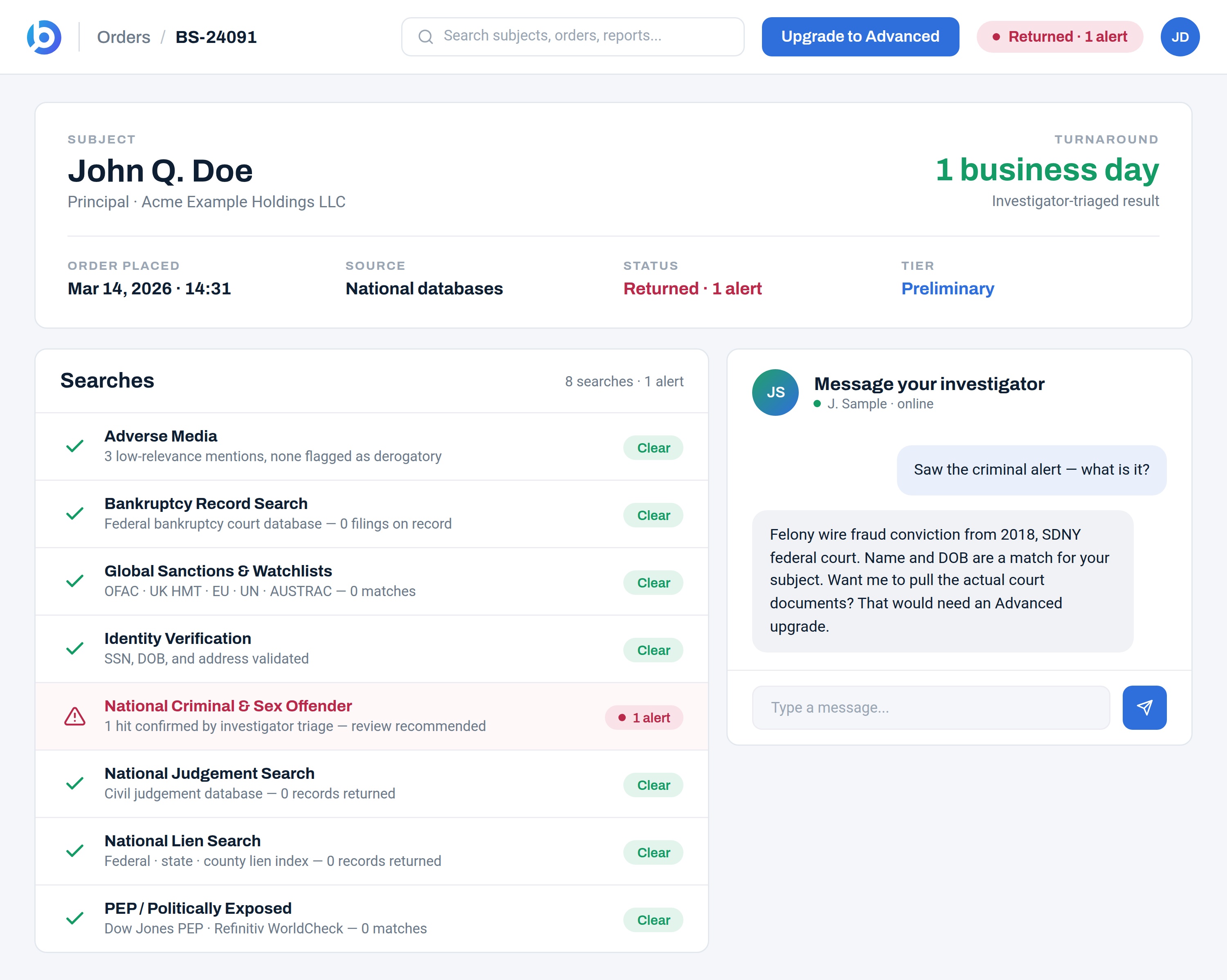
Message Your Investigator

Questions about a finding on a borrower? Talk to the investigator working your case directly through the platform at no extra cost.

Upgrade Path

Start Instant for a first-pass screen. If flags appear, upgrade to Advanced or Deep Dive with one click at the credit difference.

Continuous Monitoring

Automated re-checks on active borrowers at configurable intervals. New liens or sanctions hits trigger alerts through the platform.

Cloud-Based Platform & API Integration

Submit orders individually, in bulk, or via API. Webhook notifications alert your systems the moment a report is ready for review.
BusinessScreen platform showing an order with a criminal record alert and an open investigator chat thread.

Know the Full Borrower Record Before You Fund

Whether you’re an underwriting manager screening a single borrower or a head of credit building a repeatable process across your portfolio, the question is the same: does your borrower’s record look the same when someone pulls it directly from the source? Find out in under 2 minutes for our Instant package or in 2 to 3 business days for investigator-sourced verification.