



When you look into a company you are about to work with, the findings that stand out are the big ones, like an open lawsuit, a bankruptcy, or a criminal record. Sitting next to those are the smaller records that are easy to skim past, a civil claim for a few thousand dollars, a judgment that was paid off years ago, a lien on a single piece of property, an invoice that went unpaid long enough to end up on file. They rarely explain themselves in one line, so what follows is a plain guide to what each of them is, what it can tell you about a company, and how it turns up when you run due diligence on a company.
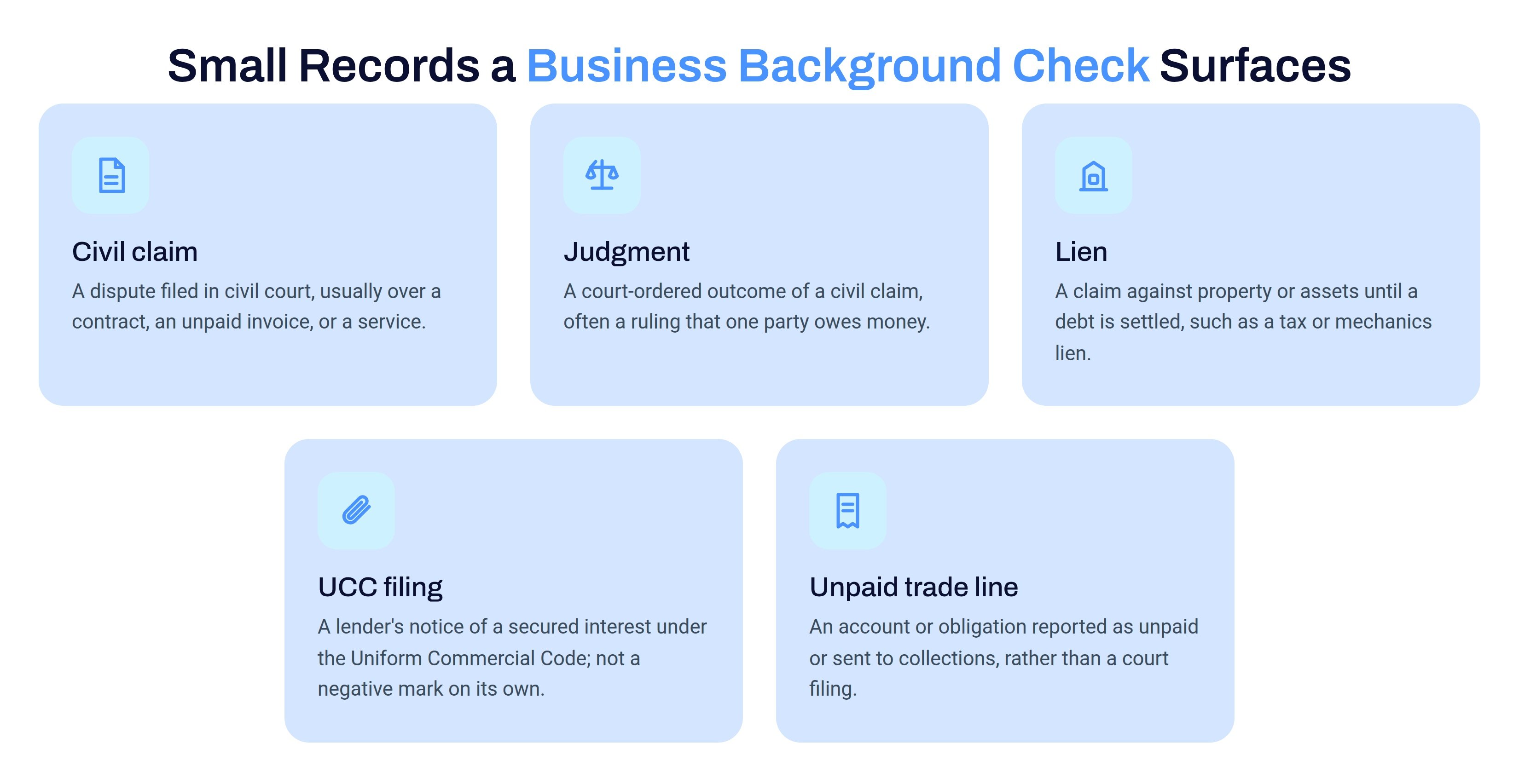
These records tend to get grouped together, but they describe different things, and the differences change what each one is telling you.
A civil claim is a lawsuit filed in civil court, which in a business setting usually comes down to a disagreement over a contract, an unpaid invoice, or a service that did not go as promised. A judgment is what a civil claim turns into if the court actually rules on it, usually an order that one side pay the other. The distinction is worth holding onto, because a claim is only an allegation while a judgment is a decision that the money is owed.
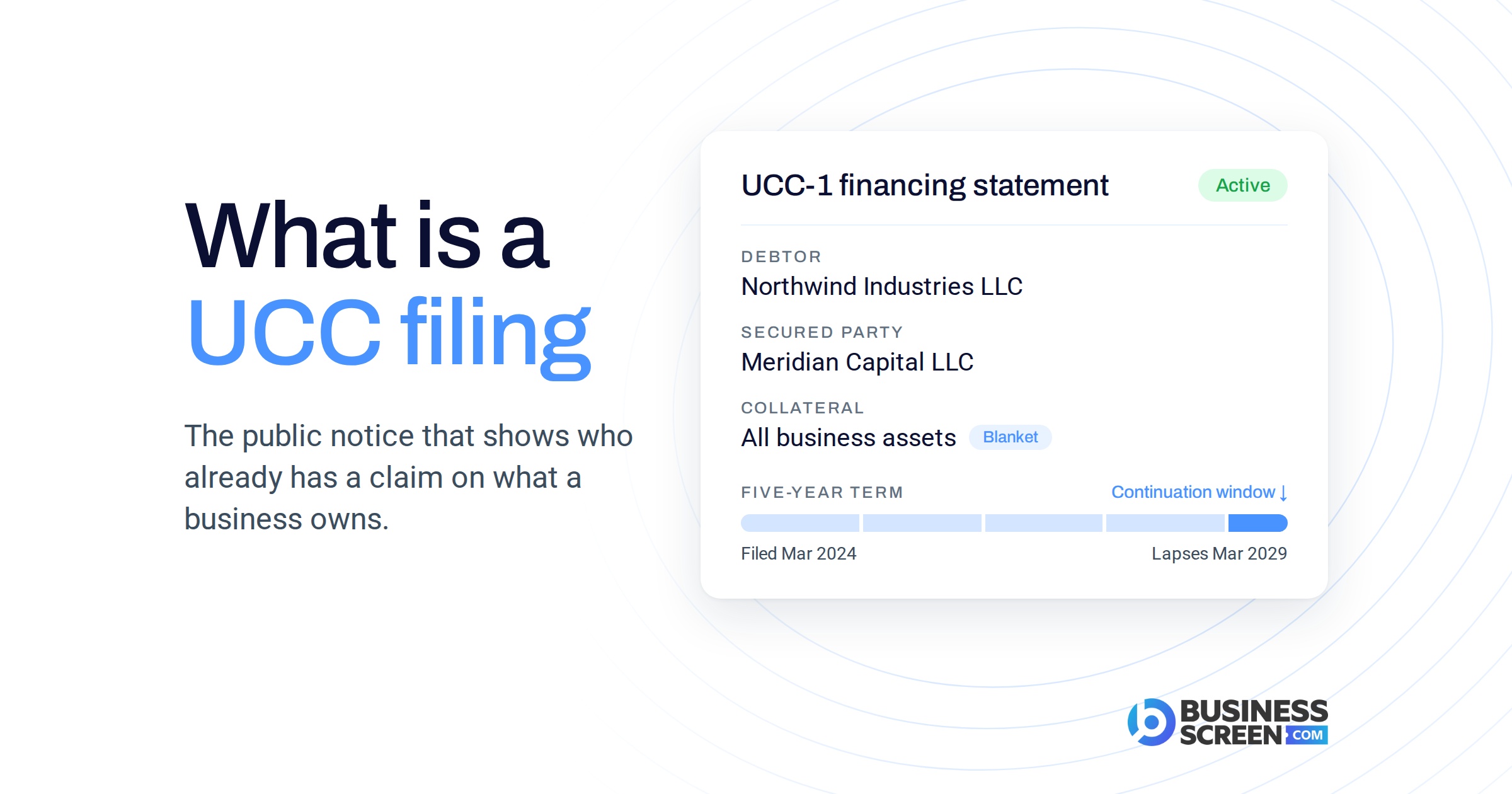
A lien is a legal claim against property or assets that stays attached until the debt behind it is cleared. A tax lien is placed by a government body over unpaid taxes. A mechanics lien is filed by a contractor or supplier who says they were not paid for work on a project. A lien on a company can also secure other kinds of unpaid obligations. A close cousin, the Uniform Commercial Code (UCC) filing, is simply a lender's public notice that it holds a secured interest in a company's assets, and on its own it is routine rather than a warning sign.
The last of the group are unpaid trade lines, which are accounts or bills a company was reported as paying late or not at all, sometimes after being handed to collections.
Read together, these records tend to speak to one thing, which is whether a company meets its financial obligations and what happens when it does not. That is also why the same record can land very differently depending on what you are about to do with the company.
A large tax lien is a good example. It means a taxing authority already holds a claim on the company's assets, and it puts that authority ahead of others waiting to be paid. On a company that is asking you to lend to it or extend terms, that ordering is central, which is why a lien like that gets read closely in commercial lending and specialty finance. On a company you are paying up front for a one-time job, the same lien carries much less weight.
A mechanics lien behaves the same way. Because it is filed when someone says they were not paid for work on a project, on a contractor it speaks directly to how the subcontractors and suppliers on their recent jobs were treated, which is exactly what tends to get weighed before hiring a builder in construction and commercial real estate.
The relationship matters as much as the record itself. A single unpaid trade line reads one way on a company you will place a single order with, and another on a supplier you plan to build a product line around and depend on, which is the kind of decision where vendor and supply-chain screening usually goes further. None of these records is automatically serious or automatically harmless. Each is a piece of context about how a company has handled money and its obligations, which you read against the specific relationship in front of you.
Knowing what these records are is one thing. Getting an accurate read on them is another, and that comes down to how the search is actually run.
A business lien search looks for liens and secured interests, including tax liens, other liens, and UCC filings. A judgment search, usually part of a wider civil records search, looks for lawsuits and the judgments they produced. A business lien search or a judgment search can be run two ways, as a fast automated lookup that casts a wide net, or as a search pulled directly from the county, state, or court where the record was filed.
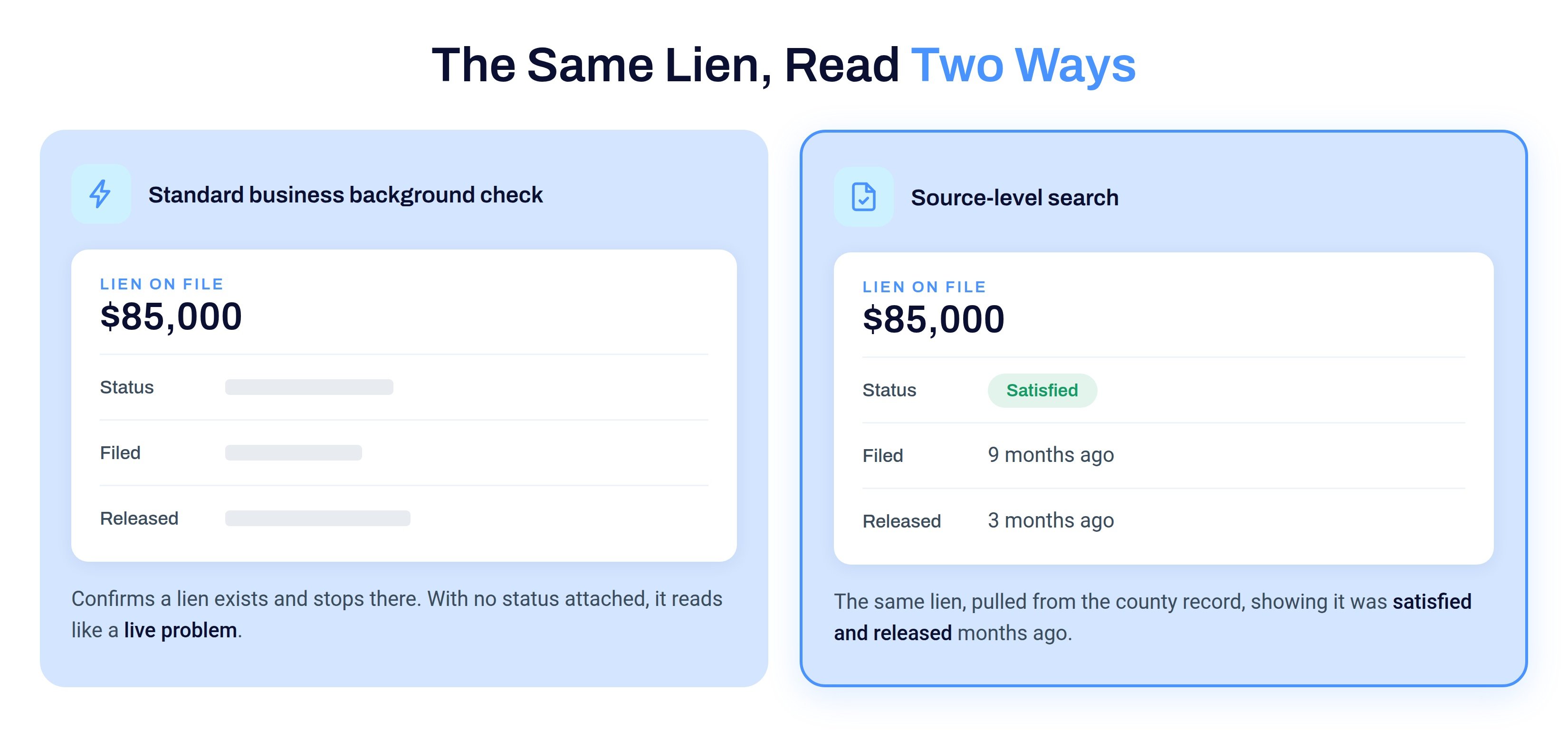
That difference is not just procedural. A fast lookup is a summary stitched together from many sources, and a summary can be thin. It will often show that a claim or a lien exists without keeping up with what became of it, and status is usually the piece that goes missing. Whether a claim is open, dismissed, or satisfied, and whether a lien is still active or has already been released, is what separates a live issue from one that was settled years ago, and that is often confirmed only by going back to the source or having an investigator read the actual court file. Records can also attach to the people behind a company as much as to the business itself, so a search run only against the company name can miss a judgment or lien tied to an owner, which is why looking at the principals as well as the entity rounds out the picture. Whether you handle this in-house or bring in a lien search company, the version of a record you can rely on is the one traced back to where it was filed.
Small civil claims, judgments, and liens are one layer of the picture that due diligence on a company builds, sitting alongside criminal, corporate, and reputational records. On their own they are neither proof of trouble nor a clean bill of health. They are a record of how a company has handled what it owes, and read in the context of the deal in front of you, they help fill in a fuller sense of who you are dealing with. A business lien search and a judgment search are how that layer gets surfaced and, at the source, confirmed.
If you want these records surfaced and their status confirmed on a company you are reviewing, fill out the form below to get started.






.png)
