



A due diligence investigation runs against one specific subject, and a background screen is only the part of it that pulls the records. That subject is a legal entity, the people who run it, or both, pinned down precisely enough that the records coming back actually belong to them. Business identity verification is the work that turns a name a client submits into the actual business and the actual people behind it, before any record is pulled. Many screening options skip it and return whatever a database matches, leaving you to sort out whether it is the right subject. Here at Business Screen, an investigator reviews any adverse hit before release even at the entry tier, so a match does not reach you as a finding until someone has confirmed it belongs to the right party. That is what separates a result you can act on from a list of records that may belong to someone else.

A name on an order form is not yet a subject. “Acme Holdings” could be a company registered in Delaware, a similarly named company in Texas, or an operating name that a different entity does business under. Before any search runs, that name has to resolve to one registered legal entity, with a formation state and an address attached. If the name resolves to the wrong company, the searches that follow are precise and useless. That is where a due diligence investigation starts, and the reason the resolution step gets real attention.
A second resolution happens in parallel. A business and the people who run it are separate subjects, linked but distinct, and a complete read on a counterparty usually needs both. The entity record and the principal’s record answer different questions, and the operator’s history often carries a deal as much as the entity’s structure does. This is the split that Know Your Business (KYB) and Know Your Customer (KYC) frameworks were built around. KYB confirms the entity exists and is what it claims to be, and KYC verifies the identity of the person behind it. Resolving the subject means resolving both, and keeping them straight.
Identity resolution starts with intake, and the required fields are not bureaucratic. They are what make a match possible.
A company search begins with the legal business name as registered with the state, plus the headquarters address. It starts from registered identity, not from a doing-business-as (DBA) name or a partial trade name, because the registered record is the anchor everything else ties back to. A person search requires the full legal name and a location, plus at least one strong matching identifier. A Social Security Number (SSN) gives the best match accuracy. A date of birth, full address, cell phone number, or driver’s license number will also resolve a person against the right records. The identifier is the part that carries the weight, because a name on its own collides. Common names return dozens of people, and a search anchored only on a name produces either false positives or quiet misses.
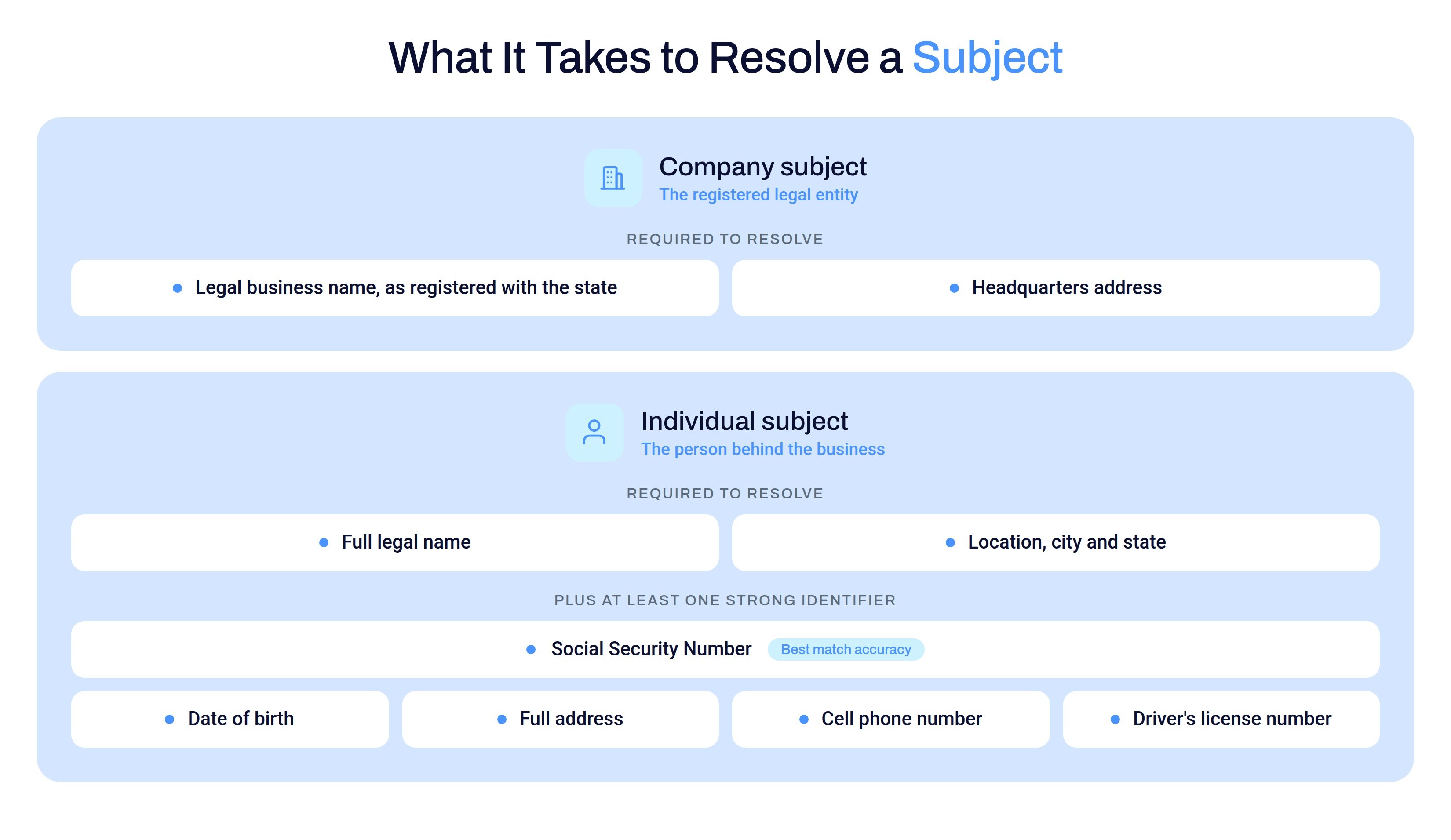
The reason to get this right at intake is simple. The quality of the downstream results is set here. A precise subject produces results you can trust. A loose subject produces noise someone has to clean up later, or worse, a clean-looking report on the wrong party.
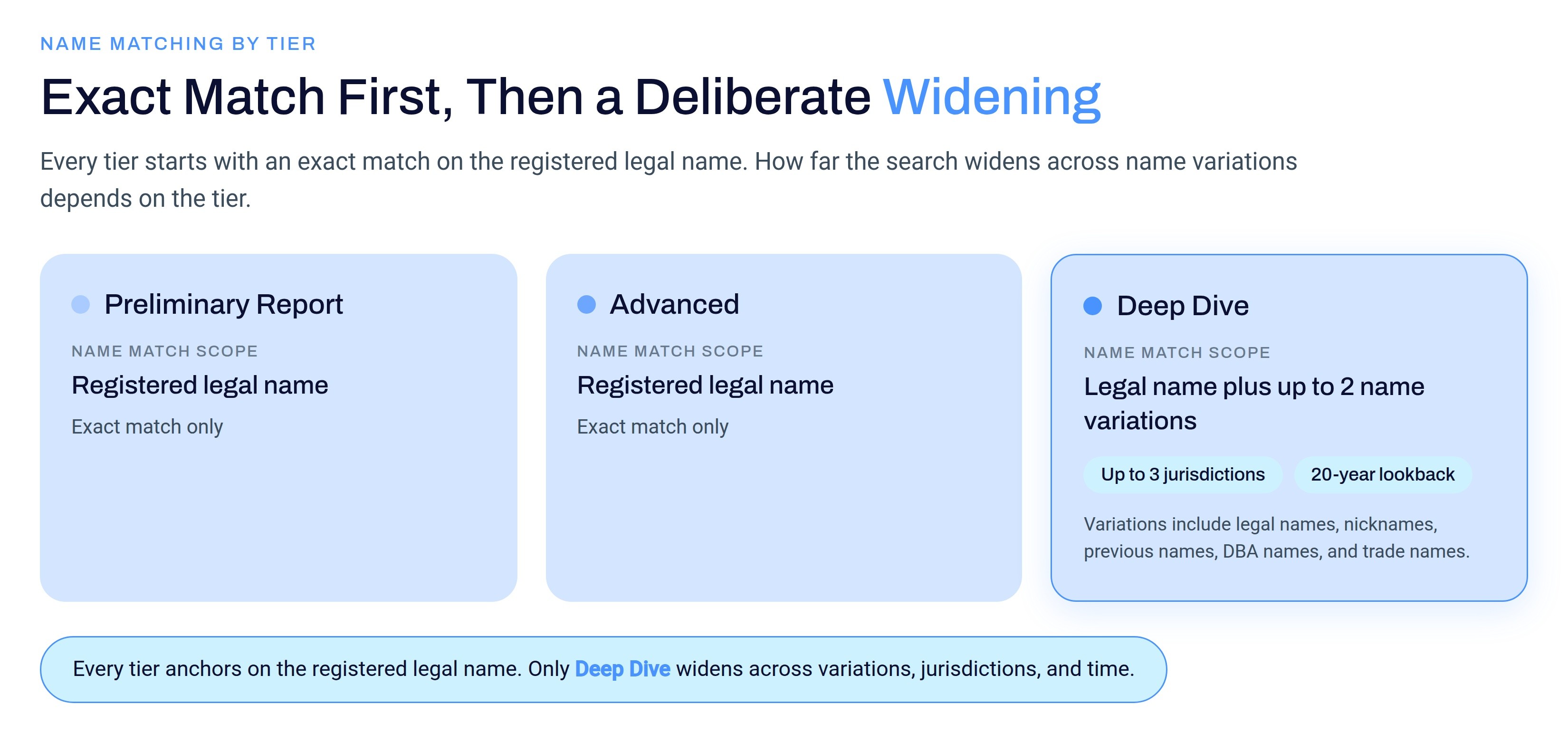
Once the subject is anchored, matching works from the inside out. The first pass is an exact match on the registered legal name. From there, the search broadens to variations, and how far it broadens depends on the tier.
For individuals, the Identity Verification search does specific work here. It matches the supplied information against the credit-header profile, then runs an SSN trace that returns identifiers, jurisdictions, and name variations, both legal names and nicknames. That trace pulls alternate and prior names into scope, so a person who has gone by more than one name is screened under each of them rather than only the one on the order. Because Identity Verification is part of the entry-tier report, that name tracing happens even on a Preliminary Report.
On the company side, Tax Identification Number (TIN) verification closes a gap that names alone leave open. It is a direct IRS check confirming that the supplied tax ID, an Employer Identification Number (EIN), or an SSN for a sole proprietor, maps to the legal entity name. This is the control built to catch the case where a name looks right but the entity behind it is not the one you think you are dealing with.
How far the search widens across name variations scales with depth. The Preliminary Report and the Advanced report run the legal name. Deep Dive expands to additional name variations, up to two of them (legal names, nicknames, previous names, doing-business-as names, and trade names), across as many as three jurisdictions and a twenty-year lookback. That is the tier built for subjects with tangled name histories, where the relevant records sit under a name the subject no longer uses. It is also where a cross-border subject whose entity sits in a foreign registry gets resolved across the jurisdictions that actually hold its records.
Matching identifies the records that probably belong to the subject. Confirming that they actually do is the part of a due diligence investigation that raw automated screening skips. Automated matching is fast and casts a wide net, which is what you want for a first pass, but it produces a probable match, not a confirmed one. A database-only provider stops there and hands you that unconfirmed match, so an automated hit can reach you looking like a finding when it belongs to someone else.
Our reports add the confirmation step that raw automated matching leaves out, starting at the lowest tier. On our entry-tier Preliminary Report, you never see a raw, unreviewed adverse hit. Any adverse or derogatory result is held and reviewed by an investigator before release, who confirms it belongs to the subject and suppresses false matches. The underlying searches are automated, which is what lets clean results come back in minutes, but nothing adverse reaches you until an investigator has checked it.
On our Advanced and Deep Dive reports, that confirmation goes all the way to the source. Investigators pull each record from the court or registry that holds it, read it against the resolved subject, and keep it only if it belongs. This is the strongest control in the sequence, and it is the clearest line between this approach and a raw database pull. Going to the source is also how sanctions and watchlist screening gets resolved past the common-name collisions that make raw sanctions hits so noisy, and it is the core of a corporate due diligence investigation at the upper tiers. What deepens as you escalate is not whether the subject gets confirmed but how far an investigator goes to prove it, from suppressing a mismatched hit to verifying each record at its source.
A decision-ready report starts with a subject you can trust, not a name that happened to match. If you have a counterparty in front of you and want the entity and the people behind it confirmed before anything gets pulled, send us the details and we will make sure the report comes back about the right party.







.png)
