



A purchase order is sitting in someone's inbox. The supplier is new, work starts in two weeks, and somebody asks whether anyone has checked them out. Nobody has.
The screening tool the company already owns usually cannot help. Employment platforms are built for checks on people you hire, with their consent, and many cannot screen a business entity at all. So vendor screening tends to start from scratch, with one supplier and one person working out what checking them out actually means.
Here is a working sequence for that first screen, and for the fifty after it.
Before choosing any searches, decide what the screen is protecting against. That sets the depth, and it is not the same as contract value.
A general contractor working through this recently landed on a better rule. A smaller contract on a critical path scope deserves more scrutiny than a larger contract on finishes, because the exposure is schedule and structural integrity rather than just money. A supplier who can halt the job matters more than one you could replace in a week.
So score a new supplier on two axes: what you would lose in dollars, and what you would lose in time or continuity. High on either means a deeper screen. Write the thresholds down, even roughly. The teams that do this well have a one-page rule assigning a tier by spend and criticality. The ones that struggle re-litigate it supplier by supplier.

A vendor is a legal entity plus a small number of people who control it. Screening only the entity is the most common gap in a new program.
An entity can be eleven months old and carry no records at all while its owners have a decade of judgments behind them under a previous company. That is why screening the principals alongside the business is generally worth it, especially for sole proprietors and closely held suppliers where the person and the company are effectively the same risk. Treat the business and each controlling officer as separate subjects. On the people, the searches that earn their cost are criminal records at the federal and county level, plus the civil and financial records that would surface under their name rather than the company's.
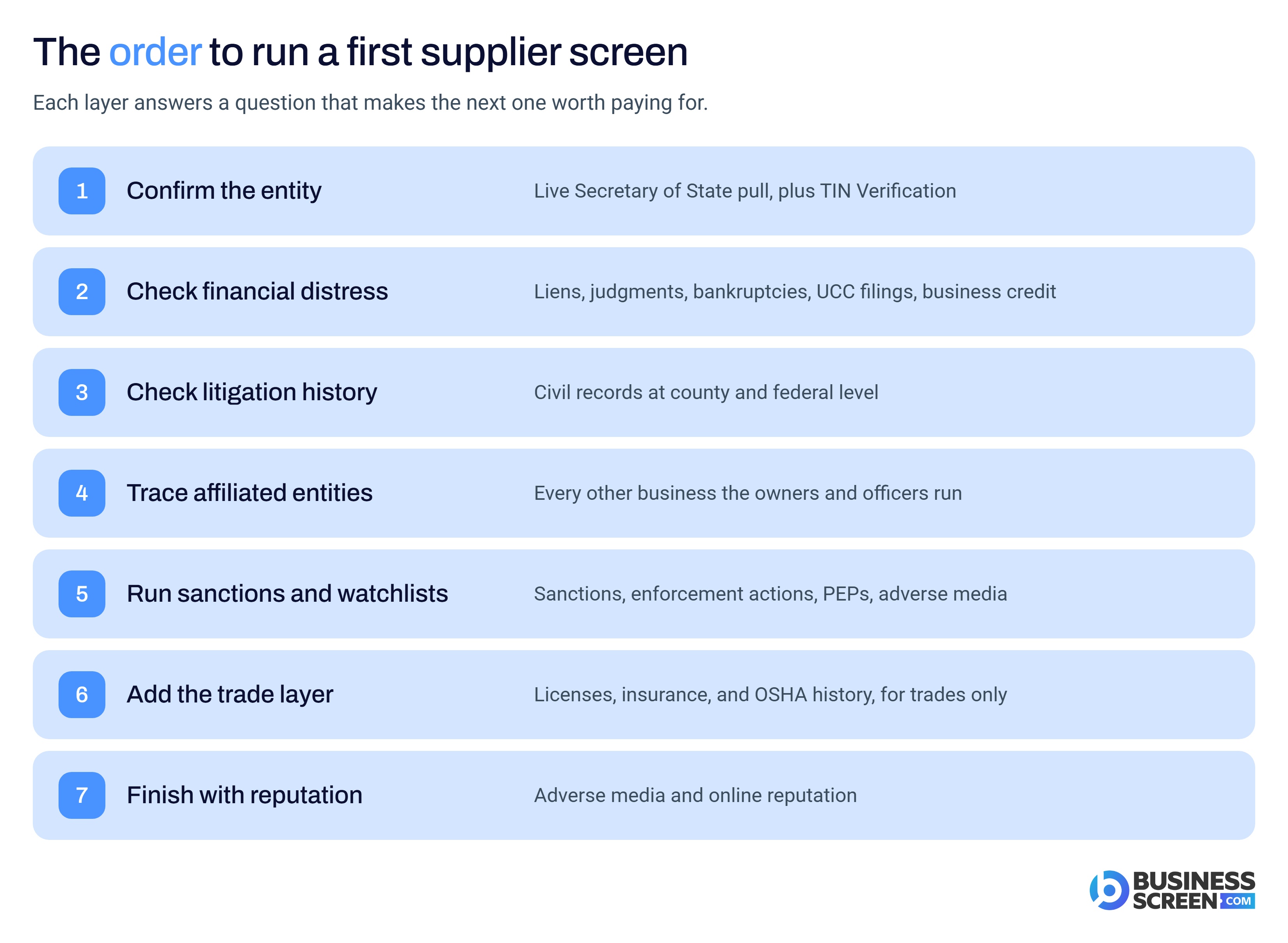
For a new supplier of ordinary size, this is the order of importance as we see it. Each layer answers a question that makes the next one worth paying for.
Confirm the entity is real and current. A Corporate Record Verification pulls the Secretary of State record live and returns current status, registered agent, and officers. Tax Identification Number (TIN) Verification confirms the number they gave you matches the legal name. A website check costs almost nothing and catches the supplier that exists mostly on paper. For a foreign supplier, the equivalent first step is an international corporate registry pull. This layer catches the wrong entity before anything else is spent on it, and it is where KYB verification stops being a formality.
Look for financial distress. Liens, judgments, bankruptcy filings, and Uniform Commercial Code (UCC) filings tell you whether the supplier can finish what they start. A business credit report adds a current read on how they pay the people they owe. Reading liens and judgments correctly matters as much as finding them, since active and satisfied records often sit side by side. For a supplier on a critical path, you can go a step further and analyze the financial statements they provide directly.
Check litigation history. Civil records at county and federal level show patterns worth knowing, particularly repeat disputes with customers or other suppliers.
Trace the entities behind the principals. An Associated Business Risk Search lists every business where your supplier's owners and officers are named as owner, operator, or executive, then screens those entities for bankruptcies, liens, and litigation. This is the step that catches the operator who wound down one company with judgments against it and opened another under a new name. It is the most useful search you can run on a young entity, and the one first-time programs leave out most often.
Run sanctions and watchlists. This screen is fast and inexpensive, and for any supplier with an international footprint it is not optional. What sanctions screening verifies is narrower than most people assume.
Add the trade layer only where it applies. License verification, insurance verification, and OSHA violation history matter enormously for a subcontractor and not at all for a software reseller. If you are prequalifying trades, the subcontractor prequalification checklist goes deeper on that layer.
Finish with reputation. Adverse media and online reputation searches surface what never reaches a court file.
This is where programs get expensive in the wrong direction.
A routine, low-exposure, easily replaced supplier does not need investigator-verified depth. A fast database screening answers the question, and if it comes back clean you move on. Running deep diligence across a long tail of small suppliers costs more than the risk it retires, and it slows onboarding enough that people route around the process entirely.
You also do not need the supplier's consent. These are commercial decisions rather than employment ones, so they fall outside the Fair Credit Reporting Act, which is why no authorization is required and why the lookback can run further back than an employment check. You generally need only the legal business name and address to begin.
Our recommendation on the long tail is usually to run the lighter tier and save the depth for suppliers that warrant it.
Escalation should be triggered by something, not chosen by mood. The triggers worth writing into your process:
Any of those is reason to move to investigator-verified work, where records are pulled at the source rather than read from a database copy. Advanced reports come back in two business days, Deep Dive in three with a twenty year lookback across multiple name variations.
Stop when the remaining questions would not change what you do. That is the honest end of a screen, and it usually arrives earlier than people expect. Right-sizing the escalation is the whole skill.
A good screen leaves a decision you can explain six months later: what you checked, what came back, what you judged acceptable, and who signed off. That record turns a one-off check into a program, and it is what an acquirer or an auditor will ask for.
One thing worth planning at the start. A screen is accurate on the day it runs, and suppliers change. Licenses lapse, liens get filed, ownership shifts. For suppliers you hold for years, re-checking at set intervals keeps the file true.
If you are standing up vendor and supply chain screening for the first time and want help deciding which tier fits which supplier, hit Get Started below and fill out the form. Our investigators can talk through what makes sense for your supplier mix at no additional cost, and on most of the long tail the answer is the lighter one.







.png)
