



A clean sanctions screen is the easiest result in due diligence to over-read. All it confirms is that a business and its principals are not on a set of government lists as of today. On most legitimate counterparties that is exactly what you would expect to see, which makes a clean screen a weak stand-in for the diligence it does not perform. Getting real value from sanctions screening starts with being precise about what the screen checks, and where its answer ends.
At its core, the screen matches a business, and the individuals named as its principals, against published lists of parties that governments and regulators have flagged. In the United States that starts with the Office of Foreign Assets Control (OFAC) and its sanctions and denied-party lists, so an OFAC sanctions check is one layer of the process. From there it reaches the European Union, the United Nations, the United Kingdom's HM Treasury, and hundreds of other national and regional bodies.
Most screens fold a few related checks into the same pass. Watchlist screening looks past formal sanctions to enforcement actions, regulatory penalties, debarment lists, and wanted-persons records. Sanctions and PEP screening adds politically exposed persons, meaning people who hold or held prominent public office along with the close associates who can carry elevated corruption or conflict risk. The reason to run them together is coverage. A counterparty that is clean on the core sanctions lists can still surface on an enforcement action or a PEP link that changes how you approach the relationship.
Underneath all of it is automated name matching. The screen takes the name, and where available the country and other identifiers, and looks for corresponding entries across those source lists. It runs automatically and returns in seconds, which is why it belongs early in almost any counterparty review, before you commit real time to deeper work.
A clean result is worth having. As of the moment you ran the screen, the business and the principals you submitted did not match an entry on the covered lists, and for many organizations, being able to show that is a baseline legal and regulatory requirement rather than an optional extra. In regulated or cross-border work, a documented clean screen is part of a defensible file.
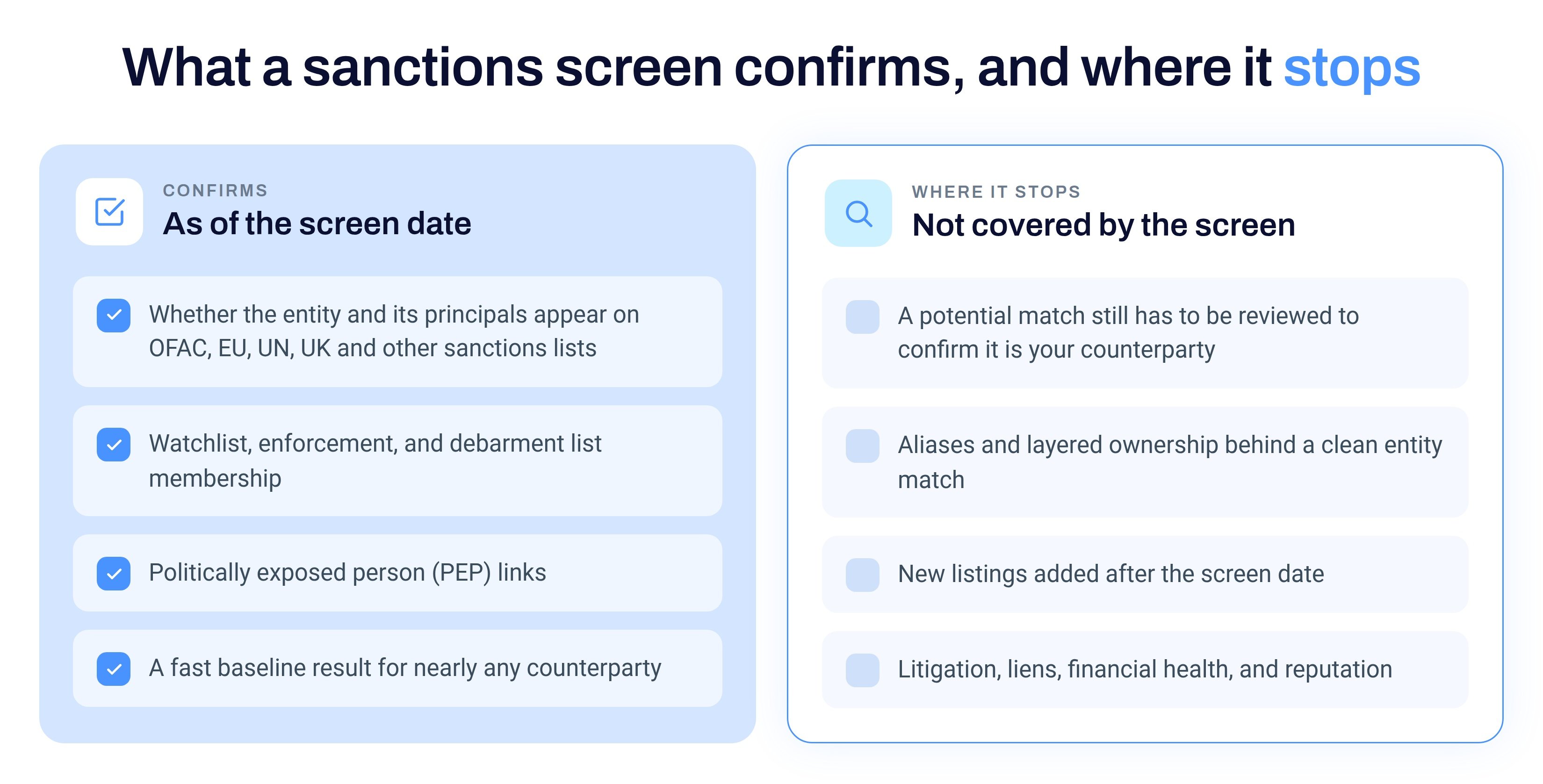
The discipline is to hold it to its actual size. A clean screen is a point-in-time confirmation of list membership, and treating it as more than that is where a lot of counterparty reviews quietly go wrong.
When a screen does surface something, what you have is a potential match, not a verdict. Automated name matching is built to be broad on purpose, because a system that only caught exact spellings would miss aliases, transliterations of foreign names, and the near-variants a listed party would happily hide behind. The tradeoff is that common names, shared names, and partial overlaps also generate matches that turn out to be an entirely different person or company.
That is the gap between a list of possible matches to sort through and a confirmed finding you can act on. Closing it takes review. Someone has to compare identifiers such as date of birth, jurisdiction, and known aliases, decide whether the flagged party is actually your counterparty, and separate a genuine hit from background noise. How far that review needs to go comes down to right-sizing the screen to what is actually at stake. Either way, an alert is the start of a question, not the answer to one.
This is where a clean screen gets over-read as a clean bill of health. Across more than 34,000 completed sanctions and watchlist screens on our platform, fewer than 3 percent surfaced any potential match to review, so more than 97 percent came back with nothing on the lists at all. If a clean result is what almost every legitimate counterparty produces, then a clean result cannot be the thing that separates the safe counterparties from the risky ones.
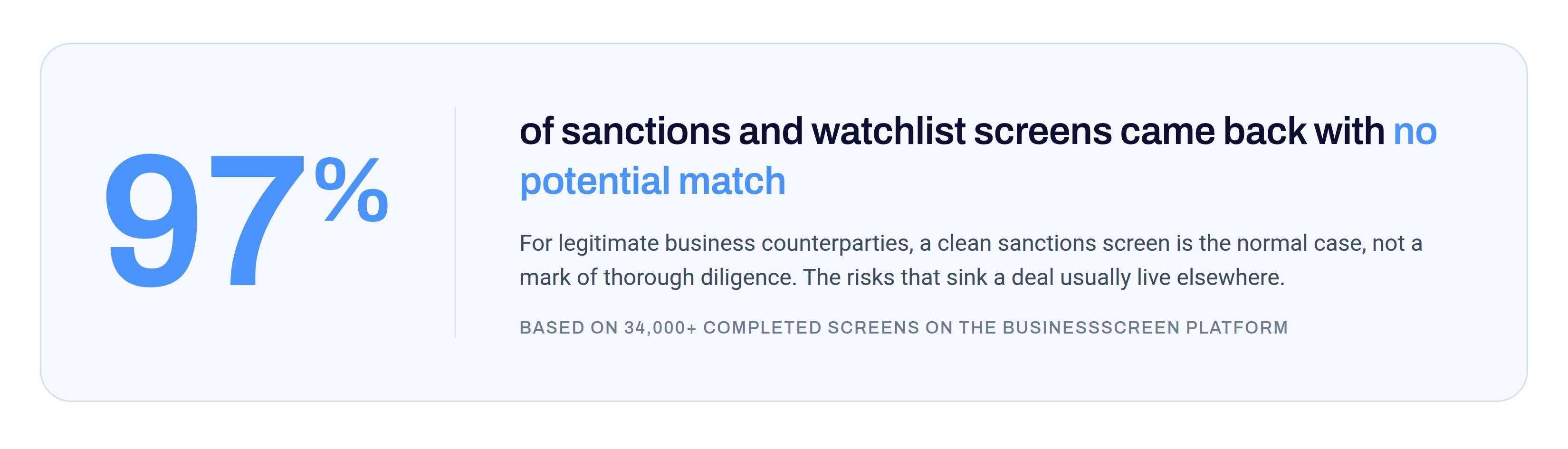
The risks that actually derail a deal rarely sit on a sanctions list. They sit in recent litigation, tax liens and judgments, undisclosed ownership, and financial distress, which is what a clean due diligence check can still miss. A name-against-list screen is not built to see any of that, and because it only reflects the day it ran, it pairs naturally with continuous monitoring, a look at the company's principals, and adverse media for the conduct a list will never show. Those are the layers a sanctions screen leaves for the rest of the review to carry.
That is where our global sanctions and watchlist screening is built to help. When a screen returns a potential match, we verify whether it actually belongs to your counterparty. Our team compares identifiers against source records, works through the aliases and near-matches that trip up automated matching, and tells you whether the alert is a real hit or noise, with the supporting documents attached. You get a confirmed or cleared finding rather than a name to chase down on your own.
On top of the sanctions and watchlist screen, the same review can layer in know your business (KYB) verification, beneficial ownership, adverse media, and the litigation, lien, and judgment history that a sanctions list will never carry. That gives you a reasonable level of diligence on a counterparty without the heavy lifting of assembling it yourself. Because not every counterparty warrants the same depth, you can keep the baseline light and reserve the deeper work for the relationships and dollar amounts that carry real exposure, the same judgment behind where a due diligence investigation actually starts and why vendor due diligence should go further only when the risk calls for it.
If you are looking for a partner to run sanctions and watchlist screening for you, or to take the manual work out of the diligence around it, fill out the form below and our team will walk through how we can help.







.png)
