


You run a business background check on a new counterparty, the results come back clean, and the deal moves forward. That finding was accurate the day it was produced. The question most teams do not ask is how long it stays accurate. A lien filed three months after onboarding, a judgment entered the next quarter, a license that lapses mid-contract: none of it shows up in a report you already ran and filed away.
That gap is the difference between point-in-time screening and continuous monitoring. They are not competing products. They are two answers to the same question asked at different moments in a relationship, and choosing between them comes down to one thing more than any other: how long the relationship lasts.
A point-in-time screen is a snapshot. It tells you what the public record showed about a subject on the date it was run. A business background check at onboarding establishes that baseline: business identity verification on the entity, business credit, entity-level litigation, liens and judgments, sanctions and watchlist screening, and, done well, a look at the people behind the company, because a complete business background check also covers the principals, not just the entity. Run at a depth that matches the deal, that baseline is genuinely decision-ready.
The limit is time, not quality. The record keeps moving after the date of the check. A snapshot taken in January describes the subject in January, and nothing about it updates on its own when a new filing lands in April. For a one-time transaction, that is fine; the decision and the data live at the same moment. For a relationship that continues, the baseline quietly ages while you are relying on it.
Continuous monitoring keeps watching a subject who is already in the system and surfaces changes as they emerge, rather than waiting for a re-scan on a fixed schedule. How quickly a given change reaches you depends on the record. Where a source provides data in real time, a new development can surface as it happens; for record types that update rarely or are not available as a live feed, we re-check at the point that makes the most sense for that record type rather than on a blanket calendar. Either way, updates reach you by email, in the dashboard, or by webhook for clients connected through the API.
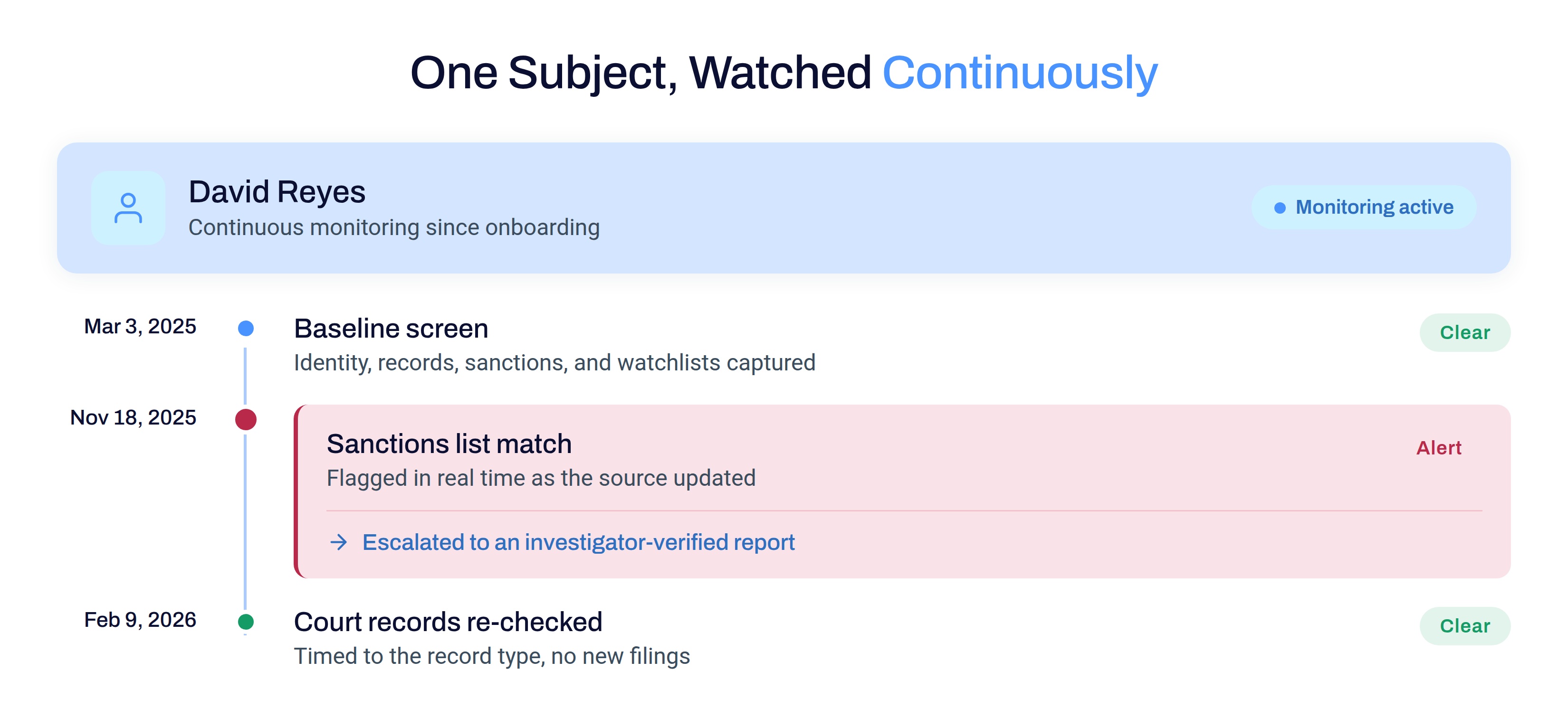
Because monitoring tracks only what has changed against the baseline the first screen established, it costs far less than re-ordering the same check over and over. What it watches are the signals most likely to shift after onboarding: new lawsuits and judgments, liens and other claims against assets, new criminal records on an owner or officer, bankruptcy filings, business credit movement that can be an early indicator of distress, sanctions and watchlist hits, and, where it applies, professional license and insurance status.
Many monitoring tools stop at the database layer, surfacing only what has already been digitized and indexed. Ours uses that automated layer for breadth, but when a change raises a real question, the subject can be escalated to an investigator-verified report that pulls live from the source. The automated layer tells you something changed; the investigators tell you what it means.
The real question is not whether to monitor a one-time deal; it is which of the relationships you keep are worth the ongoing spend, and which are fine with the screen you already ran.
A few factors tip that decision toward monitoring:

The inverse is just as useful to name. If the exposure on a counterparty is low enough that a new lien or a lapsed policy would not change what you do, monitoring is spend without a payoff. If you already re-run a full screen at a natural checkpoint, like re-underwriting at renewal, a separate monitoring layer is redundant. And a handful of relationships you can review by hand may not need an automated layer at all.
This is not a one-way door. You do not have to decide it at onboarding. A common pattern is to screen point-in-time at the start, then enroll the relationships that clearly carry ongoing exposure once it is obvious they will, and revisit that list as exposure changes.
Monitoring is built to surface changes, not to run a deep investigation. It flags that something moved; it does not adjudicate what that means. An alert is a prompt to look closer, and for a higher-stakes relationship, looking closer means escalating that subject to an investigator-verified report rather than acting on the automated signal alone.
The automated layer also carries the same timing limits as any database refresh. A county filing can take time to index, so a recent record may surface on a later check rather than the day it is filed. That lag is precisely why a flagged subject can move to a live, source-verified pull when the stakes justify it. Monitoring widens how often you look; investigator verification deepens how far you see when a look turns up something.
The two approaches work best in sequence, matched first to the deal and then to the life of the relationship. The sequence itself is simple; what matters is the judgment at each step.
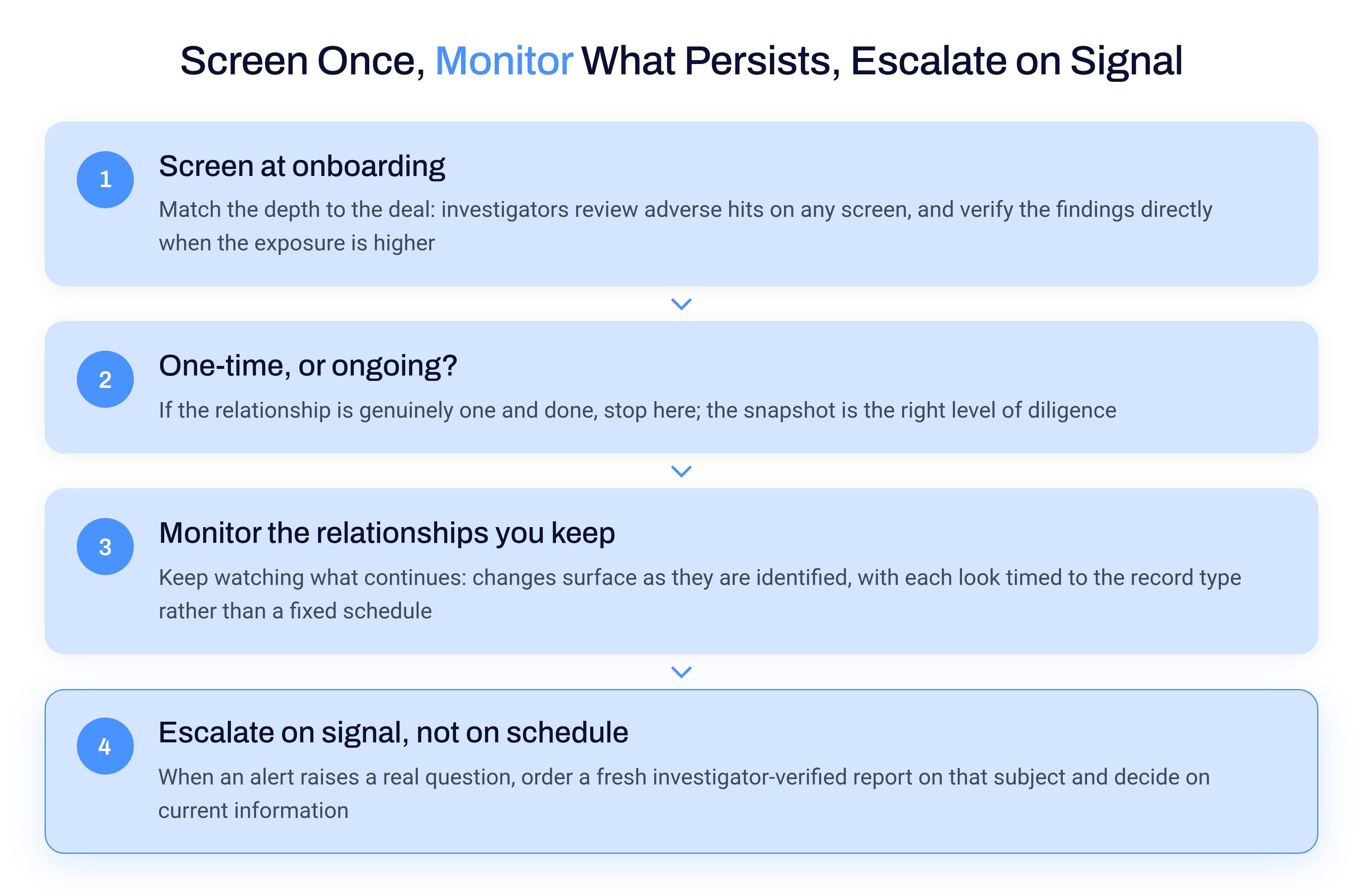
The depth of the first screen should track the size of the deal: a routine, low-stakes relationship can run as an automated screen, while a larger exposure earns investigator-verified depth from the start. Enrolling in monitoring is a separate decision, driven by whether the relationship persists and how much a later change would cost you. Once enrolled, the timing takes care of itself: changes surface in real time where the source supports it, and on a schedule suited to the record type where it does not. The rule worth stating plainly is to escalate on signal, not on schedule: when an alert raises a real question, that subject moves to a fresh investigator-verified report and you decide on current information.
The aim is not to watch everyone. It is to match how closely you watch a counterparty to how much the relationship still matters, and to spend the deeper diligence on the moments and subjects where a finding would actually change what you do next.
Point-in-time screening and continuous monitoring answer the same question at different points in a relationship's life. The screen tells you who you are dealing with today. Monitoring tells you when that picture changes. Which one a given relationship needs comes down to how long it lasts and how much it still matters, and for many relationships the honest answer is that one good screen is plenty.
The harder part is usually deciding which relationships fall on which side of that line. If that is the call you are facing, for a single counterparty or a whole portfolio, we can help you scope the right level of diligence.







.png)
