



When you lend to a company, onboard it as a vendor, or buy it, you are dealing with a legal entity rather than a person. Somebody owns and controls that entity, and their name often appears nowhere obvious. That individual at the end of the chain is what diligence and compliance teams call the beneficial owner.
Finding out who that is sounds like it should be a simple lookup, and it is not. The records you can actually reach were built to register companies rather than explain them, so what they hand back is whatever somebody filed with a state agency. That is a narrower thing than who runs the business today, and narrower still than anything about who that person is.
Those are two separate gaps, and closing them takes two different kinds of work.
The term covers two things that get used interchangeably and should not be.
The first is the state registration filing. An entity forms with the Secretary of State, and that filing becomes the public corporate record. Depending on the state and the entity type, it may list officers and directors, a registered agent, a formation date, and current standing. For a corporation, you often get real officer names. For a limited liability company, you often get much less.
The second is a beneficial ownership information report, the disclosure created under the Corporate Transparency Act, which asks a company to name the individuals who ultimately own or control it. That is the ultimate beneficial owner, or UBO, the natural person at the end of the chain rather than the entity one layer up.
People say UBO check or UBO verification and mean either one. The distinction matters, because only one of them is available to you at all. UBO compliance in the filing sense is a separate question, and the answer there has moved recently too.
If your mental model is that beneficial ownership is now a solved problem because there is a federal database, two things are worth knowing.
The scope collapsed. In March 2025, FinCEN issued an interim final rule that removed beneficial ownership information reporting for entities formed in the United States. Reporting company was redefined to mean foreign-formed entities registered to do business in a US state, and even those are not required to report their US-person owners. The rule is not final and this could move again. But as things stand, the domestic counterparty you are screening most likely has no beneficial ownership information report on file.
The database was never yours to search. Even when the filing requirement applied broadly, the registry was non-public and exempt from public records requests. Access runs to law enforcement, certain government agencies, and financial institutions doing customer due diligence with the customer's consent. A private lender, a marketplace, or an acquirer evaluating a target could not query it then and cannot now.

That leaves the corporate record, which is where entity and identity verification starts and where it is both genuinely useful and genuinely limited.
Most states do not require a limited liability company to disclose its members. A manager-managed LLC can name a manager and stop there, and the manager may be an employee, an attorney, or another entity. The registered agent is a service address, not an owner, though it gets read as one more often than you would think. And an officer listed three years ago may have left two years ago, because the filing reflects the last time someone updated it rather than the state of the world today.
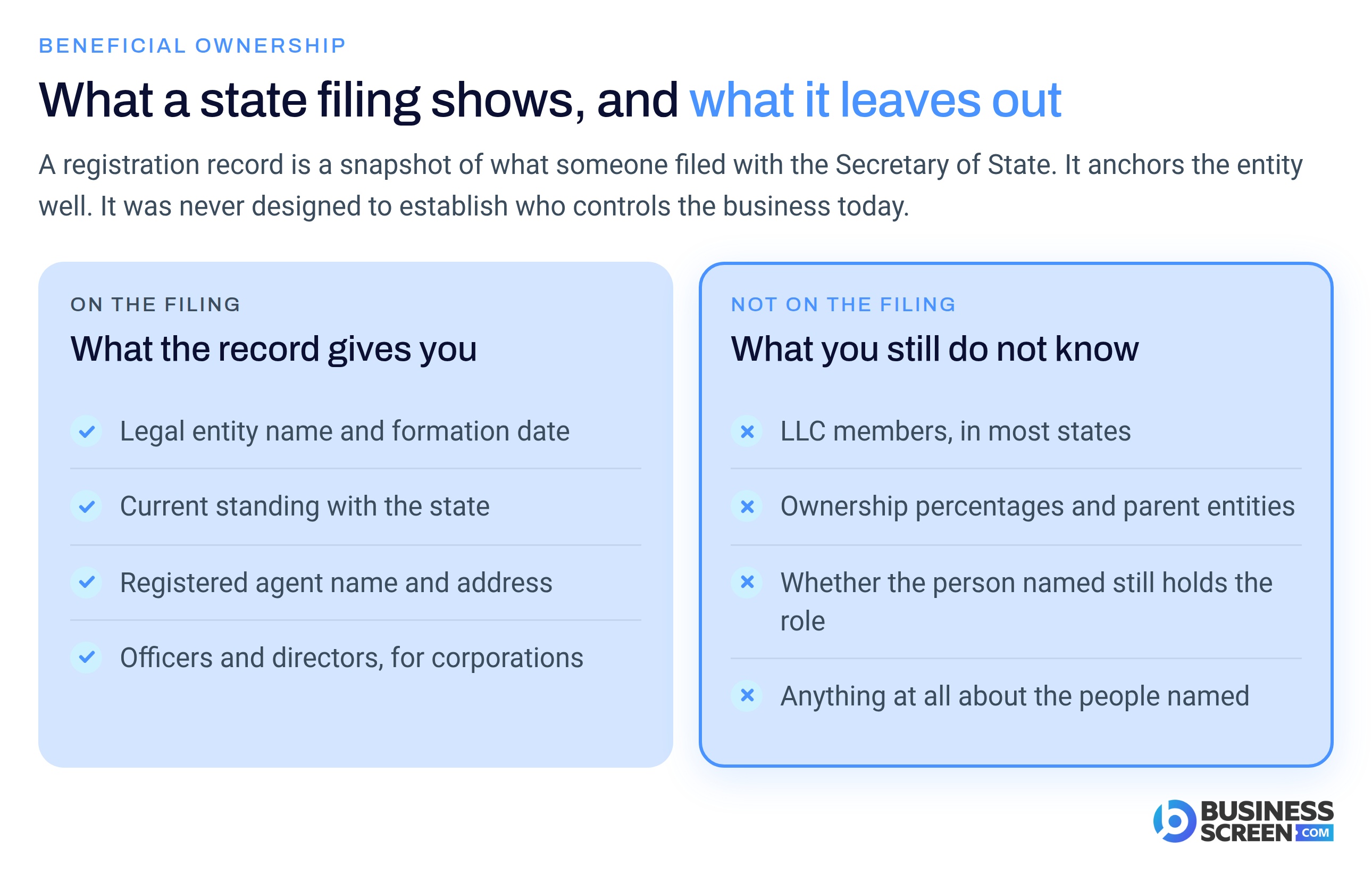
Then there is layering, which is not exotic. An operating company is owned by a holding company, the holding company is owned by two other LLCs, and one of those is held by a trust. Every layer is a legitimate structure with an ordinary business reason behind it. But each one is a separate filing in a separate place, and the registration record for the entity you started with will not walk you up the chain. Add a foreign domicile and the record may sit in a registry with different disclosure rules, a different language, and no online access at all.
None of this makes the filing worthless. It anchors the entity and gives you names to work with. It just runs out earlier than most people assume, the same pattern that shows up when KYB verification confirms an entity and then stops.
Once you have a name off a filing, you are holding a string of text. The check has not told you whether the name is current, and it has not told you a thing about the person.
That second gap is where the interesting findings tend to live, and our own reports bear it out. Across completed screens where a business was the subject, about 86 percent covered the entity alone with no principal attached. Of the cases that did include both, where the business itself came back with no alerts, a principal still drew a finding about one in five times.
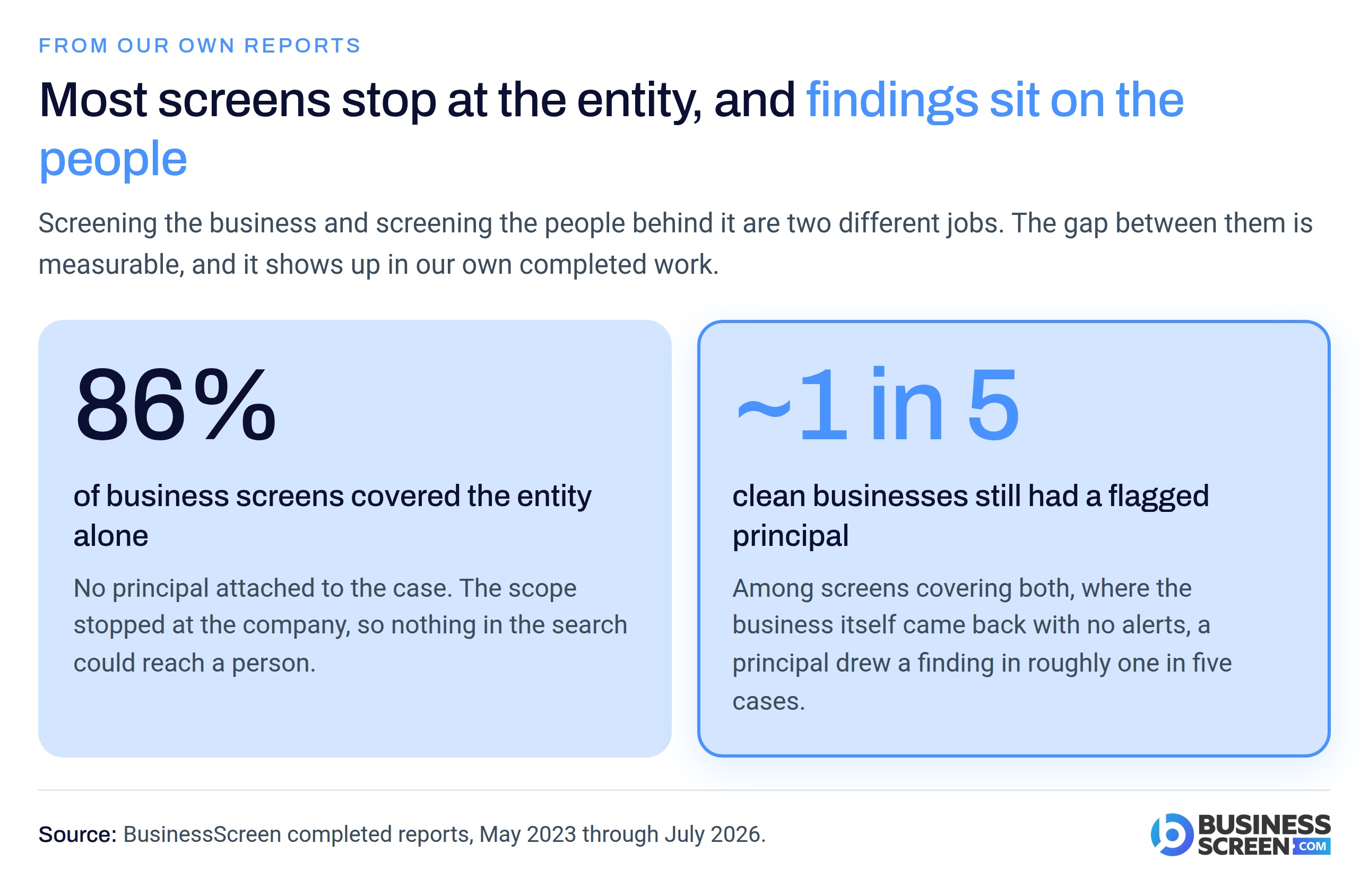
Worth being precise about what a finding is, because one in five is not one in five fraudsters. A finding can be a civil claim from a decade ago that settled quietly, a satisfied judgment, or a licensing lapse that was cured. It can also be an active tax lien for a serious amount, a pattern of suits from former partners, or a bankruptcy nobody mentioned. The value is that somebody gets to weigh it rather than never seeing it.
None of this means entity screening is broken. The entity screen was accurate and the business really was clean. The finding was simply attached to a person, and a search scoped to the company was never going to reach it. That is the same dynamic behind what a clean check can still miss, and the reason we argue that a business screen should cover principals too.
Many providers stop at a database lookup of the corporate record, and for routine screening that is a reasonable place to stop. The difference starts when the lookup does not go far enough.
A database record of a corporate filing is a copy, and a copy is only as current as the last refresh. So for the tiers where our investigators do the gathering, the corporate record gets pulled live from the Secretary of State, which returns current standing, the registered agent, and the officers and directors as the state holds them today rather than as an aggregator cached them. For entities domiciled abroad, that same pull runs against the foreign corporate registry directly, which is usually the only way the record surfaces at all.

From there the work turns to the people. Once a principal is identified, a background check for business owners covers the criminal, civil, and financial record on that individual, and an associated business search runs the relationship the other direction, identifying other entities where the person is listed as an owner, operator, or executive and screening those for bankruptcies, liens, and litigation. That is often how a layered structure becomes visible, not by climbing the chain through filings but by starting from a person and finding what else they are attached to.
The depth should track the size of the decision, and for a good share of relationships that means stopping well short of the people. For a low-dollar vendor you can replace next quarter, confirming the entity exists, is in good standing, and clears sanctions and watchlist screening is a sensible place to stop.
Principal-level work earns its place when the exposure does, on a meaningful credit facility, an acquisition, a partner who will hold your customer relationships or your money, or a structure that looks more layered than the business needs. Where exactly that line falls is its own question, and when to escalate a screen is worth working out before a specific deal forces it.
The useful question is not whether you ran a UBO check. It is whether you know who is behind the entity, whether that is current, and whether anyone has looked at those people. A filing answers the first question partially, on a good day, and none of the rest.
If you are trying to work out which of those three you actually have on a counterparty in front of you, fill out the form below and one of our investigators will walk through it with you.







.png)
