



In this article
Every lender prices experience. A borrower with five completed flips gets more leverage, a better rate, and lighter reserve requirements than a borrower with one. Track record moves the terms of the deal more than almost anything else in the file.
Now consider how that track record usually enters the file. On the standard application it is the real-estate-owned section the borrower writes themselves. In most loan origination systems it is a single free-text box. One lending-platform product leader put it to us plainly: "Today we only have one field where they just type in the experience, and that's it."
The most term-moving input in the file is self-reported. And where verification happens at all, it is usually a county lookup that confirms the borrower's name appears on a deed. As the same product leader told us: "The vast majority just go in and see if the bid is there, and that's it. They don't capture whether it was in default. It just captures the actual ownership."
A name on a deed tells you a deal existed. It does not tell you how the deal went. This article is about closing that gap: what a claimed track record hides, why the standard checks miss it, and, because the how matters as much as the what, the four ways lenders actually run experience verification, with the costs and blind spots of each.
We screen thousands of subjects a month for private and commercial lenders, and the patterns in misstated experience are remarkably consistent. There are three.
The borrower claims ten deals. Look closer and they were on those projects as the contractor, not the owner. One lender we work with described the pattern exactly: "A lot of them think they did some work on a property, so they're going to call that experience. No. You've got to actually own the property. Not just hung some doors."
Swinging a hammer on a flip is experience of a kind. It is not the experience your leverage tiers are pricing. The borrower who managed a renovation for someone else never carried the debt, never made the draw decisions, never had to exit. When a lending-platform executive who sees intake across many lenders called claimed-but-not-owned deals "actually the biggest problem overall," he was telling you where to look first.
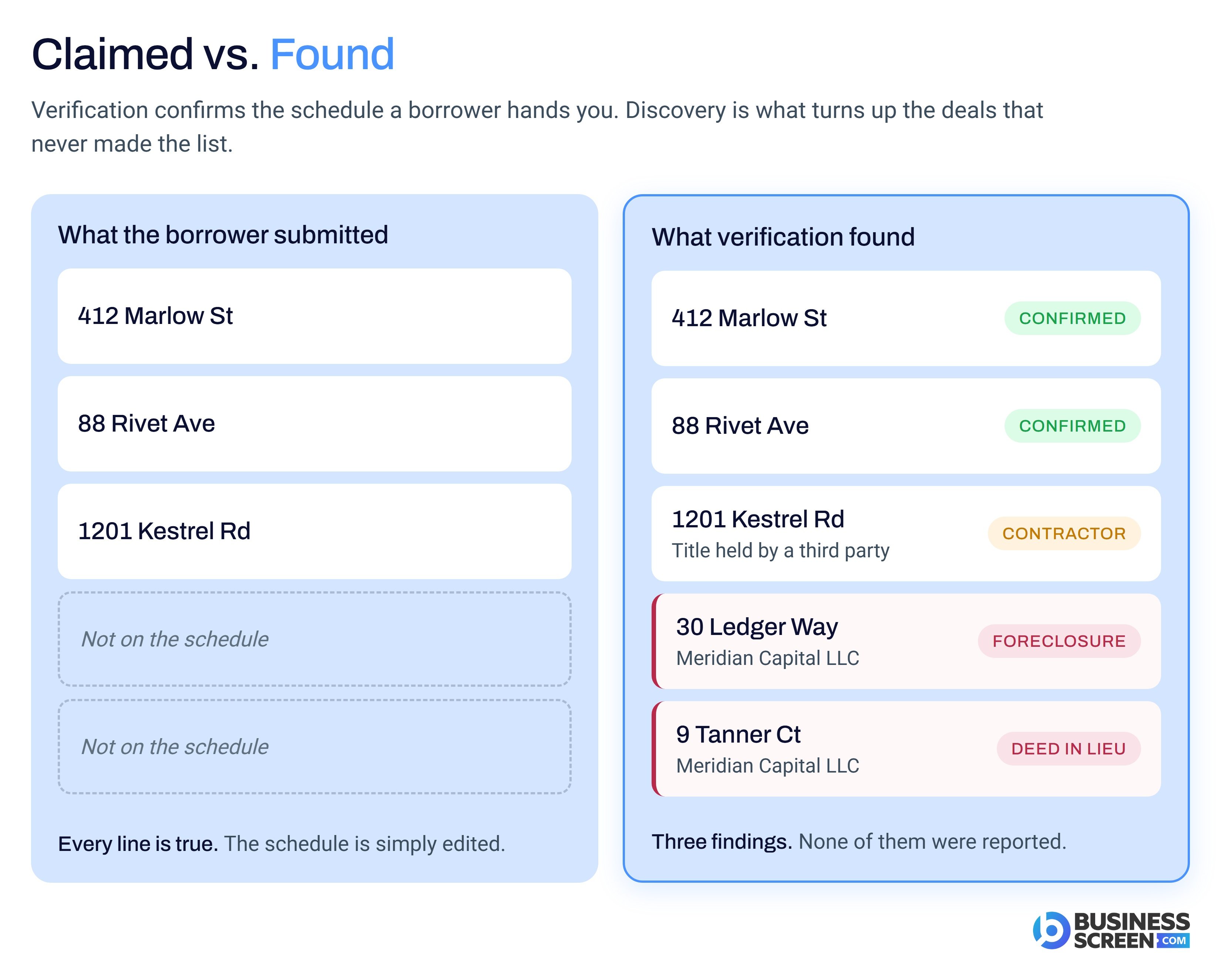
The second pattern is subtler because everything on the list is true. The borrower reports the eight deals that went well and omits the two that ended in foreclosure. Nothing they wrote is false. The schedule is simply edited.
One lender who runs verification on his own book frames it as two separate jobs. Is what they are telling you true, and what are they not telling you?
Borrowers do not list the property that went back to the bank. The deals that would actually change your underwriting decision are, by definition, the ones least likely to appear on the application. The same instinct shapes everything else the borrower hands you. Reference letters carry the flaw in the other direction, since the borrower picks the references, and whoever curates a deal schedule curates a reference list too.
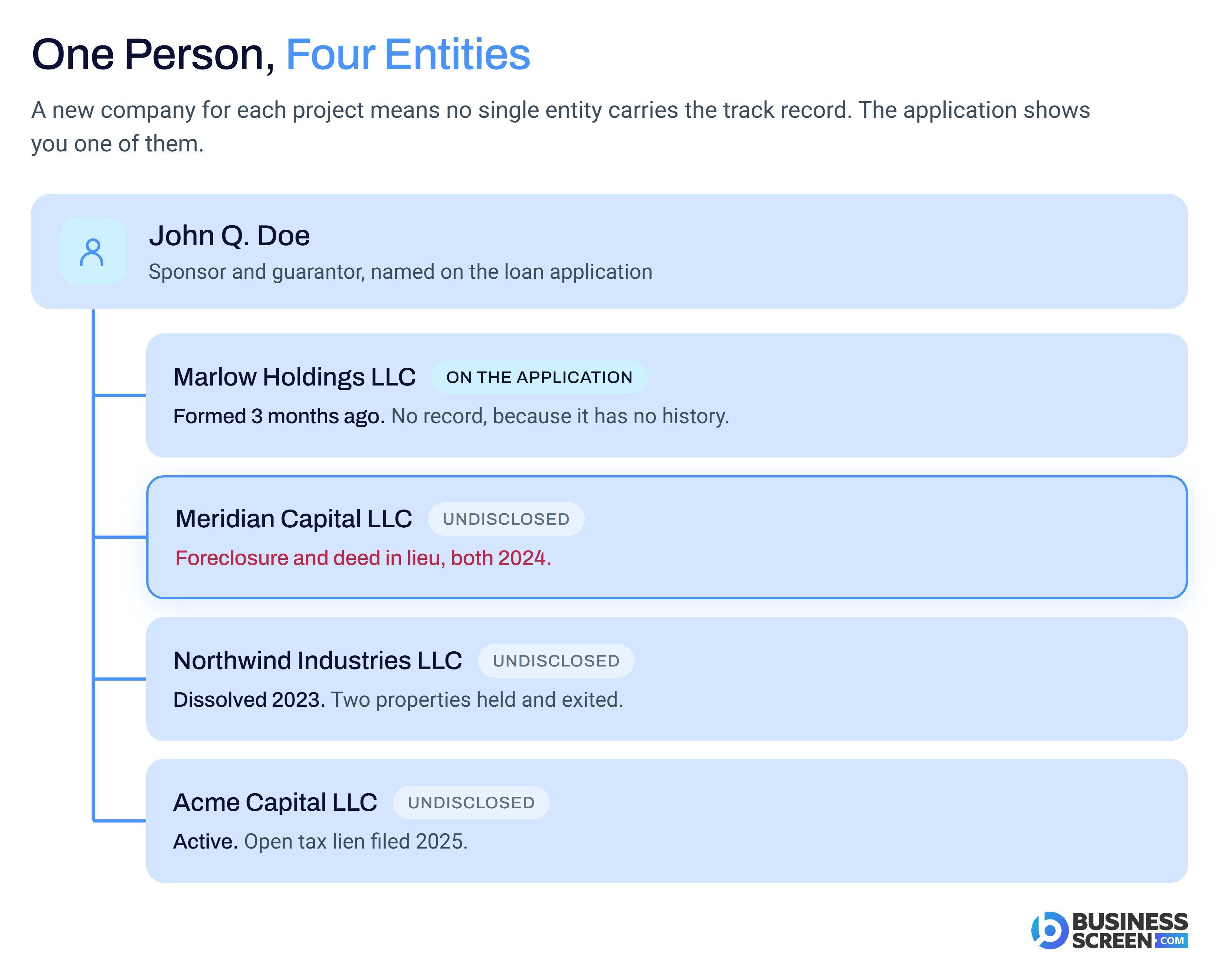
The third pattern is structural. Experienced borrowers often create a new limited liability company for every project. There are legitimate reasons to do this. But it has a side effect lenders feel constantly: no single entity carries the track record, and the entity in front of you is three months old with a clean history, because it has no history. Lenders call it what it is: a vehicle to hold the deed.
One veteran underwriter described the problem from her lending days: "That entity check didn't do me any good, because he literally created a new entity with every single project. It was him I was concerned about. I don't know the name of all of his hundred entities."
The corollary is the most useful single fact in this article: when a deal goes wrong, the entity gets discarded and a new one gets formed. A person cannot do that. Liens, judgments, foreclosures, and litigation follow the individual through the public record for decades. The entity is where the deed lives. The person is where the history lives. Screen accordingly.
And occasionally the problem is one layer deeper still: the person across the table is not really the borrower. Straw buyers and hidden parties are rarer than inflated schedules, but lenders who have hit one do not forget it. One credit-desk lead told us his team rebuilt its intake process after running into all three, borrowers who turned out not to be who they claimed, straw buyers fronting for someone else, and undisclosed parties standing behind the deal.
None of this is a story about lazy underwriting. The checks most shops run simply were not built to answer the experience question.
The ownership lookup confirms ownership, nothing else. Checking that the borrower's name is on a deed verifies the claim they made. It does nothing about the claims they didn't make. Verification of the provided list and discovery of the omitted one are different operations, and almost every standard process does only the first.
Aggregated databases lag and misclassify. A commercial database is only as current as its last data feed. A lien filed last month may not appear for weeks; a judgment shown as pending may have gone to default months ago at the county. Classification errors are routine. Lenders tell us about borrowers listed as foreclosure defendants because they bought a property out of foreclosure. One underwriter described the ritual that follows: pull the deed, confirm grantee rather than grantor, collect a not-me affidavit, run a second report from a second vendor to break the tie. Hours of staff time per hit, to establish that a record was miscategorized.
The tool may not be cleared for the decision you are making. Access to a skip-trace or investigative database carries a permissible purpose under the Gramm-Leach-Bliley Act, the federal law governing how financial institutions handle and share personal financial data. At many lenders that purpose is written as fraud prevention rather than credit decisioning, which puts the tool underwriting leans on outside the use it is actually licensed for. Most teams have never read the clause, and it tends not to come up until an audit does. Worth checking what your own agreement permits before it becomes someone else's question.
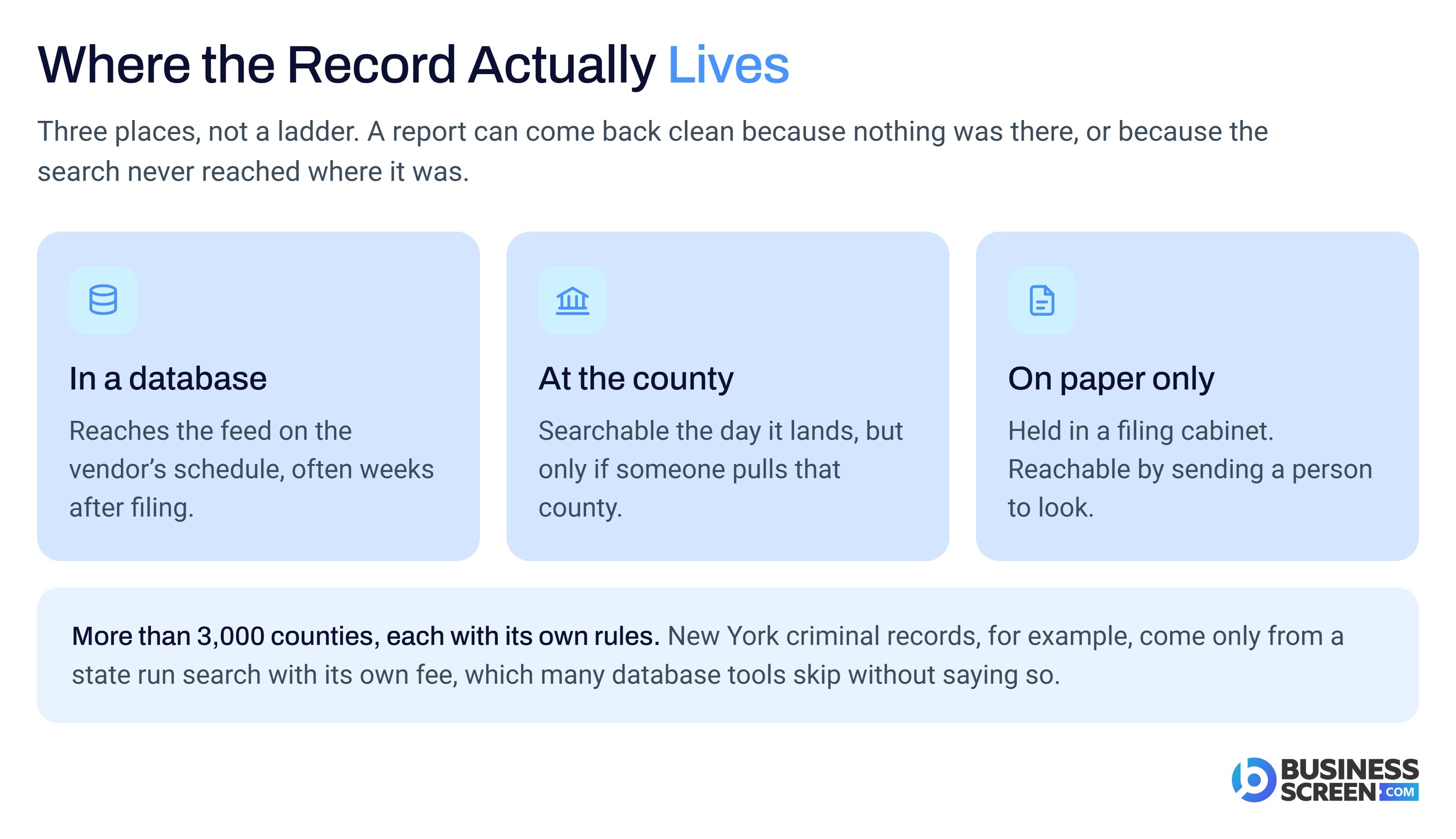
Coverage has holes that don't announce themselves. There are more than 3,000 counties in the United States, and no database reaches all of them; some records still live in filing cabinets that require a person to visit. State quirks compound it: New York criminal records, for example, come only from a state-run search with its own fee, which most database tools quietly skip. We have watched a tri-state lender realize mid-conversation that years of reports had never actually covered New York. The report did not say "this jurisdiction not searched." It just came back clean.
Some of what matters is not in the databases at all. Reputational history, the fraud case where charges were never filed, the pattern of disputes that never reached judgment. The fallback is an ad-hoc internet search when a name "sounds off," and the lenders doing it know it is not a process. One told us directly: "It's not really the right way to do it. The right way is every loan gets that search."
To be fair: for a small deal with a borrower you have known for years, a light screen is genuinely fine, and we tell lenders so. The problem is not that light checks exist. It is that the light check and the experience question are answering different things.
Strip away the tooling and vetting a borrower's experience comes down to five questions. We will get to the methods next. Whatever method you use, the test of a real process is that each question gets asked, and each answer comes with evidence rather than a borrower's assurance.
1. Is this person who they say they are? Verify the identity, confirm the connection to the borrowing entity, and look for parties who are not on the application. One twenty-year lender caught a borrower only because the identification produced at closing spelled the last name differently than the application; the record search that followed turned up six figures of check fraud. That catch was luck. The point of this question is to make it procedure.
2. Did they own the deals they claim? Verify each entry at the property record: the deed, the transfer, who held title, and whether the role was owner or contractor, grantee or grantor. For flip experience, settlement statements showing both sides of the same property remain the cleanest proof of a completed cycle. Industry practice counts deals completed within roughly the last three years, in the borrower's own name or entities, at a scope similar to the loan in front of you.
3. What did they leave off the list? This is the question that separates verification from discovery, and the one almost nobody's process covers. Work outward from the person: the entities they connect to, the properties those entities have held, and how each deal ended. Foreclosures, deeds in lieu, and defaults on unlisted properties are precisely the findings that change a decision. They are invisible on the application, and usually sitting right there in the property and court record under an entity you were never told about.
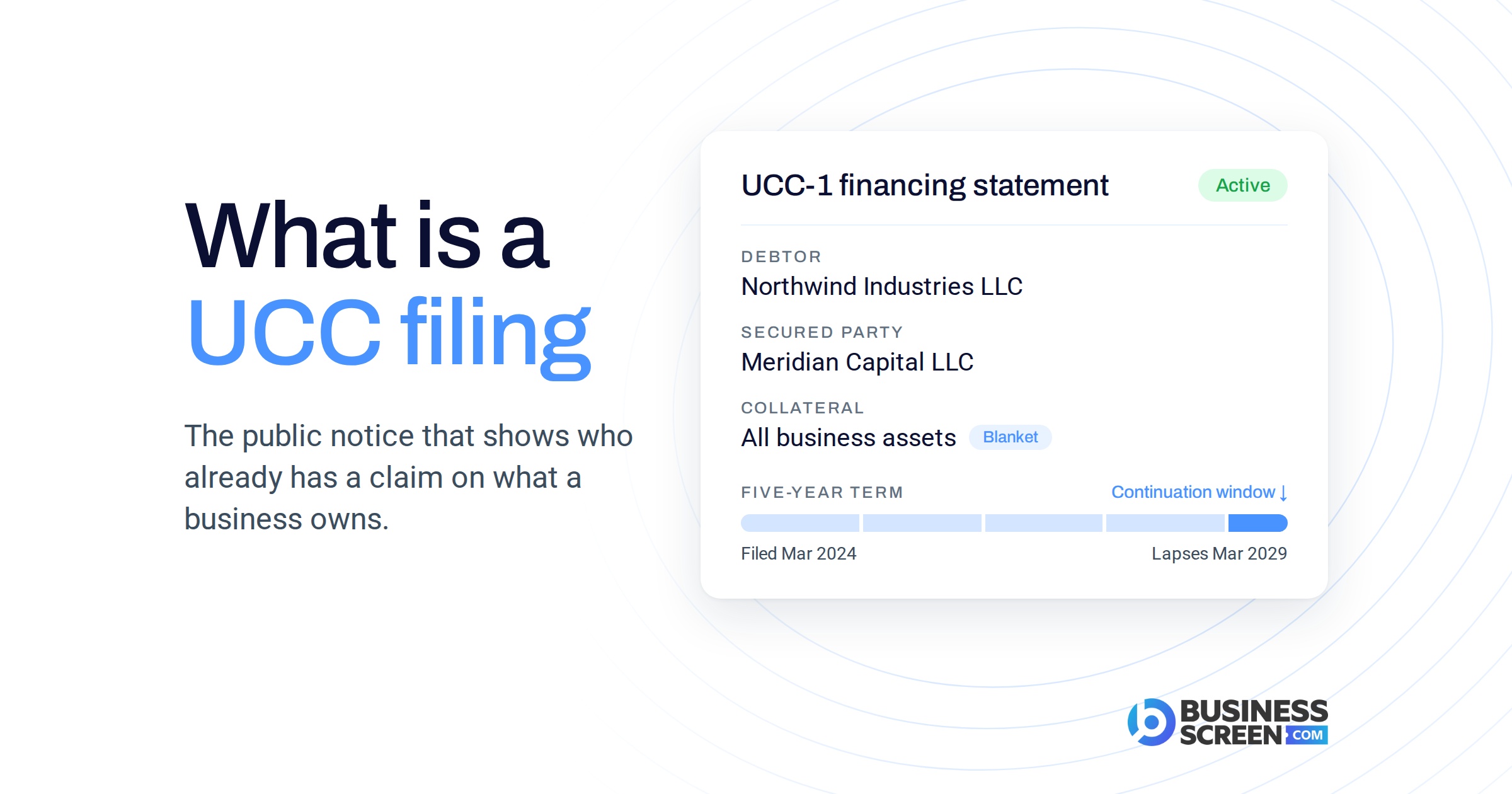
4. What does the record say about the person, not the LLC? The entity is new; the person is not. Run the history where it accumulates: judgments and their current status (a lien shown "open" that the borrower insists was paid is a conversation to have before funding, not after), tax liens, financing statements, litigation on both sides, bankruptcies, reputational history. Across the private-lending subjects we screen, roughly one in four comes back with something, whether a lien, a judgment, litigation, a criminal record, or a watchlist hit. Most findings are not disqualifying. But you want to be the one deciding which findings matter, and you can only decide about findings you have.
5. Will you know when the picture changes? A track record is a snapshot the day you pull it. Bridge and construction loans sit for months or years, and new liens and suits do not wait for maturity. Most private lenders' books are majority repeat borrowers, and the economics should reflect it: vet a new borrower deeply once, bring them into your universe, and let lighter periodic re-checks carry them from there. That is what monitoring is for, whether you build it yourself with a calendar reminder or buy it: previously screened subjects re-checked at an interval you set, with an alert when something new lands. Match the interval to the loan, since a nine-month fix-and-flip and a three-year construction note do not need the same cadence.
Here is the part most guides skip: the methods. There are four realistic ways to verify borrower experience, and they differ sharply in cost, staff time, and what they can and cannot catch. Right-sized is the goal. The best method for a four-loans-a-month shop is not the best method for a four-hundred-loans-a-month shop.
The borrower supplies their schedule; your team confirms it at the source. Done properly, that means:
What it costs: almost nothing out of pocket. County lookups are free to a few dollars per document. The real cost is staff hours: lenders told us a single file can eat "hours, sometimes days" once a record needs untangling, and underwriter time is the most expensive research time you can buy.
What it misses: everything the borrower didn't list. This is pure verification, not discovery, so the curated list sails through. It also depends on your team's comfort reading deed chains across 3,000-plus counties that each do things their own way.
Fits best: low volume, local lending footprint, deals where the claimed schedule is short and the properties sit in counties you know.
Reverse the direction: instead of checking the borrower's list, search a property-data platform by the borrower's name and known entities and see what ownership history comes back, then compare it against what they told you. Several lenders we talk to run a platform of this kind to build a real-estate-owned profile on every borrower.
What it costs: self-serve subscriptions typically run from under a hundred to a few hundred dollars a month; enterprise data contracts run four figures monthly. Cheap per borrower at any volume.
What it misses: the linkage problem. Platforms are strong on property → owner and weaker on person → all their entities, which is exactly the direction the disposable-LLC pattern exploits. Coverage and recency gaps apply, common names produce noise your team still has to resolve, and the output is ownership, not outcomes: the platform shows the property; it rarely tells you the exit was a foreclosure. You are also still the one doing the interpreting.
Fits best: moderate volume shops with a staffer who owns the process and treats platform output as a lead sheet, not a verdict.
The emerging best practice among process-driven lenders: use a platform sweep for discovery, then confirm what matters at the source. The platform surfaces the candidate universe of entities, properties, and transfers, and your team pulls deeds and court records only on the deltas: the property on their list the platform can't see, the property the platform sees that their list omits, the exit that looks like it went through a trustee.
What it costs: both of the above, the subscription plus the (now targeted, so smaller) staff hours.
What it misses: less than either method alone, but the platform's blind spots are still blind spots, and the process is only as good as its weakest reviewer. It also stops at property history: the judgments, open liens, and litigation from question 4 need a separate check.
Fits best: lenders with real volume, a defined credit-ops function, and the discipline to keep the process consistent when deals are moving fast.
The fourth option is to hand the whole question to a firm that does this for a living. Investigators verify the claimed schedule at the source and run the discovery the other methods can't: the entity web, the unlisted properties, how each deal actually ended, plus the person-level record (judgments, liens, litigation, watchlists) in the same pass, with the source documents attached.
Pricing here tracks depth and search volume rather than hours, which is what makes it usable inside underwriting, since you know what a file costs before you order it. Firms generally tier the work, running an automated screen first and putting investigator hours only where the deal warrants them. Hourly forensic engagements exist above this tier and climb into four and five figures, but they are built for contested acquisitions and active fraud, not for a loan that has to close this week.
What it costs: roughly $50 to $500 per subject, depending on depth and how many searches the file calls for. That is real money per file, and still the cheapest line item in it compared to underwriter hours or one mispriced loan. One private lender stepped away from a $500,000 loan after our investigators found more than $1 million in tax liens filed in the previous sixty days, too recent for any database to have caught.
What it misses: honestly, the least. That is the point of paying for it. What it costs you instead is time, since investigator-worked reports take two to three business days. Plan that into your close timeline. And it is overkill for the ninth loan to a borrower you know well.
Fits best: first-time borrowers, large or unusual deals where claimed experience is load-bearing for the terms, and any shop that would rather spend underwriting hours on judgment than on record research.
| DIY at the county | Property-data platform | Hybrid | Full service | |
|---|---|---|---|---|
| Verifies the list | Yes, at the source | Partially | Yes | Yes, with documents |
| Finds omissions | No | Partially, weak person-to-entity link | Mostly | Yes, incl. entity web |
| Person record | No | No | No, separate check | Yes, same pass |
| Cost | ~$0 | ~$100–500+/mo | Platform + hours | ~$50–500/subject |
| Your hours | Heavy | Moderate | Moderate, targeted | Minimal |
| Speed | Days per file | Same day | 1–2 days | A few business days |
The honest summary: every method on this table beats a self-reported text box. Pick by volume and exposure, and whichever you pick, make it a procedure, not a vibe.
Here is the part of this article a vendor is not supposed to write. Lenders regularly ask us for one thing above all: show me every entity this person has ever been associated with. The honest answer is that no one can. There is no registry linking people to all of their companies. Corporate filings vary by state, ownership can be layered through other entities, and federal beneficial-ownership reporting has not filled the gap. Entity discovery works from corporate records, property records, court filings, and registered-agent trails, and it is genuinely powerful. It is not omniscient. A sufficiently determined person can hide ownership from anyone.
We tell you this for two reasons. First, be wary of any provider who claims otherwise; a vendor selling you a complete entity map is selling you a false floor. Second, the limit is exactly why documented, evidence-backed vetting matters. Your loan buyers, investors, and partners do not expect clairvoyance. They expect a defensible file: what was searched, how far back, what was found, and the source documents behind each finding. When a finding surfaces after closing, the difference between "we ran a real process and documented it" and "we did a quick lookup and hoped" is the difference between an exception and an existential conversation.
BusinessScreen is a team of licensed investigators, supported by purpose-built technology, that runs background checks on businesses and the people behind them. We have been doing investigative work since 1996, and lenders are our largest client segment. We run the fourth method in the table above. Our Preliminary Report runs the record sweep and comes back in minutes when clean, with flagged hits confirmed by an investigator before they reach you. Advanced and Deep Dive reports are investigator-worked, with live county and court searches, ten- to twenty-year lookbacks, associated-entity discovery, and the source documents included, so the file defends itself.
Our reports are non-FCRA. Consumer background checks fall under the Fair Credit Reporting Act, which requires the subject's consent and generally caps how far back a report can look at seven years. Because we screen businesses and their principals for a commercial decision rather than for employment or credit, that framework does not apply, which is why no borrower consent is required and why the lookback runs ten to twenty years instead.
And because experience verification is the question lenders ask us most, it is where our product work is focused: mapping the borrower's entities, the properties behind them, and how those deals actually ended.
Month to month, no minimums, and your first look should be a real one. Hit Get Started below and fill out the form, then send us a borrower you already know the truth about and compare what comes back against what you know. Our investigators can talk through which tier fits which deal at no additional cost.
Find what others miss.






.png)
