


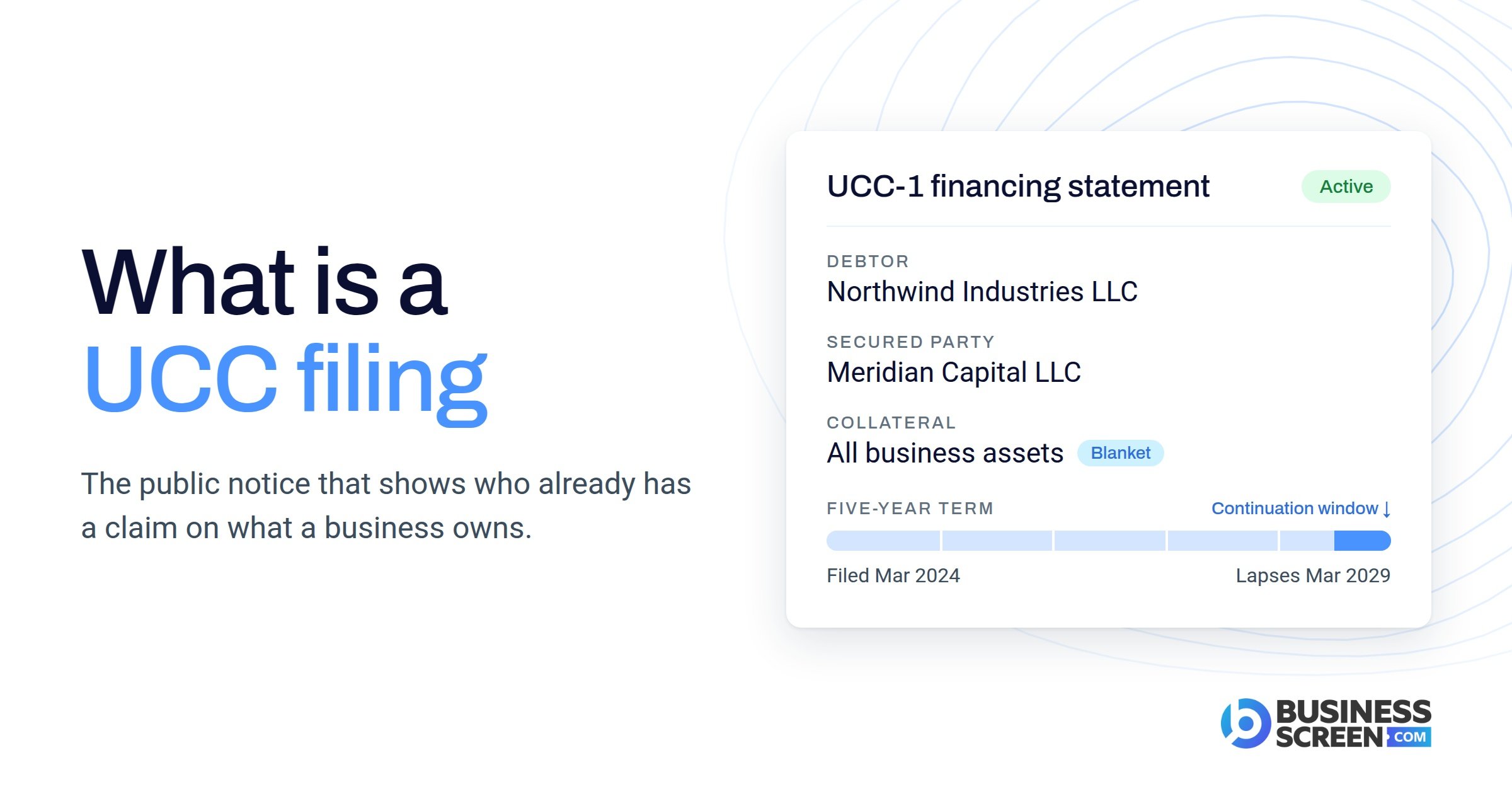
If you are about to lend to, buy, or sign a long contract with a company, a UCC filing answers a question no financial statement will: who else already has a claim on what this business owns. What is a UCC filing in practical terms? It is a public notice that a creditor has taken a security interest in a borrower's property, and it shows up whether or not the borrower mentions it.
The Uniform Commercial Code (UCC) is a set of commercial laws adopted in all fifty states. Its Article 9 governs secured transactions, meaning how a lender takes an interest in a borrower's property and how that interest holds up against other creditors.
When a business takes a secured loan, the lender files a UCC-1 financing statement with the Secretary of State, usually in the state where the business is organized. That filing is what makes the claim enforceable against other creditors, a step lawyers call perfection. The filing is the notice; the UCC lien is the legal claim it creates.
What gets secured is business personal property, such as inventory, equipment, vehicles, accounts receivable, intellectual property, and general intangibles such as software licenses. Real estate runs through the county recorder on a separate track.
Priority generally follows filing order, first in time, first in right, which is why the date on a filing often matters more than the dollar figure. Our Business Lien Search breakdown shows how UCC records sit alongside tax liens and judgments.
| Feature | Blanket lien | Specific-asset lien |
|---|---|---|
| Scope | Most or all business assets, often including future acquisitions | Only particular, itemized assets |
| Typical description | "All inventory, equipment, accounts receivable, and general intangibles" | "2023 Ford delivery truck, VIN 1234567890" |
| Common use | Working capital loans, lines of credit, Small Business Administration loans | Equipment financing, vehicle loans, project funding |
| Effect on the borrower | Ties up nearly everything, which narrows future financing options | Leaves other assets available as collateral |
A blanket UCC lien is not a red flag by itself. Plenty of healthy companies carry one against a line of credit they barely use. It does tell you the borrower has little left to pledge, which matters if your deal assumes otherwise.
There are really only two types of UCC filings. The UCC-1 financing statement starts the lifecycle. It names the debtor and the secured party and describes the collateral. The UCC-3 amendment handles everything after, whether that is a continuation, a change to the collateral, an assignment to a new lender, or a termination once the debt is paid.
The debtor's name on a UCC-1 has to match the legal name on file with the state, entity suffix included. Get it wrong by enough and the filing may not protect the lender at all. The same detail matters when you search, since a filing under a slightly different spelling can be easy to miss.
A filing is valid for five years. If the loan is still open, the creditor files a UCC-3 continuation, and it has to land within the six-month window before expiration. Early does not count. Miss the window and the filing lapses. The creditor loses priority, later creditors move ahead, and a secured loan quietly becomes an unsecured one.
When the debt is paid, a creditor on business collateral only has to file a termination after the debtor sends a written demand, and then within twenty days. Without that demand, nothing requires the filing to come off the record, so a filing that looks active may be a stale one nobody cleared, and a filing that looks absent may have lapsed while the debt is still very much alive.
UCC filings are public records, so a search is easy to start and easy to run incompletely. There are three routes.
The state filing office. Nearly every Secretary of State offers a free online UCC search. The National Association of Secretaries of State keeps a directory of state UCC filing offices. For one company in one state, this is the right first move.
A database search. An automated lookup covers many states at once and returns in minutes. Our UCC Database Search works this way, and it is the sensible default for routine screening. The tradeoff is that a filing indexed last week may not have reached the database yet.
A state and county record search. When the record needs to be defensible, investigators search the filing offices directly and verify what comes back. That is a UCC Record Search at the state and county level, and it is what our Advanced and Deep Dive reports use, including as part of a financial risk assessment.
Whichever route you take, search name variations (legal, former, and trade names), and search every state the business has been organized in, which is not always where it operates.
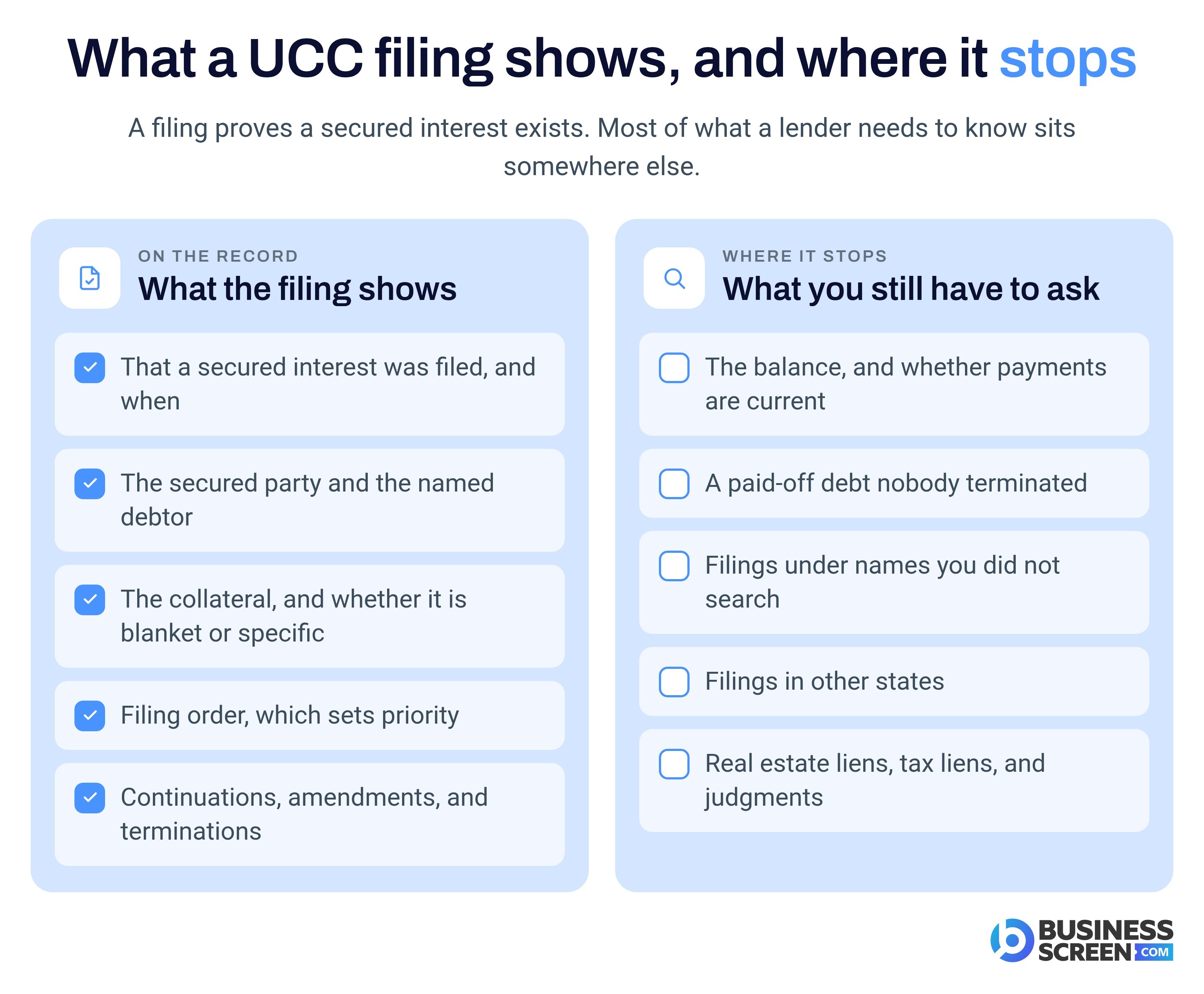
A UCC filing shows that a secured interest was filed. It does not show the outstanding balance, whether payments are current, or whether the borrower can service the debt. It will not show real property liens, federal tax liens that can be recorded well before anyone can find them, or judgments, which we cover in reading liens and judgments in company diligence.
Most UCC questions do not need investigators. For a routine vendor or a small facility, a database search answers the question and you move on. Our recommendation on plenty of files is exactly that.
Going to the source earns its cost when a filing date is close enough to matter, when the borrower runs under several names or states, or when the deal is large enough that you will need to document what you knew and when. We lay out that logic in when to escalate a screen. Teams in commercial lending and specialty finance will find UCC records alongside the other layers in our checklist of what lenders verify before funding, and one asset-based lender's version in practice in how Yieldi screens the borrowers behind its loans.
Most writing on what is a UCC filing addresses the business with one filed against it. If you are on the other side of the table, the useful question is what the pattern tells you.
Three filings from equipment lenders over six years reads as a company that finances equipment. One blanket lien filed three weeks ago by an unfamiliar lender reads differently, particularly if the borrower described the balance sheet as unencumbered. None of these is a verdict. All of them are questions worth asking before the money moves.
If you want the filings on a specific deal verified rather than simply listed, our team can tell you which level of search it actually needs. Connect with us by filling out the form through the Get Started button below.






.png)
