



Before you sign a contract, extend terms, or wire a deposit, the hard part of learning how to vet a company is rarely finding where the records are. It is knowing which ones matter for the decision in front of you, in what order, and how much you should spend getting them.
This is the map. It covers what to check and why each layer moves a decision, then points to the piece that goes deep on each one. It is written for the person carrying commercial risk, a lender sizing up a borrower, an operations lead onboarding a supplier, a firm checking a partner before an agreement goes out.
There is no registry field for it. No agency issues a finding of legitimacy, and no search returns one.
What people usually mean by the question is a mix of five different things: does this entity exist, is it who it claims to be, can it pay, is it in trouble right now, and has it done this before. Each has its own record, its own custodian, and its own blind spot. A company can be properly registered and three months from insolvency. It can be free of lawsuits and also operating without the license its work requires.
That is why "the company checked out" can be technically true and still tell you nothing useful. The better question starts with the deal rather than the company.
Depth should follow exposure. Running a twenty-year lookback on a vendor sending you office supplies is a way to feel careful rather than be careful, and how far you vet a company is worth deciding on purpose before you start.
Three questions set it: how much is at stake in money and in operational dependency, how reversible the arrangement is, and how much you already know about the counterparty. A month-to-month supplier you could replace in a week is a different problem from a multi-year agreement with a termination penalty. Right-sizing diligence works through where the escalation line usually sits.
| Check | Why it matters | Free | Product | Investigator |
|---|---|---|---|---|
| Entity and signer | Confirms the company exists, is in good standing, and that the person signing can bind it | Secretary of State registry | Returned quickly at scale | Live registry pull when status must be defensible |
| Disqualifying checks | Sanctions, licensing and insurance are pass or fail, so a hit ends the question rather than shading it | OFAC search, state licensing boards | Continuous watchlist coverage | Confirms a name match is your subject |
| The people behind it | Where the entity came back clean, a principal still carried a finding in roughly one in five cases | Officer search, state by state | Associated business risk | Multi-jurisdiction trace and prior entities |
| Financial pressure | Most relationships fail on performance, not fraud. Liens and UCC filings show strain earliest | County recorder, state UCC index | Broad coverage, lags the courthouse | Source pull, current to the filing |
| Litigation pattern | A repeat defendant is a cash flow signal. A repeat plaintiff is a behavior signal | PACER, state and county portals | Inherits gaps where courts do not publish | County-level live search |
| Reputation and conduct | Complaint patterns and regulatory actions, read for recurrence rather than for score | BBB narratives, state AG, OSHA | Adverse media screening | Sourced negative media review |
1. Confirm the entity, and confirm your signer can bind it. The Secretary of State registry in the state of formation returns standing, formation date, registered agent and often the officers on file. Read it for whether the entity is active or lapsed, how old it is, and whether the registered agent address matches what you were told. Then do the step most people skip and compare the signature block against the officers on record. Where entity verification stops covers the limits, and business verification as four checks rather than one covers the layers.
2. Run the disqualifying checks early. Sanctions, licensing and insurance are pass or fail, they take minutes, and a hit changes the deal rather than shading it. Do them before the expensive work. Treat a sanctions name match as a screen rather than a verdict, since common names produce hits that are not your subject. What sanctions screening verifies covers where the automated match ends.
3. Screen the people, not just the company. In reports where the business came back completely clean, we still found something worth flagging on a principal in roughly one in five cases. This matters most when the entity is young, because an eighteen-month-old company has no record to speak of and the absence is not reassurance. Why a background check should cover principals too is the full argument.
4. Look for financial pressure before you look for wrongdoing. Most counterparty relationships fail because the other side could not perform, not because anyone set out to defraud you. Liens, judgments and Uniform Commercial Code (UCC) filings show strain earliest. A UCC filing alone is ordinary; it gets interesting when there are several, when they are recent, or when the collateral is the asset being offered to you. Reading liens and judgments and what each lien layer reveals go deeper.
5. Read litigation as pattern, not count. One lawsuit tells you almost nothing. Repeatedly a defendant in collection actions is a cash flow signal. Repeatedly a plaintiff tells you how they handle disagreement, which is worth knowing before you sign with them.
6. Treat reputation as pattern evidence. A rating describes someone's experience as a customer. It does not tell you whether a company pays its subcontractors or has been cited by a regulator. Read complaint narratives for recurrence rather than reading the score, then check the state attorney general (AG) database and, where there is a jobsite, the Occupational Safety and Health Administration (OSHA). Separating signal from noise in adverse media covers the harder version.
This page is about what to pull. Weighing what comes back is its own skill, and the short version is that active matters more than settled, a pattern matters more than a single filing, and unpaid matters more than satisfied.
The longer version, including which findings are genuinely disqualifying and which are the ordinary paper trail any business accumulates, is in due diligence red flags and what each one signals. The companion problem, findings that look worse than they are, is covered in three findings misread in a business background check.
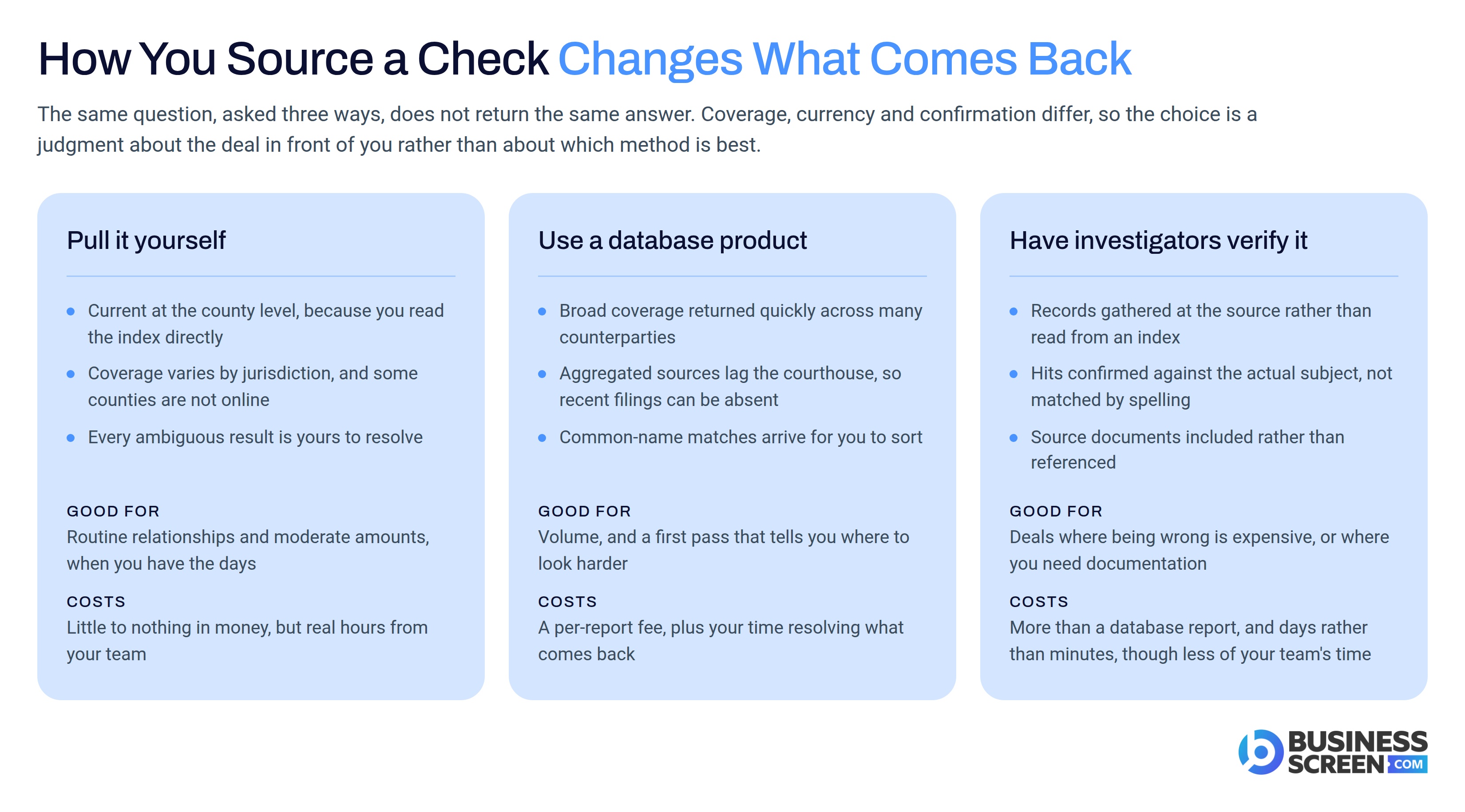
Every check above can be sourced three ways, and they do not return the same thing. Coverage, currency and confirmation all differ between them, so there is no single right way to vet a company, only a right way for a given deal.
Pull it yourself. Free, and current at the county level in a way aggregated sources cannot match. You pay in time, uneven coverage between jurisdictions, and the fact that every ambiguous result is yours to resolve.
Use a database product. Broad coverage returned quickly, which makes it the practical choice for volume and for a first pass. The tradeoffs are structural: aggregated sources lag the courthouse, jurisdictions that do not publish electronically are absent, and common-name noise arrives for you to sort.
Have investigators verify it. Records gathered at the source, hits confirmed against the actual subject, documents included rather than referenced. Slower and more expensive, and worth it when being wrong is costly or when you need to show your reasoning later.
Our tiers follow that shape. A Preliminary Report is an automated screen where an investigator confirms flagged hits belong to the subject before it goes out, so a clean one returns in minutes. Advanced at two business days and Deep Dive at three, with a twenty-year lookback across multiple name variations, are where investigators gather the records directly. For a routine vendor on ordinary terms the first option is often enough, and we would rather say so. Choosing between database screening and investigator-led work covers the step up.
Two failure modes survive a careful search. The first is that it ran on the wrong name, because a company may be registered as one thing, invoice as another and hold property as a third, and an index returns exactly what you typed. The second is that the record exists but has not been indexed yet, a gap that commonly runs sixty days and is the subject of why a tax lien exists before anyone can find it.
Neither is a reason to skip the work. Both are reasons to treat "no records found" as a narrower statement than it feels like, which is the theme of what a clean due diligence check can still miss.
The priorities shift by what you are deciding.
Lending. The file is organized around what sits ahead of your position and whether the guarantor carries history the borrowing entity does not. What lenders should verify on a borrower before funding covers the pre-funding file, and our commercial lending page covers how teams run it at volume.
Vendor and supplier onboarding. The question is usually where a first pass is enough and what triggers escalation. What a vendor background check covers and what it misses sets the scope, alongside our vendor and supply chain page.
If you work through this and something will not resolve, or the deal is large enough that you want findings verified at the source and documented, click the Get Started button below and fill out the form. Our investigators can tell you what level of diligence the situation calls for, including when the answer is that you have already done enough.







.png)
