



A pre-funding file on a borrower comes down to a handful of questions, and there are fewer of them than the tooling suggests. Is this the company they say it is? What is already ahead of us on the collateral? Does the person behind the entity carry history the entity does not? Can we transact with these people at all? The records that answer those questions are well established and have not changed much in years. What varies between lenders, reasonably, is how deep they go on each one and where they draw the line on what comes back.
This is a guide to the file itself rather than to the records in it, since what each layer of a business lien search covers is worth understanding separately. What follows is which record answers which question, how we would read one that comes back with something on it, and how much depth a given deal tends to justify. Where the line sits between a finding you fund over and one you decline on is yours to set, and it should be.
The tax identification match is the cheapest item in the file and the one carrying the most leverage, because every other search inherits its answer. Running the Employer Identification Number (EIN) against the legal entity name confirms you are searching the company the borrower says you are searching. Leave it out and you can collect four clean reports on the wrong company without anything in them looking wrong.
The subject list is the other thing worth settling early. You could screen the borrowing entity alone, and on some deals that is a defensible call. Our recommendation is to screen the entity and the people behind it, for a structural reason: the borrowing limited liability company is often what lenders accurately call a vehicle to hold the deed, formed for this project and clean because there is nothing behind it yet. An entity can be discarded and replaced. A person cannot, which is why the history tends to sit with the principals and why screening them alongside the entity usually earns its cost.
Lenders we work with usually land on two to three subjects per loan, the entity plus each guarantor. Identity and entity verification is inexpensive, and it determines whether everything else is pointed at the right target.
Beyond identity, a pre-funding file is answering four questions. Each has a record group behind it, and none of the four depends on the others.
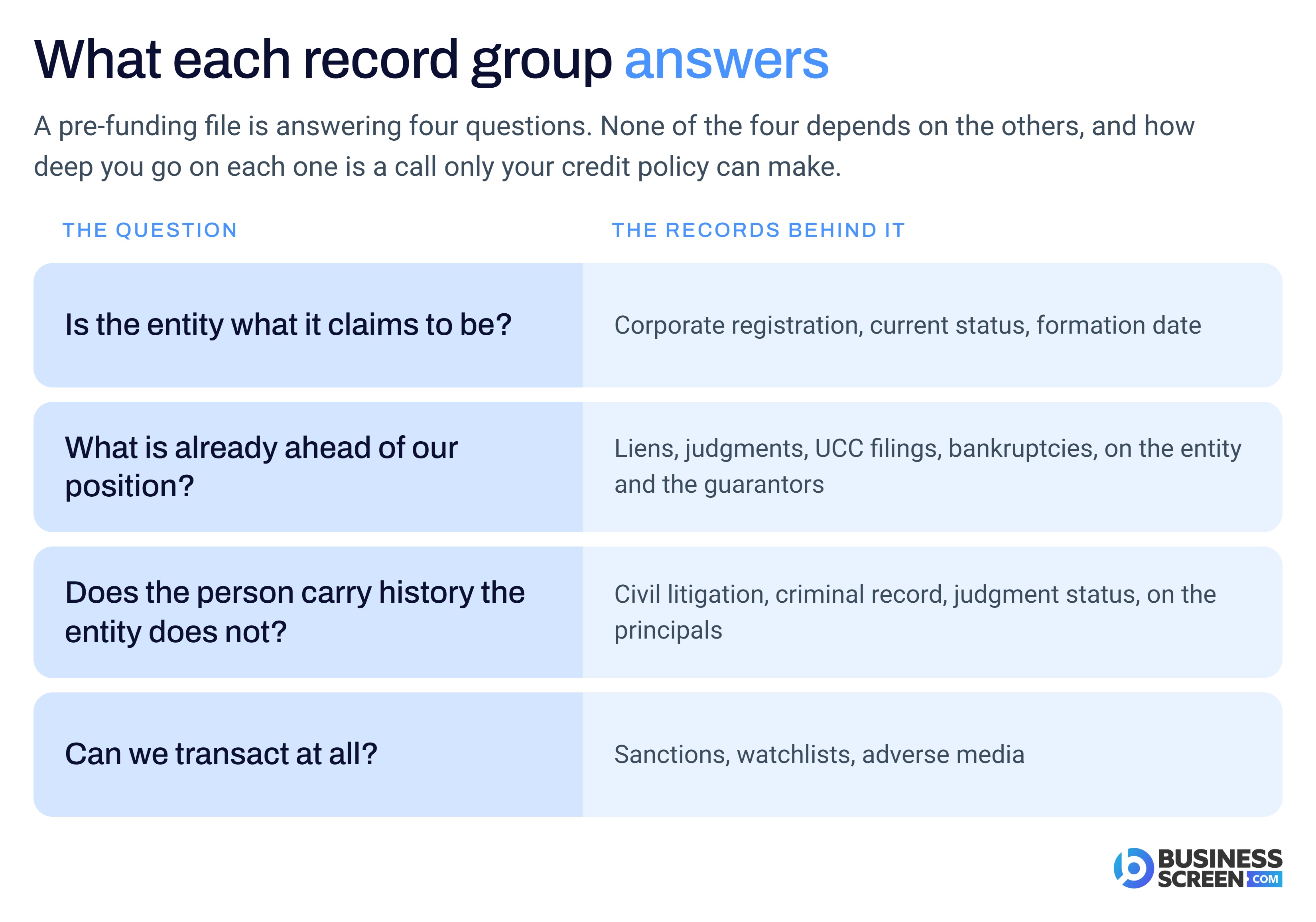
Is the entity what it claims to be? Corporate standing answers this. Registered, active, in good standing in the state it claims, with a formation date that matches the story you were told. A company formed last month is unremarkable on a fix-and-flip. A company formed last month that the borrower described as a ten-year operation is a conversation worth having before funding rather than after.
What is already ahead of our position? Liens, judgments, Uniform Commercial Code (UCC) filings, and bankruptcies, on both the entity and the guarantors. This is the group that most often changes terms rather than ending deals. An open tax lien ahead of you changes what you are actually in first on, and existing UCC filings tell you who else already holds a secured interest in the collateral you are pricing.
Does the person carry history the entity does not? Civil litigation and criminal record on the principals, with the current status of each. Contract disputes, fraud claims, prior judgments. A borrower with three open construction disputes is telling you something about how their projects tend to end, regardless of how this one is priced.
Can we transact at all? Sanctions screening answers a yes-or-no question, and it is fast. Adverse media covers reputational history that never reached a courthouse, which is a layer many database tools aimed at lenders do not include.
The one question this file does not answer is whether the borrower actually did the deals they claim. That is a separate operation with its own methods, covered in the lender's guide to vetting borrower experience.
What counts as disqualifying is a policy question, and it is yours. Some lenders will fund over a satisfied judgment from eight years ago. Others treat any fraud-adjacent filing as an automatic decline no matter how old or how small, and that is a perfectly defensible way to run a book. What the file owes you is an accurate picture of what the record actually says, so your threshold gets applied to facts rather than to a database's formatting. Four things get in the way of that.
Status is not severity. A judgment marked open and a judgment marked satisfied are different facts, and databases are inconsistent about which one they show. A lien the borrower insists was paid but which still shows open is worth resolving before funding rather than after. Ask for the release. If it exists, it is recorded somewhere.
A name-only match is unconfirmed. Common names generate hits that belong to other people. Confirming a record belongs to your subject means matching identifiers, not matching spelling. This is routine enough that lenders keep a not-me affidavit on hand, which is worth recognizing as a borrower's denial rather than as verification.
Misclassification clusters around foreclosure. Buyers of foreclosed property get listed as parties to foreclosure actions with some regularity, which turns an opportunistic purchase into an apparent default in a database summary. Pulling the deed to check whether your borrower was grantee or grantor settles it. Several of the findings lenders most often misread follow this shape.
Recent can mean invisible. A lien filed in the last sixty days may not have reached a commercial database yet, because the record exists well before anyone can find it there. One private lender we work with stepped away from a five hundred thousand dollar loan after our investigators found more than a million dollars in tax liens filed in the previous sixty days, too recent to appear in the screening that lender normally relied on. A clean database result on a deal closing this week is the result most worth a direct county pull.
Short windows are the normal case in bridge and fix-and-flip lending rather than the exception. A deal that funds in seventy-two hours does not change which questions matter. It changes how much of the answer you can hold before you decide, which makes it a question about what you are willing to decide without.
Some of the file comes back fast enough that the constraint never binds. Our Preliminary Report runs the record sweep and returns in minutes when it is clean. When it flags something, an investigator confirms the hit belongs to your subject before it reaches you, which generally takes one to two business days and spares your team the afternoon of screenshots and deed pulls that a raw database hit usually costs.
The depth work is where the window actually bites. Investigator-worked reports come back in two to three business days, so on a short fuse the binding constraint is not turnaround, it is how early you decide you want one. Making that call at intake rather than after the screen comes back is what buys you the option at all, and the subject worth it is usually the guarantor carrying the most exposure.
What tends to land after close: monitoring enrollment, added depth on the guarantors carrying the least exposure, and international records where nothing in the file suggests a foreign nexus. Deferred is not the same as skipped, and the difference is whether the deferred item has a date on it. For a bridge or construction note that will sit on the book for months, the re-check schedule often matters more than the depth of the original pull, because new liens and suits do not wait for maturity.
Many loans do not need investigator-verified work on every subject. A repeat borrower on their ninth deal with you, at a size you have done before, is usually well served by an automated screen and nothing more. We would tell you to run exactly that.
In our experience depth tracks exposure and unfamiliarity better than it tracks a blanket policy. First-time borrowers, deals where claimed experience is doing real work in your pricing, assigned contracts, borrowers who insist on a particular title company, and anything materially larger than your usual ticket are where investigator hours tend to earn their cost. The choice between a database screen and investigator-verified diligence is a per-deal decision, and the triggers for escalating mid-file are worth writing down before you are in one.
One note on the legal frame, since it comes up in nearly every lender conversation. Business due diligence on a borrower sits outside the Fair Credit Reporting Act, which is why no borrower consent is required and why the lookback runs ten to twenty years instead of seven. Worth confirming what your current tool's agreement permits, too: permissible purpose under the Gramm-Leach-Bliley Act is often written as fraud prevention rather than credit decisioning, and that distinction tends to surface at audit rather than at signup.
A defensible pre-funding file is not the one with the most pages. It is the one that can answer four questions months later, when a loan buyer or an investor asks: what was searched, how far back, what was found, and where are the source documents.
That last one is where files most often fall short. A screenshot of a database summary is not a court record. When a finding surfaces after closing, the distance between a documented process and a quick lookup is the distance between an exception you can explain and a problem you cannot. Lenders working under investor or loan-buyer mandates tend to know this already, since those mandates are usually written about documentation rather than thoroughness. For teams building this in at volume, the diligence file across a lending book is worth designing once rather than per deal.
Put together, that is what we would want to see in a file: the subject list settled and confirmed, each of the four questions answered by a record rather than by an assurance, every hit classified as active or resolved with a document behind it, and a re-check date on the calendar for the life of the note. What each of those findings is worth remains a question only your credit policy can answer.
If you want help deciding which depth fits which deal in your book, hit Get Started below and fill out the form. Our team can walk through what fits your loan sizes and borrower mix.






.png)
