



A business lien search can come back clean on a counterparty that is not. Not because the search failed, but because "clean" is five separate answers from five separate record systems, and each one goes quiet for its own reasons. A county recorder that has not posted this month's filings looks exactly like a county with nothing to report. Nothing in the result distinguishes them.
So the useful question about one of these searches is not what it found. It is what the silence is worth. Below are the five layers that make up the financial record on a business, what each one confirms, and where each one goes dark. Depth on any single layer lives in the articles linked from here. This page is about how to read the set.
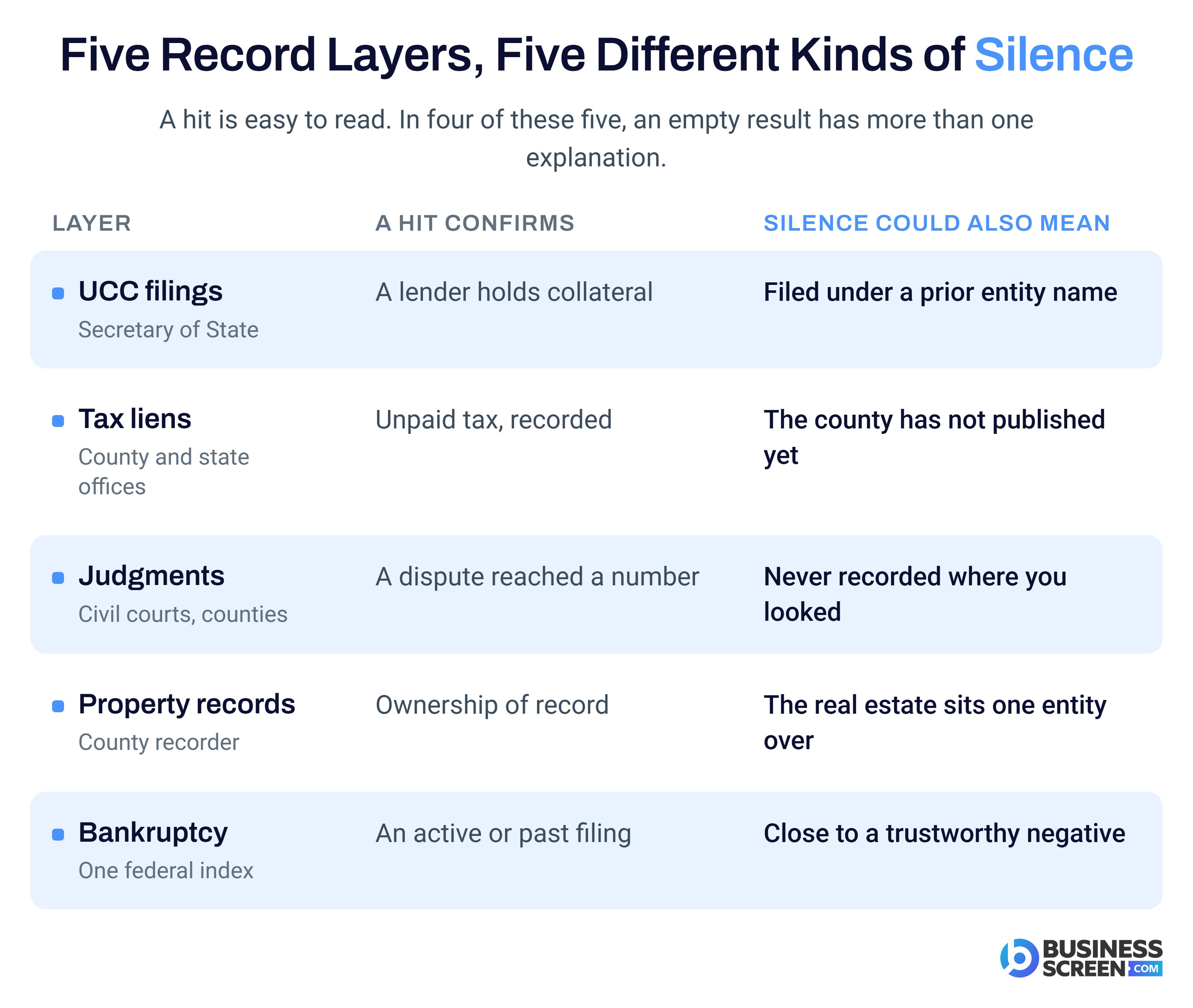
There is no single office to ask. The financial record on a company is assembled from five systems that answer to different authorities and update on different clocks.
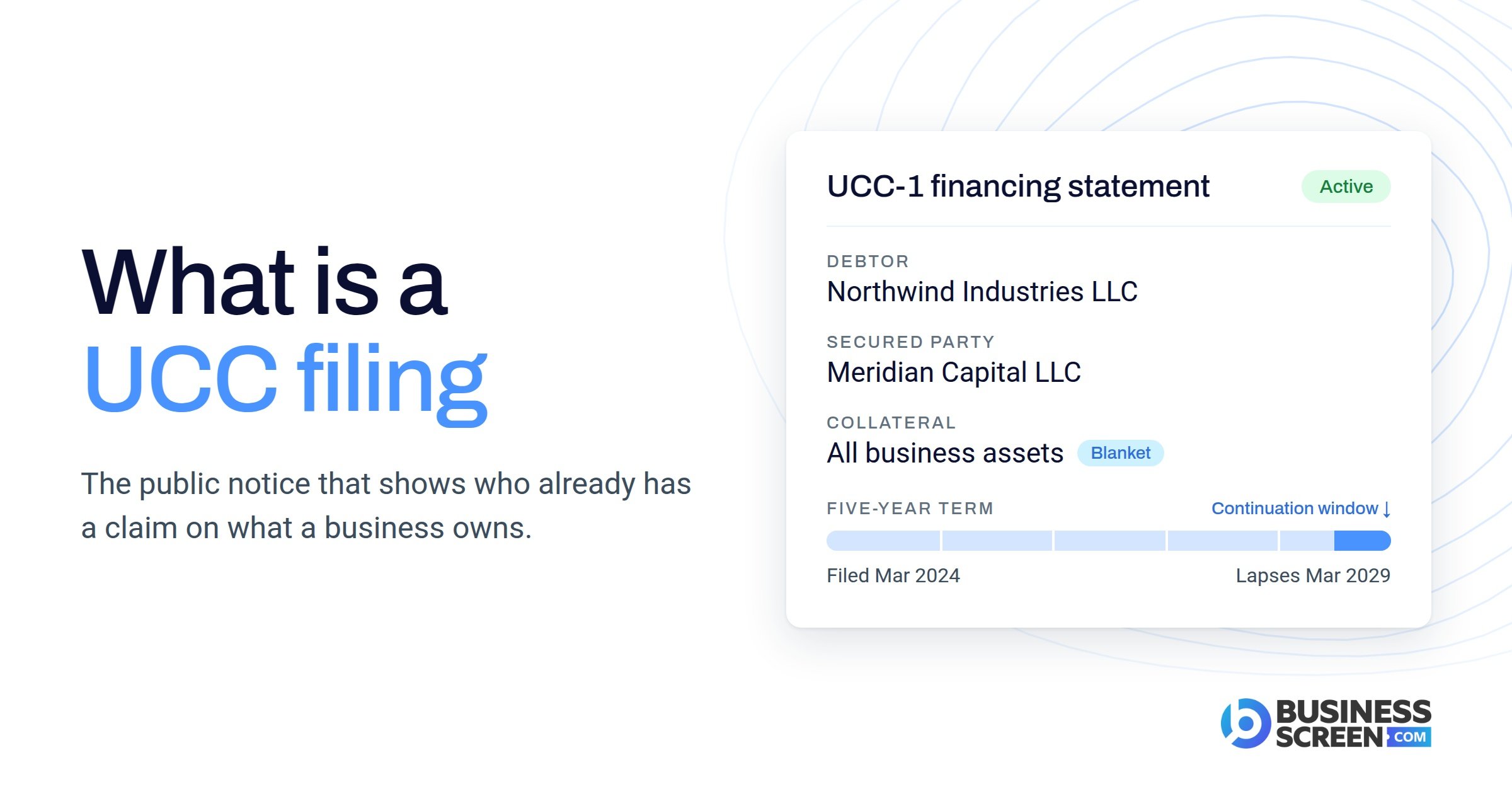
UCC filings. Article 9 of the Uniform Commercial Code (UCC) lets a lender taking collateral file public notice of its claim, usually with the Secretary of State. It shows who holds claims against the assets and when those claims started. It carries no balance, and it is indexed against the debtor's exact legal name.
Tax liens. When the IRS assesses tax that goes unpaid, it can file a Notice of Federal Tax Lien with a county recorder or a state office. State revenue departments file on their own patterns. A federal tax lien search is therefore a search of recording offices rather than of the IRS, because there is no public national registry to query.
Judgments. A court's ruling that one party owes another money. It confirms a dispute reached a number. It does not confirm collection, and it attaches to real property only once a creditor records it in the county where that property sits.
Property records. County recorders and assessors hold deeds, mortgages, and recorded encumbrances. They establish ownership of record and transfer history. Recorded mortgage amounts are original amounts, so current equity has to be inferred.
Bankruptcy. Federal, indexed nationally, searchable in one place. The one layer here where the record system genuinely cooperates.
A hit is easy to read. Silence is the hard part, because in four of these five systems an empty result has more than one explanation.
An empty UCC result can mean no secured debt. It can also mean the filings sit under a prior entity name, because a company that reorganized two years ago carries a spotless record under the new name while the obligations stay with the old one. Settle what a KYB check confirms and where it stops and run identity and entity verification before you order anything, because every search on this page is name-dependent and a wrong name returns a confidently empty answer.
An empty tax lien result can mean no liens, or a county that has not published recently, or the right lien sitting in a county nobody searched.
An empty judgment result can mean no judgments, or a judgment that exists and was never recorded as a lien where you looked. A civil records check is what surfaces those, and reading liens and judgments on a company covers how to weigh them once you have them.
An empty property result can mean no real estate, or real estate parked one entity over under a name nobody gave you, which is where beneficial ownership work earns its place.
Bankruptcy is the exception, and it is instructive. Because there is one federal index, an empty bankruptcy result is close to a trustworthy negative. That is what a real negative looks like, and it is worth noticing that only one of these five layers can hand you one. Worth separating too: a principal's personal filing and the company's are different events, and only one of them surfaces when you screen the entity alone. That is the case for covering principals as well as the business.
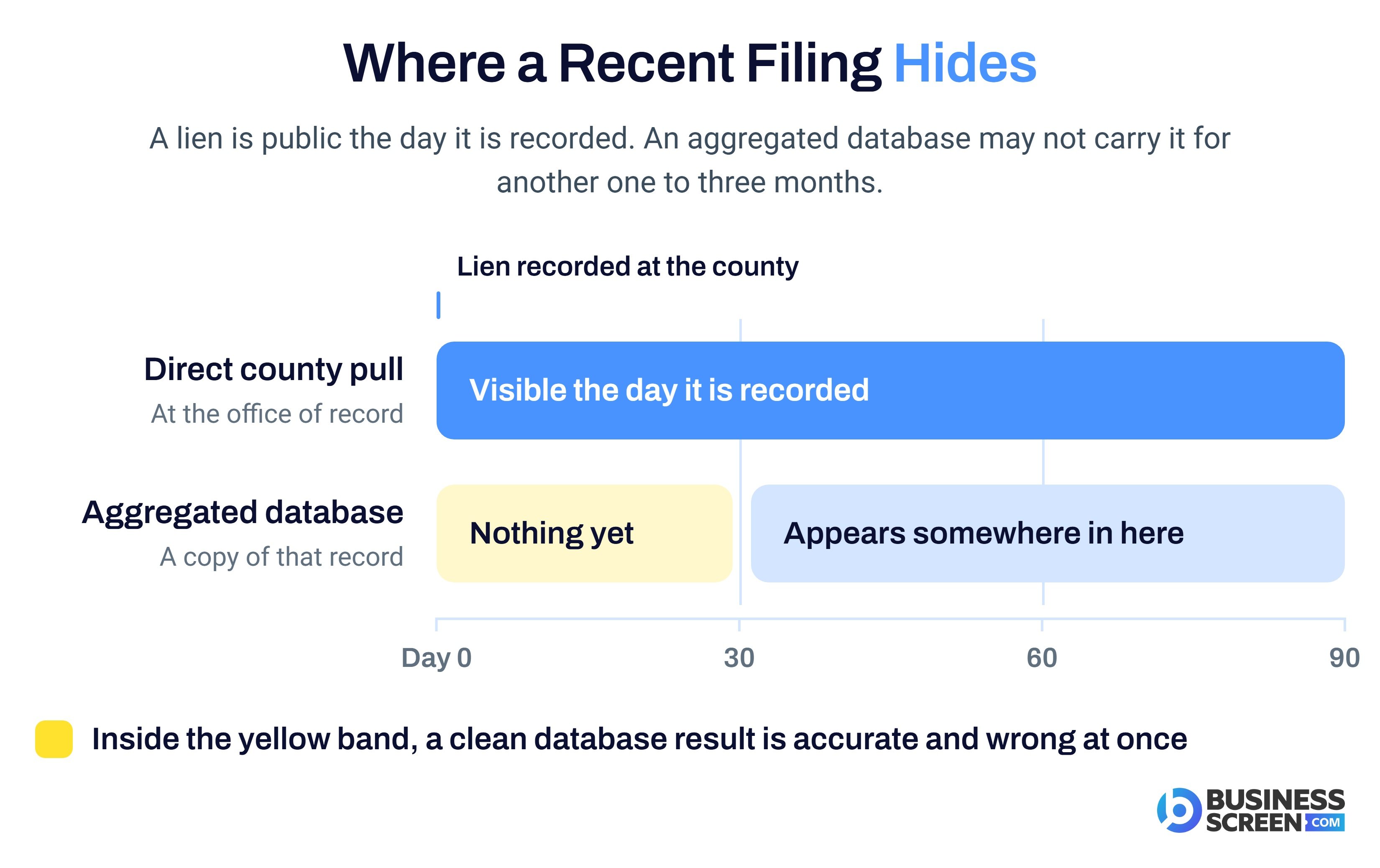
Every one of these layers exists in two forms, an aggregated database copy and a live search at the office of record. The difference is not effort. It is currency and coverage.
A database is a copy. Someone gathered records from thousands of offices, normalized them, and indexed them, and that copy is exactly as current as its last feed from each source. Feeds vary. Some offices publish daily, some monthly, some still run on paper. So a database sweep returns real records quickly and broadly, with two known soft spots: filings too recent to have arrived, and offices that never fed the aggregator at all.
A live search goes to the source. An investigator queries the Secretary of State directly or pulls a county recorder's index, and in the uncommon case where a record exists only on paper, we pay someone local to go pull it in person.
If you have not worked with us, here is how that maps to what you would actually order. A Preliminary Report is our automated sweep. It comes back in minutes when it is clean, and when it flags something, an investigator confirms the hit belongs to your subject before it reaches you. That is identity review, not source verification, and the distinction matters for exactly the reasons above. Advanced and Deep Dive are our investigator tiers, two and three business days, where a person gathers the records at the source instead of reading a copy of them. Advanced looks back ten years in the jurisdictions that matter. Deep Dive goes back twenty, across name variations and multiple jurisdictions.
The cost of that gap is not theoretical, and it lands hardest in commercial lending and specialty finance. A private lender came to us on a five hundred thousand dollar loan against a borrower who had screened clean in their usual process. Our investigators found more than a million dollars in tax liens filed in the previous sixty days, too recent for a database to have captured. The lender stepped away.
We compare the two approaches properly in database screening versus investigative due diligence.
Run these separately and you get five results. Read them together and you sometimes get a story none of them tells alone.
A blanket UCC filing from a high-cost lender is a fact. A state tax lien from four months ago is a fact. Two small supplier judgments in the same window are facts. Individually each is the sort of thing a working business accumulates. In that sequence, they describe a company that ran short of cash, borrowed expensively against everything it owns, fell behind with a state revenue department, and started stretching its suppliers.
No single layer flags that. The order does. Pattern reading is most of what separates diligence from a lookup when fraud risk is what you are actually managing, and it is why plenty of counterparties who look clean are not, as a clean result set can still miss things when nobody reads across the layers.
One thing the set cannot do is stay current. All of it is a photograph. Liens, judgments, and filings appear after you screen, which is the argument for ongoing monitoring rather than a single point-in-time check on counterparties you stay exposed to.
Our read is to start where the decision justifies and escalate on cause.
The Preliminary Report sweep described above covers UCC filings, liens, judgments, bankruptcy, and property, the searches grouped on our financial risk assessment page. It is fast and broad, and for routine, low-exposure work like vendor and supply chain onboarding it is usually enough. Saying otherwise would be selling you something you do not need. Escalate to live state and county searches when the exposure is large, when the deal closes this month and timing matters, when the entity has a messy name history, or when the sweep surfaces something that needs confirming rather than repeating. Clients pay only the credit difference on an upgrade, deliberately, because a model that penalizes starting light quietly pushes everyone to overbuy. The triggers are laid out in right-sizing diligence and when to escalate a screen.
Two questions worth putting to any provider before you buy. Ask which of its searches are database lookups and which are live pulls at the office of record, because if everything is described in the same language, it is all one thing. Then ask what they would tell you to skip. It is easy to sell the deepest tier on every file and harder to say when the lighter one covers it.
Going a level deeper on any single layer: the timing problem in tax liens, why UCC filing data lags in asset-based lending, when a property lien search is worth running on a borrower, and what lenders verify before funding.

If you are working out which of these layers a given deal actually calls for, that is worth a conversation before you order. Hit Get Started below and fill out the form. Our investigators will look at what you are screening and come back with where each level fits, at no additional cost.






.png)
