



A payments platform onboards a new merchant that clears KYB verification on the first pass. The entity is registered, active, in good standing, and the legal name on the application matches the state record exactly. Nine months later the account is closed over a pattern of activity tied to an owner the registration filing never named. The check confirmed the business was real. It confirmed almost nothing about who was running it, or what they had done before.
Confirming a company exists and is properly registered answers a specific, useful question. It does not answer the one most decisions turn on, which is whether the business, and the people behind it, are safe to work with. This piece covers what KYB verification confirms at its base layer, what a registration-record check leaves open, and how to think about how far past registration a given deal needs to go.
KYB stands for Know Your Business. At its base layer it confirms a company is registered and captures the basic facts on record, including the legal name, formation jurisdiction and date, current status and good standing, the registered agent, the principal address, and identifiers like the Employer Identification Number (EIN). This is business identity verification, and it is what most providers mean when they sell a business verification service or return a pass or fail on an entity through a KYB API. Our own version of it lives in identity and entity verification, which confirms the entity exists and is who it claims to be against corporate records.
Done well, that base layer catches real problems. It flags applications where no registered entity exists behind the name, mismatches between the legal name and the trading name, entities that have been dissolved or fallen out of good standing, and businesses operating in a state where they were never registered. For a large share of routine onboarding, that is a meaningful filter, and it clears quickly.
A registration record confirms that an entity is real. It does not establish that the entity is legitimate, solvent, or safe to work with. Registration is an administrative fact, not a risk assessment, and the two get conflated more often than they should.
A company can be perfectly registered and in good standing while it carries tax liens filed last quarter, sits inside active litigation, has an owner on a sanctions list, or is run by a principal with a track record of failed prior ventures. None of that lives in the incorporation record. A filing confirms the paperwork is in order, not that the business behind it is sound.
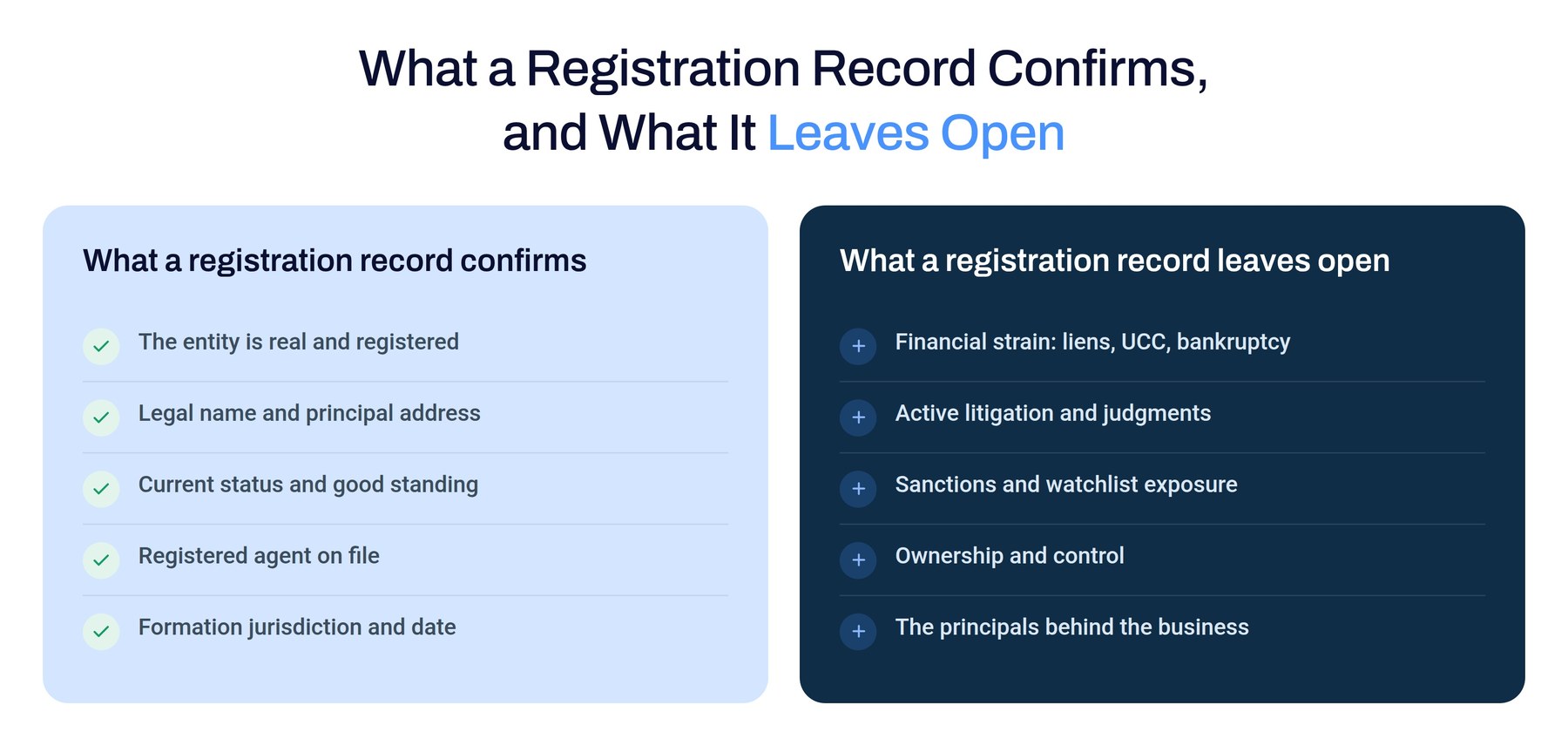
This is not an argument that a registration-record check is worthless. For plenty of low-stakes relationships it is exactly the right depth. The point is narrower. A clean registration record answers the first question, and only the first question.
A complete KYB verification is layered, and each layer answers a different question the base check leaves open.
Financial standing comes first for most commercial relationships. Liens, judgments, Uniform Commercial Code (UCC) filings, and bankruptcies show whether a business is under strain that its registration record would never reveal, and reading them in context is its own skill, which we cover in how liens and judgments actually read on a company.
Litigation and civil history sit alongside it. A civil records search surfaces lawsuits and money judgments involving the entity, which often say more about how a business operates than any filing it submits voluntarily.
Sanctions, watchlist, and politically exposed person (PEP) exposure is a separate layer again. Sanctions screening checks whether the entity or its owners appear on restricted or denied-party lists, which is a compliance requirement in some contexts and a straightforward risk question in all of them.
Adverse media catches what the records have not caught up to yet. Negative coverage can surface a problem months before it lands in a court or registry, though a fair amount of it is noise, which is why separating real adverse media signals from background noise matters as much as running the search at all.
Then there are the people. A registration record names an entity, not the humans steering it, and the operators usually carry a longer and more revealing history than the company does. A business incorporated three years ago has three years of corporate record. The principal running it may have a twenty-year track record worth understanding. That is the case for screening the principals and operators, and it is the reason a complete business background check should cover the principals too, reaching into criminal history on the individuals where the exposure justifies it. For counterparties with operations abroad, international due diligence extends these same layers across borders.

Registration records name a registered agent and, in some states, officers or managers. They rarely reveal the ultimate beneficial owner (UBO), meaning the person who actually controls or profits from the entity. Ownership can sit behind holding companies, nominee arrangements, or layered structures that a single state filing will not unwind.
This matters when knowing who is really behind a counterparty changes the decision, for instance where sanctions exposure runs through an owner rather than the entity, or where related-party concentration is a concern. Beneficial ownership verification, and the reporting expectations that come with frameworks like the Corporate Transparency Act, is a distinct step from confirming registration. A KYB check that stops at the corporate filing has not answered the ownership question.
How much of that stack a relationship needs is a judgment call about exposure, not a fixed procedure. A small account, a low trade line, or high-volume onboarding where no single counterparty carries much weight may be well served by the registration and identity check on its own. The deeper layers (financial, litigation, sanctions, and the people behind the business) earn their place when the cost of being wrong is high. That is the case on a large credit facility, an acquisition, or a supplier the operation cannot afford to have fail.
The useful question is not how thorough you can be. It is what happens if something you did not check turns out to matter, and how likely that is. Where the answer is not much and not likely, a registration check is a reasonable place to stop, and knowing when to escalate past it is as much a part of good diligence as running the deeper searches in the first place.
A KYB verification is a starting point, not a verdict. Confirming a business is registered clears the first question, and for plenty of routine relationships it clears the only one that matters. For the deals where more is riding on the answer, the next move is deciding which layers above registration the exposure justifies, then verifying those, rather than assuming a clean registration record speaks for the rest.
If you want help scoping how far up the KYB stack a given relationship needs to go, our investigators can work through it with you and map it to the depth the deal warrants. Fill out the form below and we will take it from there.







.png)
