



Run an adverse media screening on a common name and the volume of results can be misleading. One search might return a fraud indictment, a partnership lawsuit, and a local story about unpaid contractors within seconds, and much of it has nothing to do with your subject. The more common the name, the more of those hits belong to someone else, and the finding that actually bears on the deal, if there is one, sits buried in the pile. Adverse media is among the noisiest layers in due diligence, and much of its value is separating signal from noise.
Adverse media screening looks for negative information about a subject in public sources outside the structured record systems, things like news coverage, regulatory and enforcement actions, litigation that made the press, and reputational signals that never appear in a court index or a corporate filing. On a business, it covers the entity. On a principal, it covers the person.
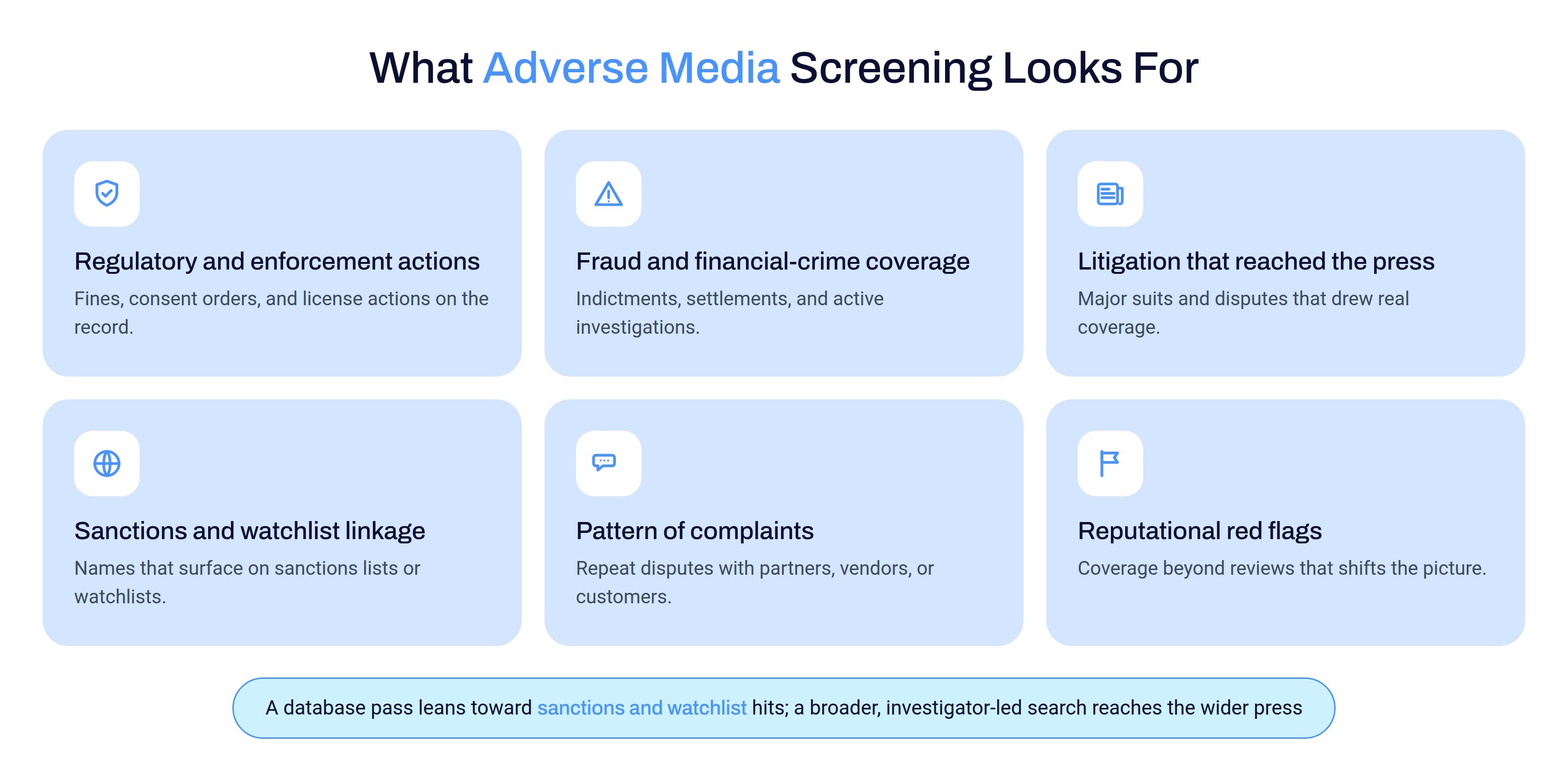
How much an adverse media check catches depends on how deep the research goes. The fast approach is an automated adverse media search that scans large databases of news and risk data in seconds. It casts a wide net, but in practice it surfaces coverage already tied to sanctions and watchlists more than general negative news, which makes it a strong first pass and a close cousin of sanctions and watchlist screening, not a full sweep of the open press. The deeper approach puts an investigator on the search directly, reaching local outlets, trade press, and coverage that never lands in the major aggregators.
The root issue is identity. Adverse media is keyed to names, and names are not unique. Search a principal named John Smith and you may get coverage of several different people, only one of whom, if any, is your subject. Business names collide the same way. A negative story about one "Summit Capital" tells you nothing about an unrelated "Summit Capital" you happen to be underwriting.
Identity is not the only source. A hit can be real and still beside the point. The coverage might be a case where your subject was the plaintiff or the victim, an allegation that was later dropped, or a story old enough that it no longer bears on the decision. Sentiment muddies it further. A run of angry reviews is not a regulatory action, even though both read as negative. And database tools match loosely so they don't miss anything, which means they return more, not less. The result looks alarming and is mostly beside the point.
The hard part is not generating the list, it is making sense of it. An adverse media screening tool can return candidates in seconds. Turning those candidates into findings takes judgment about three things. Is the hit actually the right subject? Is it material to the decision? And is it still current?

Identity is resolved with the identifiers a name alone cannot supply, like full legal name and known variations, date of birth, and location history, plus the details that tie a story to your subject rather than a namesake. Relevance is a read on whether the coverage would change what you do next. Status is what became of it, whether an indictment ended in acquittal, a suit settled, or a fine was paid and closed.
This is where we differ from a raw database tool, and it starts with our entry-level Preliminary Report. Clean searches come back in minutes, but an adverse hit is never released to you unreviewed. It is held while one of our investigators confirms whether it belongs to your subject and clears the false matches, so what reaches you is a short list of real findings rather than a page of maybes. That is the difference between a decision-ready report and a raw export, and it is built into every report we run, starting with the Preliminary Report. What changes as you move up to Advanced and Deep Dive is the reach of the search, where an investigator works the broader press directly across more names and more jurisdictions.
A clean result is useful, but easy to over-read. Coverage only exists where something was reported and a source indexed it. Plenty of real problems never reach the press, stay in local outlets a national tool won't see, or sit in a language or region outside the search's reach. Nothing coming back is a reasonable input, not a verdict. It tells you the open press is quiet, not that the subject is clean.

The reverse holds too. A hit is a lead, not a conclusion. The point of the layer is not to flag every mention of a name but to find the few that change the picture, then confirm them. Adverse media is strongest when it is paired with the structured layers it cannot replace, like a civil litigation search for cases that never drew coverage, a criminal records check at the county level, and sanctions screening on the entity and its principals.
Not every deal needs the deepest screen. Our Preliminary Report already includes an adverse media search, with the same investigator review on any hit it surfaces, so for routine, lower-risk onboarding that is usually enough. The deeper, investigator-led sweep into local and trade press earns its cost on the deals where a single finding could change the decision, like a private credit or specialty finance deal riding on a personal guarantee, or a marketplace operator whose record touches every customer who deals with them. The same question runs through a complete business background check. Would a finding change what you do next? Match the depth to that answer.
The skill in adverse media isn't pulling the list, it's reading it: separating the two results that bear on a decision from the forty-eight that don't, and knowing why each one falls where it does. That sorting is most of the value, and it gets harder exactly when the stakes are highest and the name is most common. Pulling alerts is table stakes. Knowing which ones matter, and why, is what you are actually paying for, and what we deliver.






.png)
