



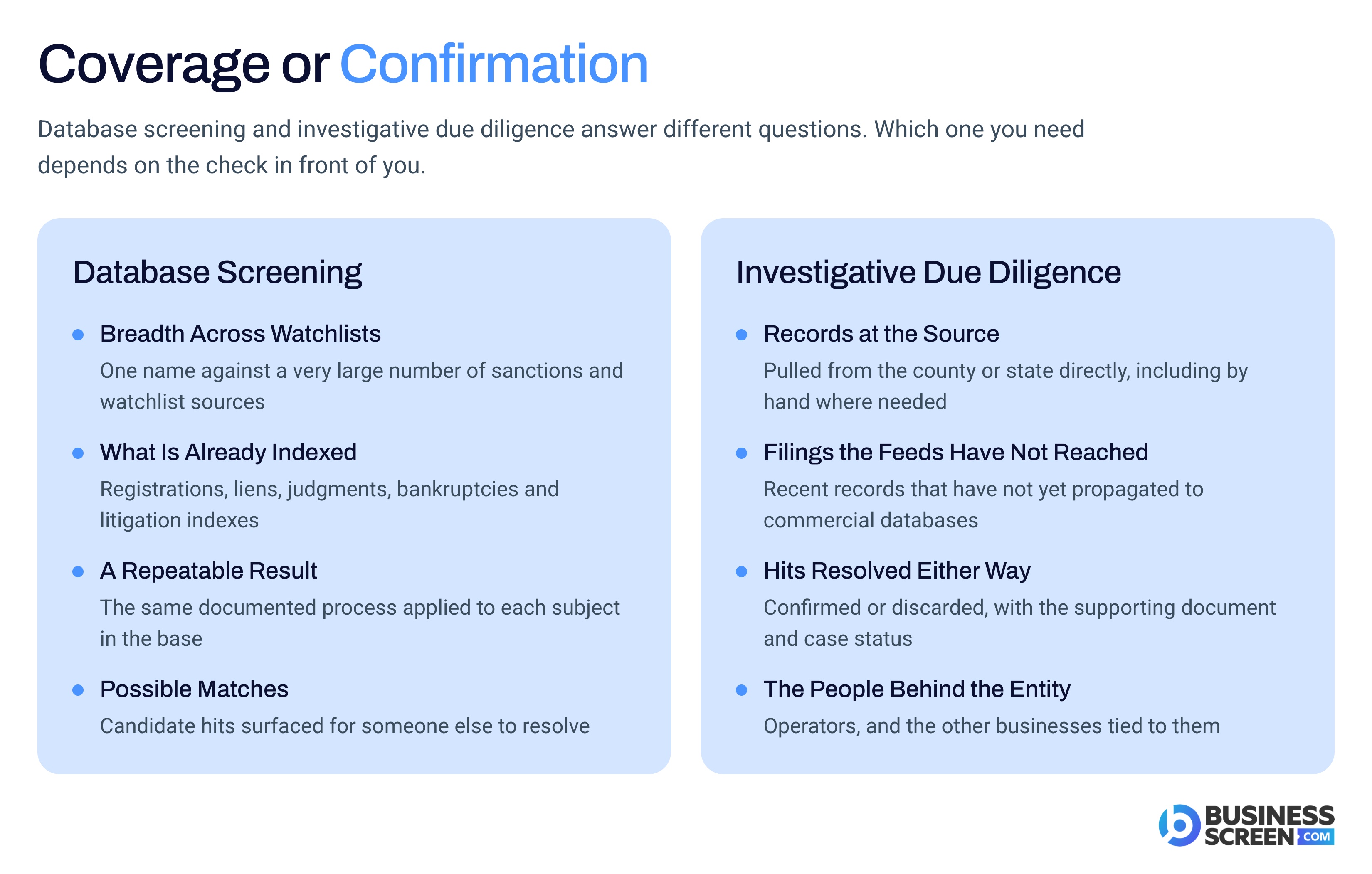
Googling a background check on a business can return two very different products. One is database screening: you enter a name, and a platform returns matches out of aggregated public records in seconds. The other is investigative due diligence: someone goes to the county or the state, pulls the records, confirms which ones actually belong to your subject, and writes up what they found.
Both are legitimate, and the gap between them is not quality. It is what each one is built to answer. Database screening covers a lot of ground quickly. Investigative work settles a question. Most teams need both at different moments, and the decision worth getting right is which one a particular check calls for.
Most of the market runs on this model, and it works. LexisNexis, Dun & Bradstreet, and CLEAR each maintain very large aggregated databases: corporate registrations, liens and judgments, litigation indexes, bankruptcies, sanctions and watchlist data, collected from public sources and refreshed on a schedule. Their products search that data and return what matches the name you entered. It takes seconds, it costs a fraction of investigative work, and it scales to thousands of subjects without anyone touching a keyboard. For a routine supplier, a small credit line, or a low-value contract, that is a perfectly reasonable way to screen.
At BusinessScreen.com our Preliminary Report works from the same kind of aggregated data, and some of the same upstream sources. Where it goes a step further is what happens to a match. A database search hands back possible matches, and someone on your side still has to work out whether the lien or the lawsuit belongs to your subject or to a business with a similar name in another state. On the Preliminary Report, an investigator reviews the adverse hits before the report reaches you and confirms whether they are actually your subject. Clean results come back in minutes, and flagged hits are reviewed within 2 business days.

Two things this layer does well that get undersold. It produces a consistent, documented, repeatable result across each subject, which matters when someone later asks what your process was. And breadth is where automation genuinely beats people: checking one name against a very large number of watchlist sources is a machine problem, not a human one.
If you want the mechanics of what that screen covers, we walk through it in how to run a background check on a business.
Aggregated databases are only as current as the feeds behind them, and the feeds lag in ways that are structural rather than occasional.
A lien recorded last month may not be indexed yet. Some counties do not report electronically at all, so their records reach commercial databases late or through a secondary path. Filings made under a name variation, an assumed name, or a slightly different legal entity may not connect to the name you searched.
The clearest example we have: a private lender ran their usual screening on a borrower and got a clean result. Our investigators found more than $1 million in tax liens filed in the preceding 60 days, too recent for any database to have captured. That was a $500,000 loan that did not get made.
None of this makes database screening unreliable. It makes it a screen. Screens are built to sort, not to conclude. The question is what you do with the ones a screen cannot settle.
Investigative due diligence changes where the record comes from, not just how much effort goes into looking. Rather than relying solely on aggregated feeds, our investigators go to the county or state directly, and for some records that means someone physically retrieving a file at a courthouse.
That produces three things a feed generally cannot.
Currency. Records pulled at the source reflect what has actually been filed, including filings too recent to have propagated anywhere else.
Resolution. A hit becomes a confirmed finding or a discarded false positive, with the supporting document attached. Case status is labeled, so an active matter is not sitting in your file looking identical to one dismissed years ago.
Connection. People move between entities. Investigative work reaches the operators behind a company, and from there the other businesses those operators are tied to. That is the search that answers questions a company-level lookup structurally cannot, which is the argument in why a business background check should cover principals too.
Depth is also where the record set widens: civil litigation history pulled at the county level, financial distress indicators, and reputation and media review.
We can put numbers to this from our own platform. Across closed cases, the Preliminary Report carried at least one alert on roughly 38% of subjects. Advanced and Deep Dive came back with one on about 66%. Going deeper close to doubles how often something gets surfaced, which is the straightforward case for it.
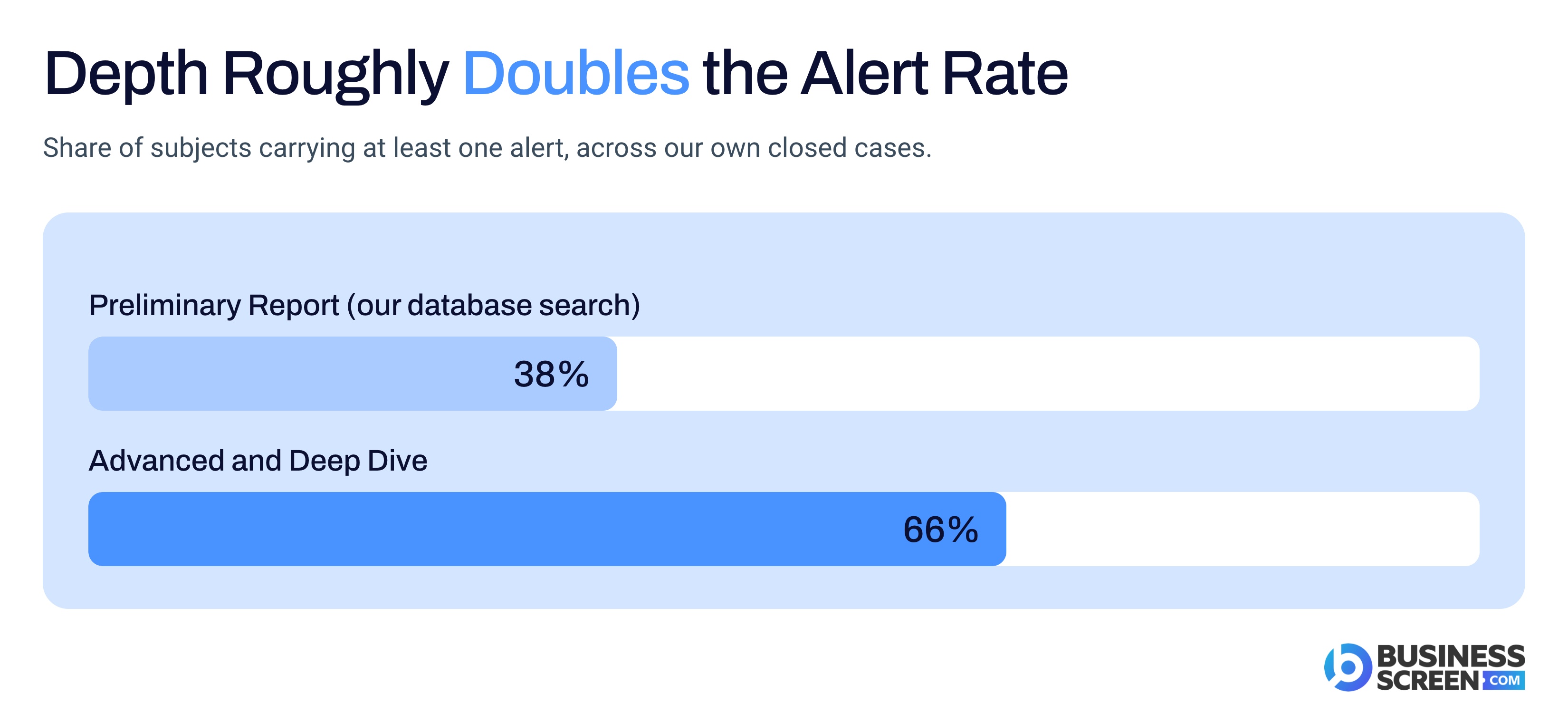
Read that second number carefully, though, because "alert" is doing a lot of work in it. More alerts is not the same as more wrongdoing. The large majority of what gets surfaced is ordinary business friction: a lien, a contract dispute, a filing that does not line up with the name on the paperwork.
We report all of it either way. We do not grade a business as approved or declined, and we do not decide which findings should be disqualifying, because that judgment is yours and it moves with your industry, your deal size, and your own tolerance. A pair of small civil suits is unremarkable on a general contractor and worth a conversation on a borrower. A tax lien resolved two years ago reads differently than one filed last quarter. Our job is to make sure what lands in front of you is accurate and actually about your subject. Deciding whether it changes your answer is your call, and it should be.
That is also why a count is a poor substitute for reading the report. A team that treats every alert as disqualifying will turn away good businesses. A team that ignores the number entirely will miss the few that matter.
The first tradeoff is time. Investigative work takes longer than a database search by definition, because a person has to locate the record and go get it. How much longer varies by provider and by how much of the work happens at the source. Ours come back in 2 to 3 business days rather than minutes. Most timelines absorb that without trouble. Some do not, and it is better to know which kind you are working with before the answer is urgent.
The second is cost. Investigator time is the expensive input, so a sourced report costs more per subject than a database search wherever you buy it. Court and record-retrieval fees are usually billed on top; we pass ours through at cost and itemize them by case, so what a given subject runs depends partly on which jurisdictions it touches.
The third is that going deeper narrows uncertainty without removing it. A verified report tells you what the record shows and what it does not, and there are subjects where the honest finding is that the record is thin. Depth buys confidence in the answer, not a guarantee about the business.
Whether it is worth running broadly depends entirely on the use case, and this is where blanket advice falls apart. A marketplace onboarding several thousand small sellers a month is in a different position than a lender writing eight-figure loans, or a fund running pre-investment diligence on a handful of targets a year. At high volume, investigative depth across the whole base usually costs more than it returns, and the screen plus clear escalation rules is the better program. On a small number of high-consequence relationships, running depth on all of them is the correct answer, and the screen alone would be the false economy. The question is not which approach is better. It is which one matches the shape of your book.
The escalation decision tends to turn on exposure and verifiability rather than on gut feeling. These are the conditions where investigative work generally earns its cost:
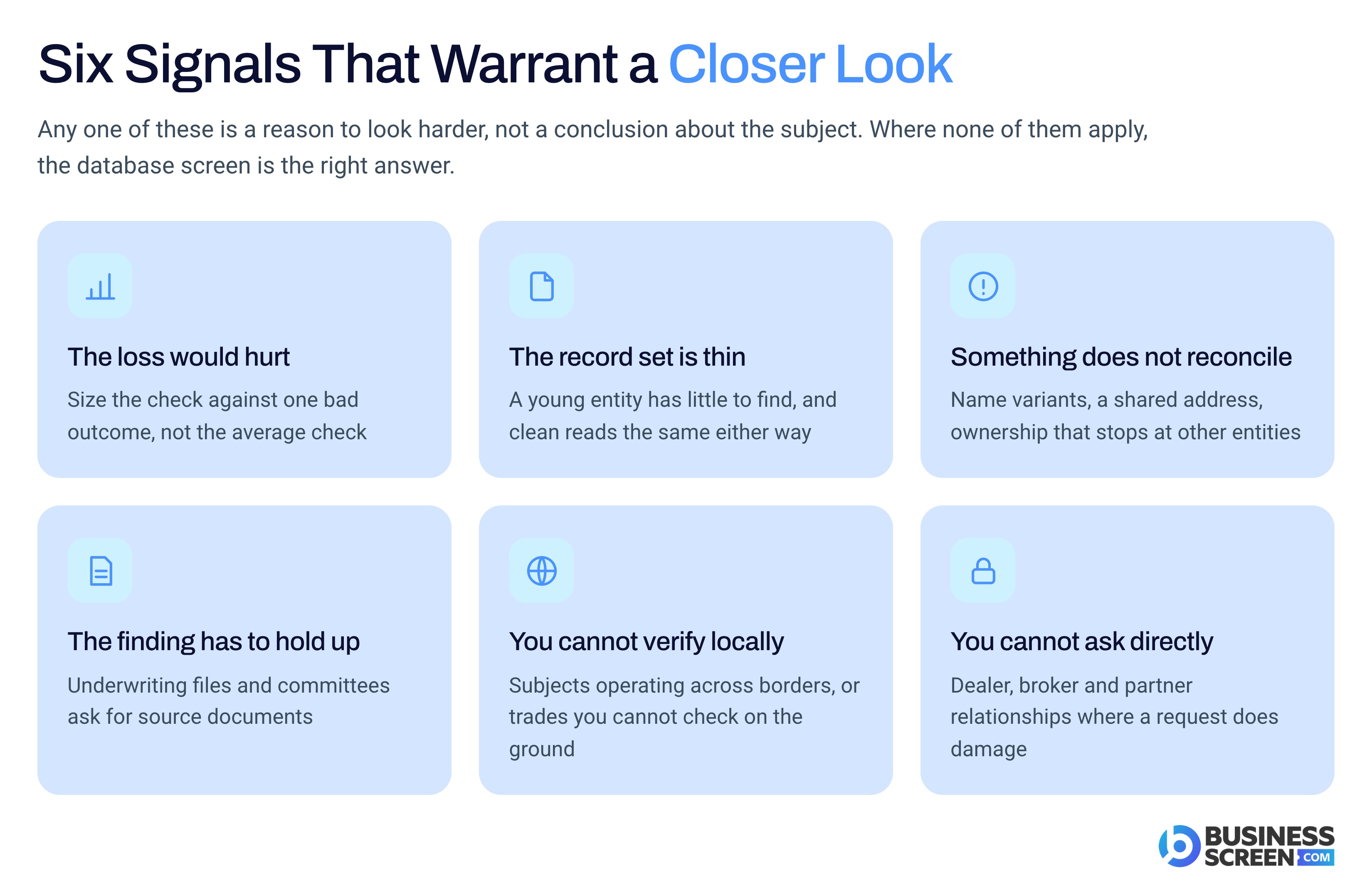
Where none of that applies, the database screen is the right call, and stopping there is a decision rather than a shortcut. We go further into drawing that line in right-sizing diligence and when to escalate a screen.
Framed as an either/or, this is the wrong question. The teams who get the most out of both treat the screen as the intake layer and investigative work as the escalation path.
Screen everything on the fast tier first. Some subjects rule themselves out immediately, and that decision gets made for you. Some come back clean on low-exposure checks, and you are done. What is left is the set worth a closer look: the borderline files, and the ones where the stakes justify it. Those are the ones that escalate. Upgrading a subject with us builds on the screen you already ran rather than starting the work over, which you can see on our platform overview.
Two habits make the difference. Set the escalation triggers in advance, in writing, so the decision is not relitigated every time by whoever happens to be looking. And put a re-check interval on anything you are keeping, because a screen is accurate on the day it runs and nothing more, which is the case for monitoring rather than a single point-in-time check. We have also written about the ambiguity a clean result can hide in what a clean due diligence check can still miss, and about reading media results in separating real signals from background noise.
The mistake is picking one of these and applying it uniformly. Database screening handles the majority of what most teams look at, and it handles it well. Investigative work exists for the smaller set where a clean screen is not enough to act on.
Our recommendation is to match the level of diligence to the exposure, one check at a time. Run the screen across everything, so nothing goes unexamined. Escalate the subjects where the exposure is real or the file leaves a question open. Then write that rule down, so the next person looking at a similar file arrives at the same answer.
If you would like a recommendation for your own screening program, hit Get Started below and fill out the form. Our team will look at what you are screening and come back with where each level fits.






.png)
