



Not every deal needs the same depth of due diligence, and pretending otherwise is how money gets wasted in both directions. A small, routine vendor order and a multi-million-dollar acquisition are not the same risk, and treating them the same is a mistake whether you over-screen the small one or under-screen the large one. The right level is the one that fits the deal in front of you.
Many business due diligence providers use a database search: an automated check that pulls records on a company and its principals from national data sources, things like corporate filings, liens, judgments, bankruptcies, sanctions, and litigation. It is fast and inexpensive, and for a lot of routine decisions it answers the question on its own. The skill is knowing when a deal needs more than that.
The judgment is in the escalation: deciding in advance what takes a check from a fast automated screen up to live, investigator-led source research, then spending investigative due diligence only where a finding would change what you do next.

The entry tier in our model is the Preliminary Report, our own take on automated screening rather than a generic database lookup. It runs national database searches across the core risk areas for a business subject: corporate record and tax ID verification, sanctions and watchlists, judgments, liens, Uniform Commercial Code (UCC) filings, bankruptcy, business credit, and adverse media on the company. Clean results come back in minutes, which is what makes it workable for high-volume third party due diligence, vendor onboarding, and marketplace seller screening.
What sets it apart is the review behind it. Any adverse hit is held and checked by a licensed investigator before it reaches you, confirming whether the hit belongs to your subject and suppressing the mismatches. Reviewed hits come back within 2 business days, so an unverified database match does not land on your desk dressed up as a finding.
Honesty about the limits matters as much as the speed. Coverage extends to what national databases hold. Records filed recently, sitting in counties that do not report electronically, or never digitized may not be there. Triage review does not include live courthouse research or source documents. For many routine decisions, none of that changes the answer. For some deals, it is exactly the gap that matters.
Escalation is not about suspicion. It is about exposure. A few patterns mark the deals where investigative due diligence tends to change outcomes:
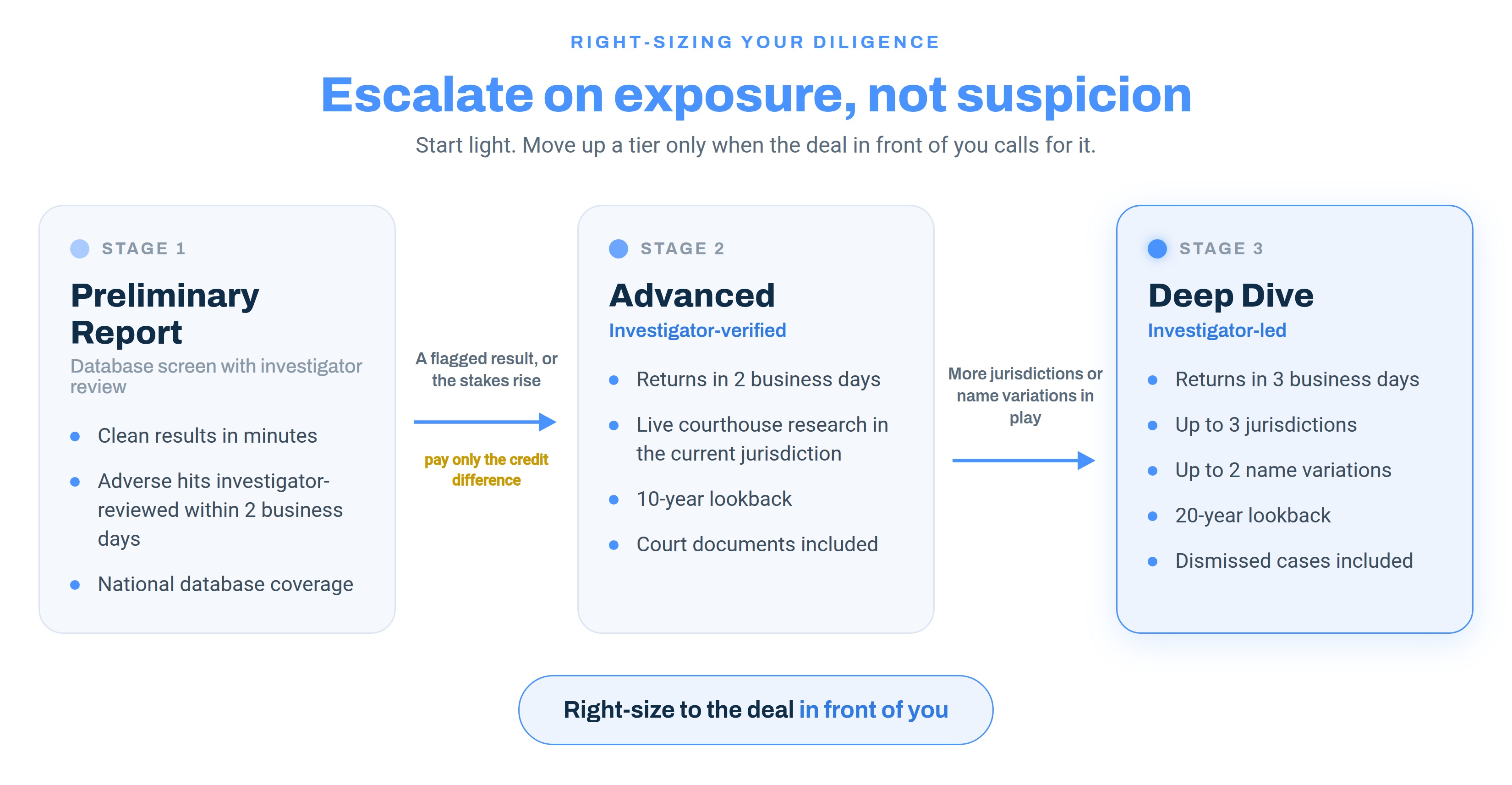
Advanced runs live research in the subject's current jurisdiction over a 10-year lookback and returns in 2 business days. Deep Dive extends across jurisdictions and name variations over 20 years and returns in 3 business days.
The strongest case against starting light is that databases lag. The records most likely to hurt you are often the most recent ones, the filings from the last few weeks that have not made it into any database yet. A clean automated screen can look like reassurance at exactly the moment the stakes are highest.
That is a fair point, and it is part of why escalation matters. A private lender we work with was about to fund a $500K deal where the borrower came back clean in standard screening. Our investigators found more than $1 million in tax liens filed in the prior 60 days, too recent for any database to have caught. The deal did not close.
What made the difference was not skipping the screen, it was knowing when to go past it. The lender escalated to source verification because the size of the deal warranted it, and did so before closing rather than after. On a high-stakes deal, "no records found" is not the same as clean, and that is exactly where deeper research earns its place. On a $5,000 net-30 vendor order, it may not, and a 20-year, multi-jurisdiction investigation there is effort spent where it cannot change the outcome.
The risk is not in starting light. It is in starting light with no plan for when to go deeper.
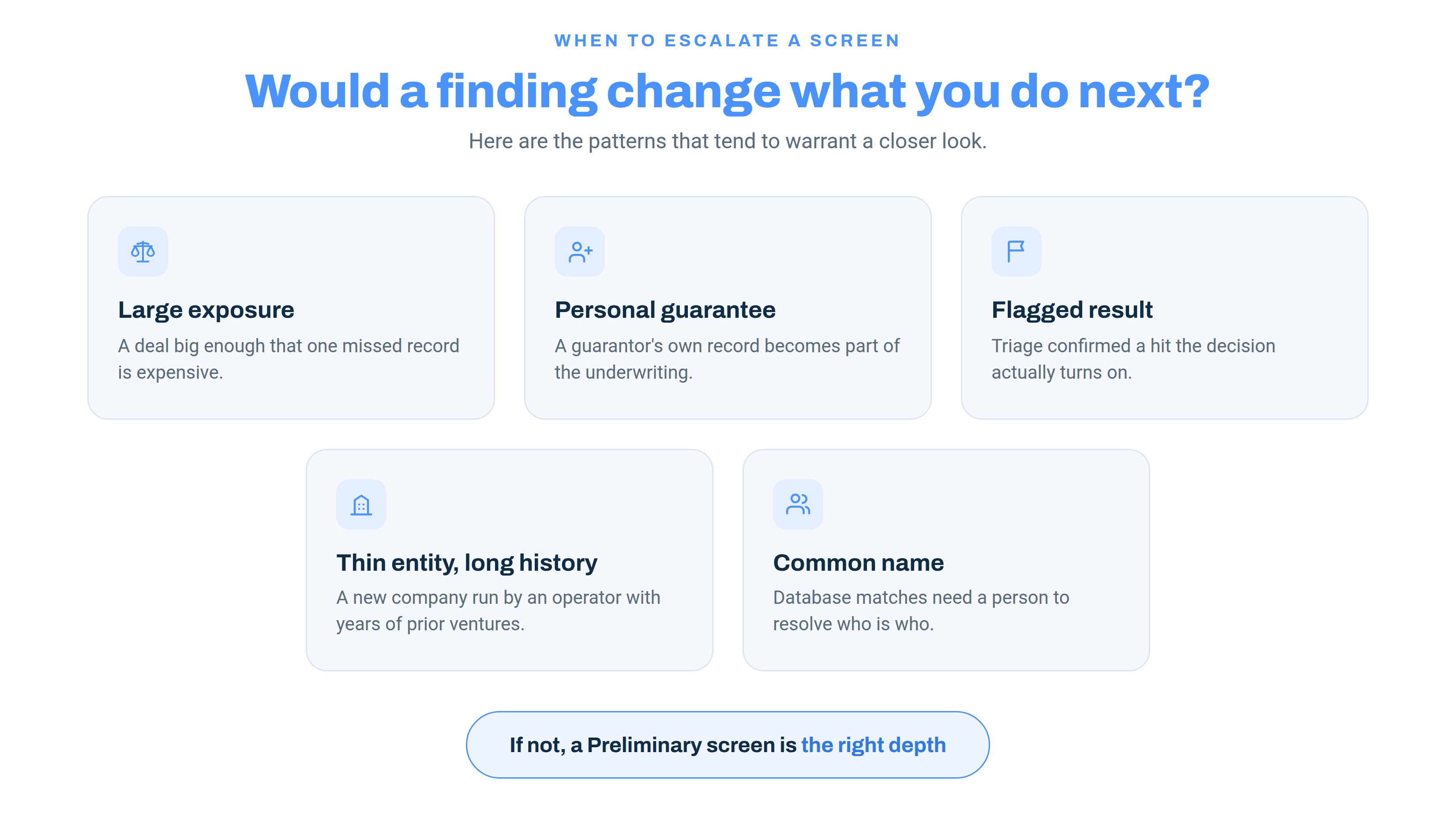
The working test is one question: would a finding change what you do next? If a lien, a lawsuit, or a sanctions match would not alter the decision, automated screening is the right depth and the savings are real. If it would, investigative due diligence is not a premium add-on. It is the underwriting.
What we actually recommend depends on the situation in front of you. A lender running a high volume of small deals might screen everything with the Preliminary Report and only escalate on the handful that carry a personal guarantee or a large balance. A private equity team looking at a single acquisition might go straight to a Deep Dive. A marketplace operator onboarding sellers might set a dollar threshold that triggers a closer look. The common thread is matching the depth to the stakes, and where a case is hard to call, our investigators help you make the call, included at no extra cost for active customers. A sample report shows what the investigator-verified deliverable looks like before you commit to one.
The whole point of right-sizing is that the answer is different for every deal. If you want a second read on where one of yours falls, tell us about the counterparty and we will help you set the depth.







.png)
