



A subcontractor's bid comes in competitive, the certificate of insurance is attached, and everything on paper looks in order. The trouble usually shows up after the sub is already on the job. The insurance lapsed a week after that certificate was issued. The license was never valid in the state where the work is happening. An unpaid supplier files a lien that lands on your project. Prequalification is where you catch those things while you still have room to act.
The items below are what a general contractor (GC), or the platform placing subs on its behalf, should confirm before work starts. Each one comes down to the same thing, which is verifying that something is true rather than trusting it was reported honestly.

Before the checklist, one judgment call sets everything else. A one-day sub on a three-thousand-dollar scope does not warrant the same scrutiny as a structural sub carrying a seven-figure contract. Prequalifying every sub to the deepest level is paying for verification that does not change the decision, and it slows down the jobs that should move fast. The useful question on each item below is whether a finding would actually change whether you bring the sub on. Where it would, verify it properly. Where it would not, a lighter confirmation is enough. That right-sizing instinct is the same one we lay out in knowing when to escalate a screen.
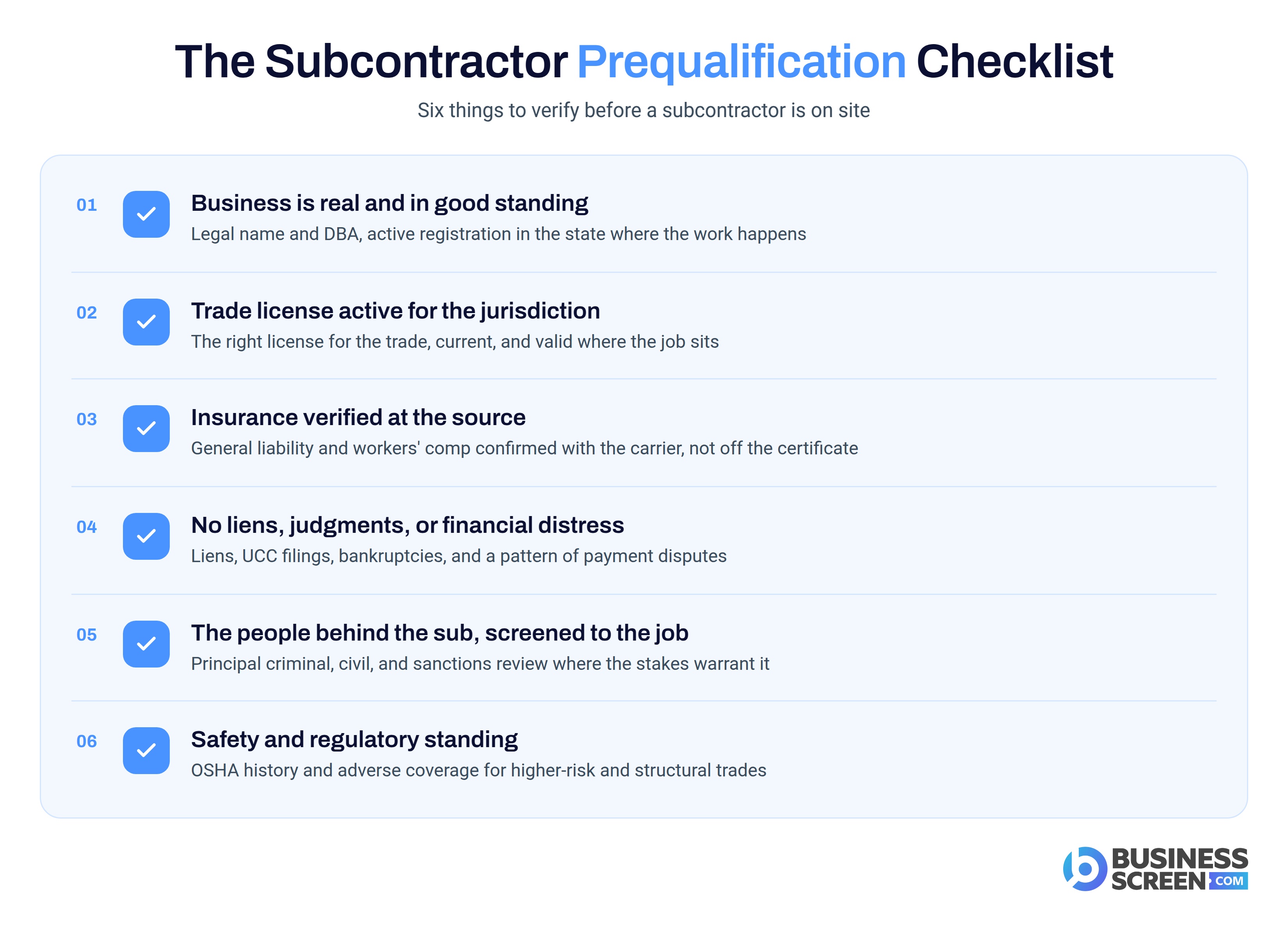
Start with the entity itself. Confirm the legal name and any assumed name (doing business as, or DBA) match what the sub put on the bid, that the company is registered, and that it is in active good standing in the state where the work will happen. A sub operating under a name that does not match its registration, or one whose registration has lapsed, is worth a question before anything else. This is straightforward entity and identity verification, and it is the foundation the rest of the checklist sits on.
Licensing rules vary widely by state and trade, and a license that is valid in one state or category does not automatically cover the work in front of you. Confirm the specific license the trade requires, that it is current, and that it covers the jurisdiction where the job sits. A license and credential verification checks the license is real and active rather than taking a number on a form at face value.
A certificate of insurance (COI) is a snapshot of coverage on the day it was issued, and it can be expired, altered, or cancelled by the time the sub shows up. Confirm general liability and workers' compensation coverage directly with the broker or carrier, not just from the certificate the sub handed over. One nuance worth building into the process is that missing workers' compensation coverage usually means the sub has no employees, not that they are out of compliance, so confirm the reason rather than rejecting the sub outright. Our Insurance Verification add-on handles the source confirmation, and the broader point that a questionnaire and a certificate are the starting point rather than the proof is one we make in why vendor due diligence shouldn't end at the questionnaire.
A sub in financial trouble is a completion risk, and an unpaid lower-tier supplier can turn into a mechanic's lien against your project. A financial risk review covers tax and other liens, Uniform Commercial Code (UCC) filings, bankruptcies, and business credit, which together show whether the sub is on stable footing. Pair that with a civil records check for lawsuits and judgments, since a pattern of payment disputes with suppliers or prior GCs is a signal that a single filing is not.
For most closely held subcontractors, the business is the person running it, so the principal's record carries the same weight as the company's. Where the contract value or the sensitivity of the site warrants it, run principal-level diligence, including criminal history in the jurisdictions where the person has worked, sanctions and watchlist screening, and an executive-level review of the operators. The case for looking past the entity to the operator is one we make in full in why a business background check should cover principals too.
For trades where the work is safety-sensitive, a sub's safety record matters as much as its insurance. A reputation and regulatory search surfaces Occupational Safety and Health Administration (OSHA) history and adverse coverage that a certificate and a license will not show. This layer earns its place on structural, high-hazard, or heavily regulated work, and is usually skippable on low-risk scopes.
A few situations move a sub from the light version of the checklist to the full one:
A finished prequal is not a folder of certificates and a license number copied off a form. It is each item confirmed at its source, current as of the time work starts, and documented in a way you can stand behind if the relationship goes wrong. That is the difference between a stack of self-reported paperwork and a decision-ready record you can actually rely on when you put a sub on the job.
Standing that process up, and keeping it consistent across the range of subs and job sizes you handle, is the part we can take off your plate. Fill out the form below and we can walk through how it would work for your projects.







.png)
