



Most problems with a new marketplace seller are not hidden in a criminal record. In our screening for marketplace platforms, the one we find most often sits right on the application: the business named there is not quite the business on file with the state.
That is where this seller onboarding checklist begins. It starts with the business, works out to the people who own and run it, and ends with how to decide on what you find and when to look again. Treat it as a records checklist, not legal advice.
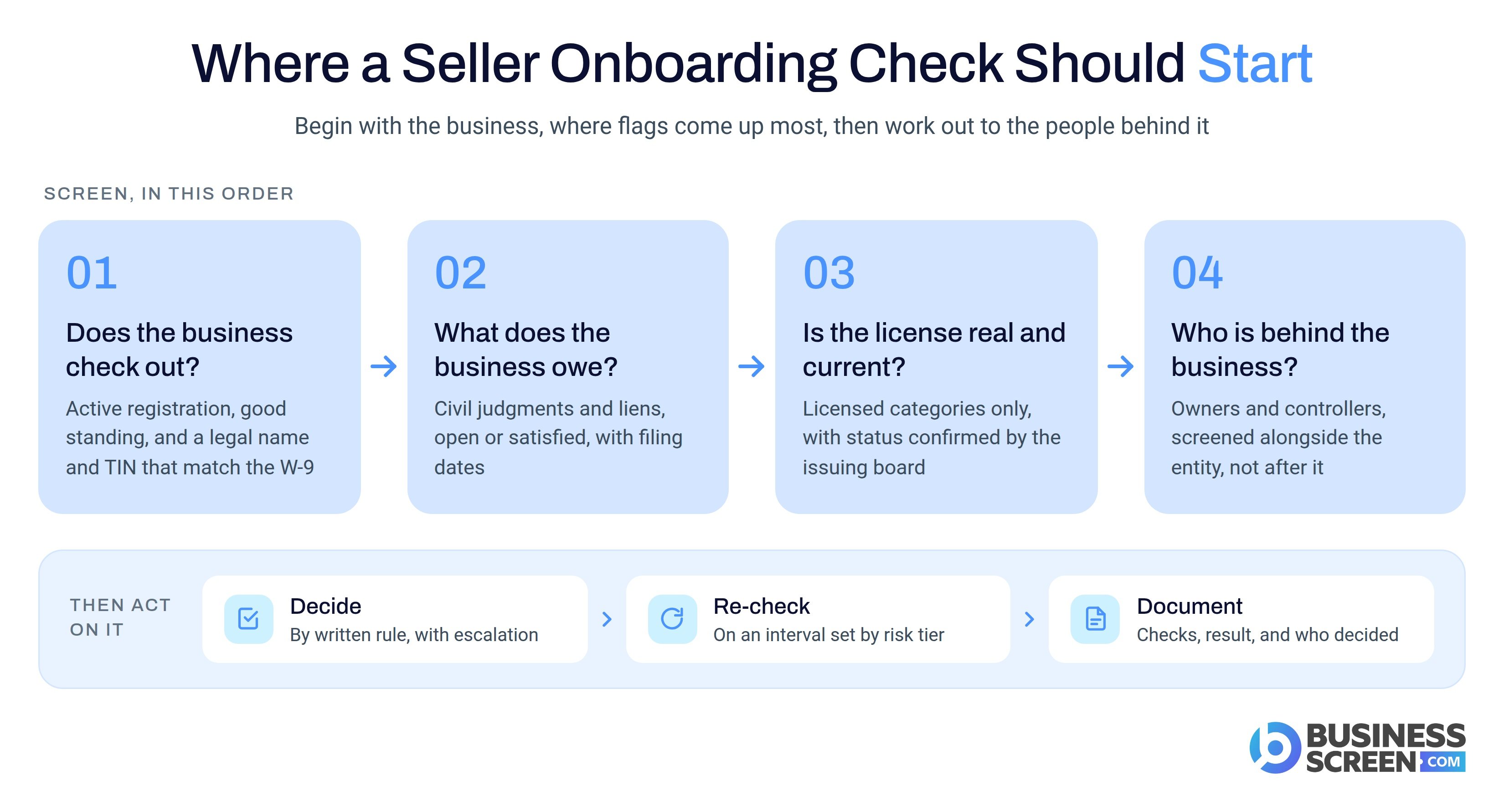
A registration problem is the least dramatic flag on this list and the one we see most. The business was formed, then let its filing lapse. The name on the seller application is a trade name, and the legal entity is something else. The Taxpayer Identification Number (TIN) on the W-9 matches a sister company. None of these proves bad intent, but each one means you do not yet know who you are about to pay.
Collect the inputs that make this checkable at signup: the legal entity name exactly as registered, the state of formation and entity number, the TIN, and the name on the W-9. Then check them against the source. State business registries confirm formation and good standing, and many are free to search. If your platform files 1099-K forms, the IRS TIN Matching program lets authorized payers confirm a name and TIN combination before filing.
Resolve a W-9 mismatch before anything else runs; it is one of the four checks behind business identity. When volume makes manual lookups impractical, identity and entity verification runs the same checks across the queue.
Civil judgments and liens are among the most common flags on a marketplace seller's business. They are also the findings most likely to be read wrong.
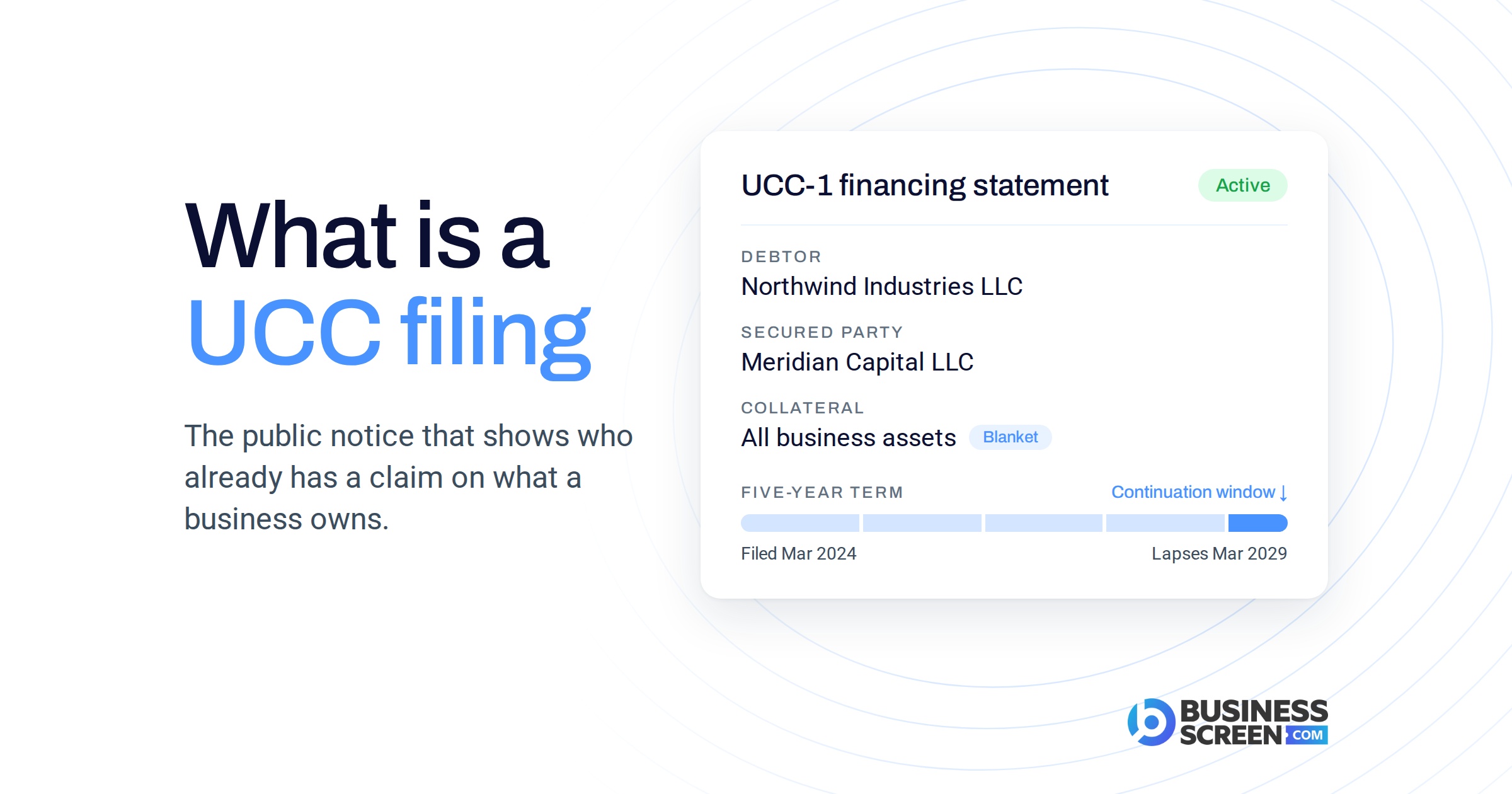
A judgment that was satisfied years ago tells you a dispute happened and got resolved. An open judgment or a lien filed last month tells you money is owed right now, possibly to someone with a claim on what you are about to pay out. A report shows both side by side, and reading liens and judgments correctly is most of the work. Recency matters in the other direction too, since a filing from the last few weeks may not have reached an aggregated database yet.
For platforms onboarding licensed providers, such as contractors, care facilities, and other regulated trades, license verification flags more often per search than any other check we run for marketplaces that produces an actual finding. Licenses lapse quietly, and many platforms accept whatever license number the seller typed in. The standard should require confirmation with the issuing board for categories that need a license, covering status, expiration, and any disciplinary action. License and certificate verification does this directly with the issuing authority when the board's own lookup is not enough. In unlicensed categories, skip it.
Most marketplace screening volume goes to the business. The owners and controllers behind it get screened far less often, and when they are, liens, judgments, watchlist hits, and criminal records turn up often enough that leaving them out is a real gap rather than a rounding error.
One marketplace we work with ran a standard entity check on a senior living facility, and it came back clean. Extending the check to the owner surfaced pending fraud charges tied to a separate facility in another state. The business was clean. The person was not. That is the case for screening the principals alongside the entity rather than treating them as an upgrade.
Two cautions on owner screening. First, watchlist hits on individuals are often name matches, which is why identity review matters before anyone acts on one. A Preliminary Report includes that review: when an automated search flags, an investigator confirms whether the hit belongs to your subject before the report reaches you. Second, the background check tool your people team uses is the wrong instrument. Employment screening runs under the Fair Credit Reporting Act (FCRA), which requires subject consent, limits how far back many adverse records can be reported, and has no concept of an entity. Screening a business and its operators for a commercial decision sits outside that framework, which is why a non-FCRA background check can cover both without subject consent. Whether a specific check on an individual seller falls under consumer reporting rules depends on how you use it, which is a question for your counsel. An executive background check on the principals covers the owner side at the depth your risk tiers call for.
Many flags are not disqualifying. A few of the findings most often misread look worse than they are, and a thin or unrated business credit file is not a finding by itself. The standard exists so the same flag gets the same answer on Tuesday as on Friday, whoever is working the queue.
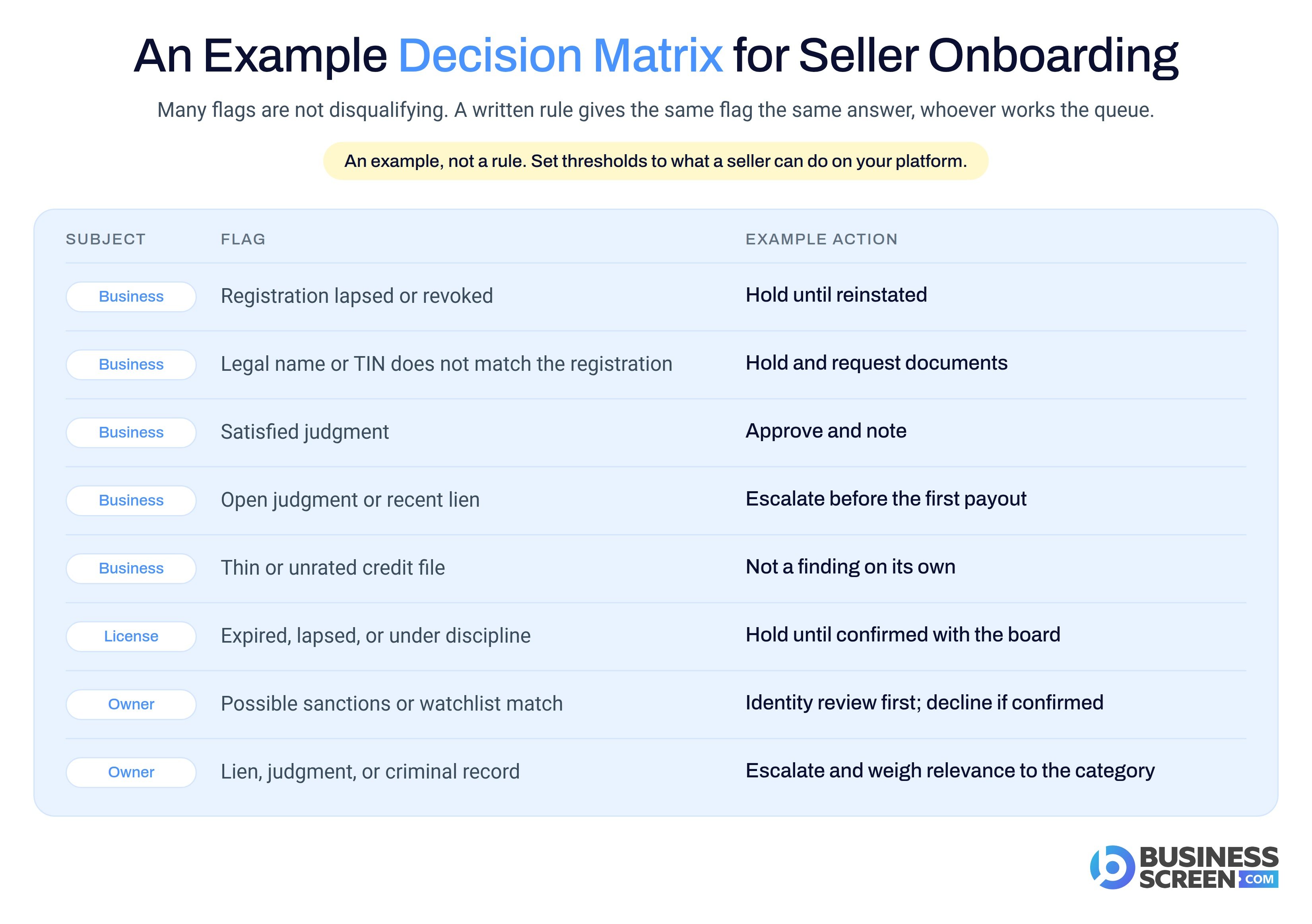
Thresholds should fit the platform, because flag rates do too. Across the marketplaces we screen for, a resale platform onboarding individual sellers sees very few flags, while a provider network onboarding care facilities sees many. Neither rate is wrong. They reflect different sellers and different things worth checking.
Escalation belongs in the rule as well. When a flag is material and unclear, an Advanced report sends an investigator to the source records and comes back in two business days. A Deep Dive, with a twenty-year lookback across multiple jurisdictions and name variations, is for the strategic partner or the high-exposure international seller, not the routine shop. In a healthy queue the Preliminary Report is the default and escalation is the exception, which is the logic behind knowing when to escalate a screen.
Onboarding is a snapshot. A seller who cleared in March can pick up a judgment or let a license lapse by June. The standard assigns each seller a risk tier at approval and a re-check interval to match: monthly for a high-payout seller, for example, quarterly for mid-volume, and once a year at renewal for a low-volume seller of low-risk goods. For that last group, monthly monitoring is cost without much return, and the tradeoff between point-in-time screening and continuous monitoring is worth settling tier by tier.
For each seller, record what was checked, when, the source, the result, the rule that applied, who made the call, and the next re-check date. That record is what you show a payments partner or a seller disputing a decline, and it lets a new hire apply the rule the way it was written.
A written standard makes decisions consistent. It does not make the records complete. A flag is a lead, not a conclusion, until someone confirms it belongs to your seller. Collection depends on what the seller tells you, and a nominee owner can sit on a registration while someone else runs the business; beneficial ownership records have limits of their own. And history is not behavior. The standard tells you who a seller is and what is on the record. What they do on your platform after approval is a transaction monitoring question, which is a separate job.
1. Confirm the business checks out
2. Check what the business owes
3. Verify the license, for licensed categories
4. Screen the people behind the account
5. Decide by written rule
6. Re-check by risk tier
7. Document
When the standard is working, the queue moves and the arguments stop. Clean sellers clear in minutes. The ones that flag get a written rule, an escalation path, and a re-check date, and the checks that run first are the ones most likely to find something.
If you want help setting thresholds for your seller mix, hit Get Started below. Our investigators can walk through which sellers a Preliminary Report covers and where escalation earns its cost. Platforms that want screening inside their own onboarding flow can connect through our API, which takes roughly five to six hours to integrate with our support. You can see more on how marketplace platforms use our screening.






.png)
