



A dismissed lawsuit gets waved off. A “no records found” gets treated as a clean bill of health. An eleven-year-old conviction gets dropped because it feels too old to matter. None of those findings were missed. They came back, sat in plain view, and got read wrong.
A finding in a business background check is not a verdict. It is a claim with three properties: a status, a source, and a scope. Until you know all three, the same line of text can support opposite conclusions. Three findings account for a large share of the misreads, and each one goes wrong in a predictable direction.
Two readings of a dismissed civil case are common and both are off. One waves it away: the case went nowhere, so nothing happened. The other overcorrects, treating the existence of a filing as evidence in itself.
A dismissal is a procedural fact about a docket. It records how a case ended, not whether the underlying conduct occurred. In commercial disputes, a case dismissed without prejudice often marks a quiet settlement, a plaintiff who ran out of money, or a filing defect that sent everyone back to the start. Voluntary dismissals frequently follow a confidential settlement, so money may well have changed hands with nothing on the docket to say so.
So read past the status. Who filed it, what they claimed, how it ended, and whether it stands alone. One dismissed contract dispute across twelve years of operating is background noise. Four dismissed suits from four suppliers in three years says something about how this company handles disputes, whatever each docket says on its own. The same reading applies to liens and judgments in due diligence on a company.
One thing to check before drawing a conclusion: whether dismissed cases were in scope at all. Plenty of report scopes leave them out by design. An empty column may mean nothing was found, or it may mean nobody looked. If the pattern of disputes is what you care about, order the civil records search that includes them.
A principal named David Miller comes back from a business background check with no records found. Most of the time that is exactly what it looks like. Most subjects do clear, and a clean result on a real person with a real history is the ordinary outcome rather than a suspicious one.
The trouble is that the same line covers a second situation. A search on a common name can also come back empty because the matches it turned up could not be tied to your subject with confidence, or because the record sits under a middle initial, a previous name, or a nickname nobody searched. Clean and unconfirmed print identically.

Telling the two apart takes identifiers, not more searching. An identity and entity verification pass matches what you supplied against a credit header profile and runs an SSN trace, which returns the identifiers, the jurisdictions tied to the person, and their name variations. That is the difference between “no records found” and a result you can lean on: we looked for this person, in these jurisdictions, under these names, and found nothing.
This limit is not universal, and it is worth being precise about it. Unresolved common names and name-variation gaps are limits of database-only searching, our Preliminary Report included. When investigators pull the records, identity gets settled before the search rather than left sitting in the result, which is one reason a clean report can still miss something.
An eleven-year-old conviction tends to get a shrug, an instinct borrowed from employment screening and its seven-year window. That framework does not govern business due diligence on a counterparty, so an old record does not drop off the report on its own.
What limits the reach is the lookback that was ordered. “Aged out” almost always means outside that window, not legally expired, and those are different sentences to put in front of a credit committee. Only one of them is a fact about the subject.
Once the seven-year reflex is gone, age turns out to be a weak variable and relevance a strong one. A fourteen-year-old drunk driving charge on a principal says little about whether someone will misrepresent collateral. A twelve-year-old wire fraud conviction says a great deal, and it says it about the exact thing you are being asked to trust them with. That is a good reason to run criminal records on the people behind the entity and not the entity alone.
The mirror image is worth naming. Old records get discounted too fast, and recent ones are often not in a database yet, which is why point-in-time screening and ongoing monitoring answer different questions. For a lender working to a funding date, the recent filing is the costlier gap.
Each of these has the same root: a finding read without its status, its provenance, or its scope. They are the routine output of routine screening, which is why they slip past people. Most findings are also exactly what they appear to be, and treating every line as a puzzle would grind a pipeline to a halt. These three earn the second look because they are the ones that flip on you.
That makes the demands on a report specific and fairly modest. Label the status, active versus dismissed, pending versus resolved. Say whether a hit is verified to your subject or a possible match somebody still has to resolve, the distinction that separates real signal from noise in adverse media. Include the underlying document. And state what was searched, how far back, and under which names, so that an absence carries information. The lookback runs ten years on our Advanced report and twenty on our Deep Dive, and knowing which one you are reading is the difference between an old record and no record.
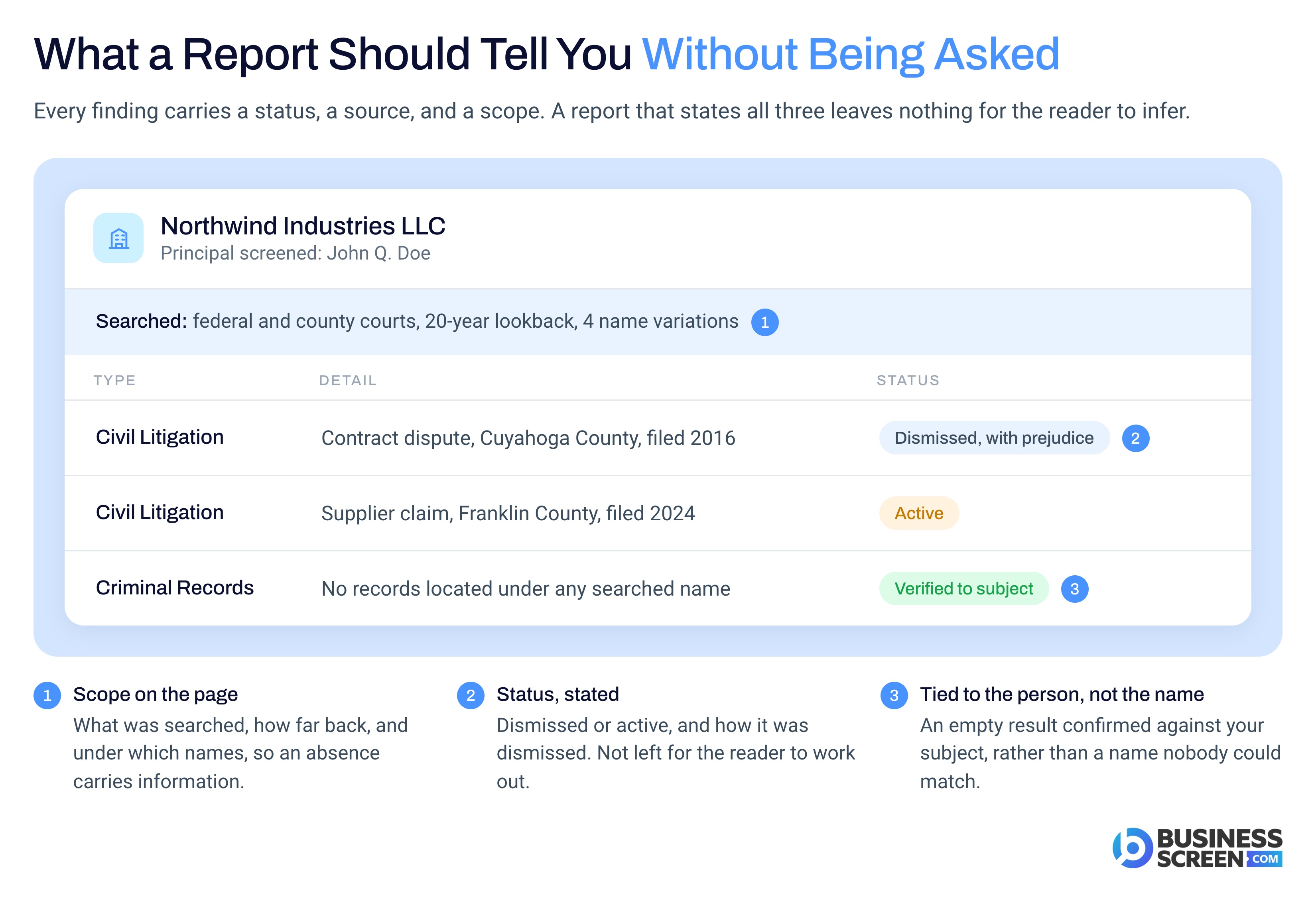
Business verification services differ on those four points more than they differ on coverage, and the gap shows up in how the records get gathered.
None of that argues for buying the deepest report every time. On a routine vendor with modest exposure, our Preliminary Report usually tells you what you need, as long as you read it as a filter and not a clearance. Right-sizing that call is most of the skill.
A finding is not a verdict. It is a claim with a status, a source, and a scope, and reading those three before it moves your decision is most of the discipline. The reports worth paying for hand you all three without being asked.
If you have a deal moving and you are not certain which of the three you are missing, that is a conversation worth having before the report comes back rather than after. Our investigators take those questions directly, including which searches are worth running on a particular counterparty and which ones you can skip. Click the Get Started button below and fill out the form, and we will get you connected with the team.






.png)
