



A new counterparty checks out. The company is properly registered, the numbers line up, and a records search turns up no liens, no judgments, and no open litigation. It is easy to read a clean result like that as a low-risk deal, and a due diligence company check that comes back empty often does mean exactly that. But an empty result is answering a narrower question than it looks like. It tells you what had surfaced in the records you searched, on the day you searched them. What got filed last week, or recorded in a county that still works on paper, or filed under a name the search never tried, is a separate question, and a blank result says nothing about it. On a small, routine deal, that gap rarely matters. On a large one moving fast, it can decide the outcome.
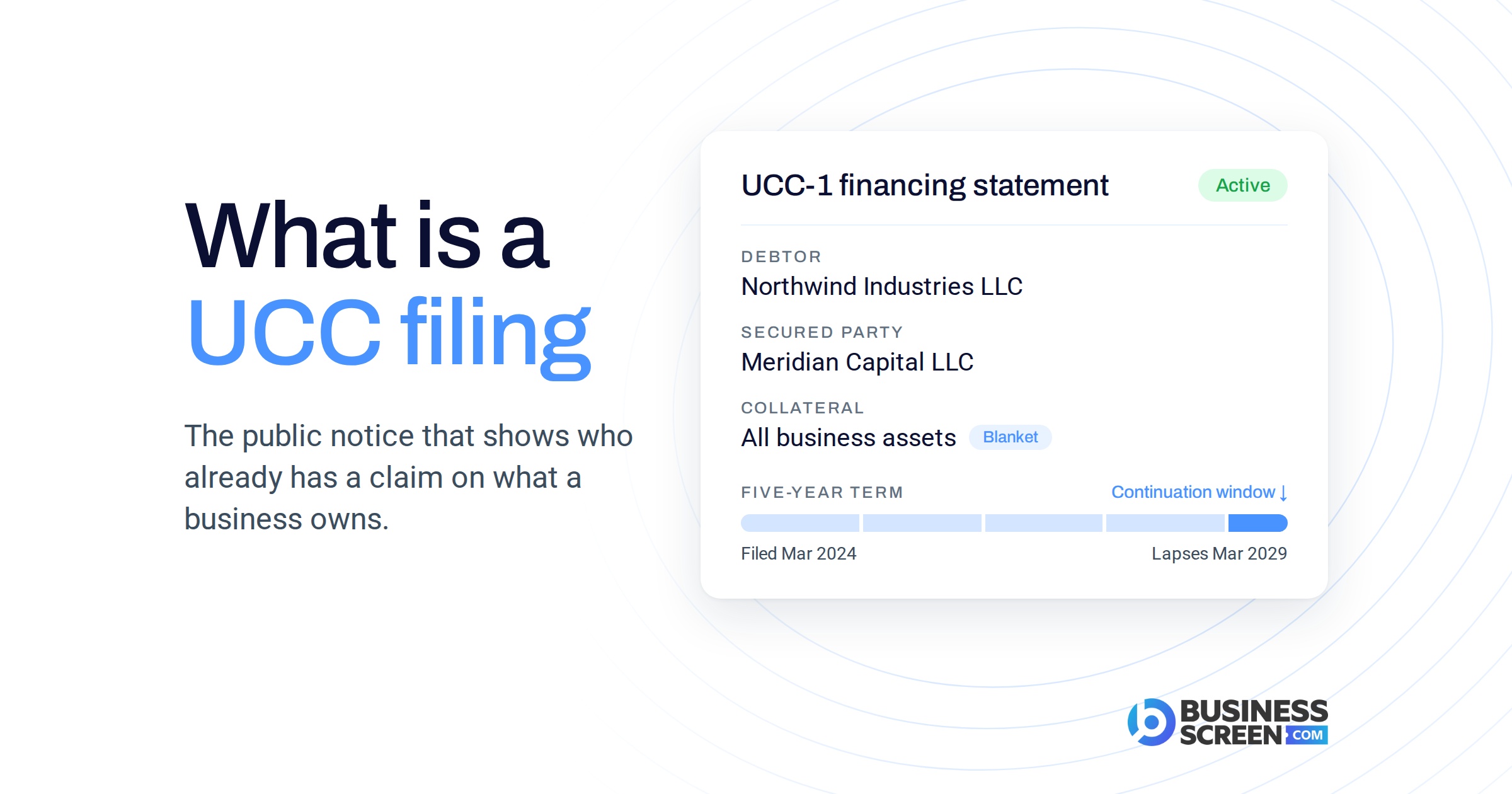
A judgment, a lien, or a UCC (Uniform Commercial Code) filing is real the moment it is entered at a court or registry. Whether it shows up in your search is a different story. A standard check runs against commercial databases that pull public records together from thousands of courts and agencies, and those databases are only as current as their last refresh. A record has to be filed, digitized, passed along to the aggregators, indexed, and matched back to the company you are checking, and every step of that takes time. The delay lands hardest on the filings that just happened, so the newer a record is, the better the odds it has not finished the trip.
That is easy to underrate. A check like this usually looks across years of a company's history, and the lag does nothing to the older record. It hits the newest slice, the filings from the last few weeks or months, which is often exactly where a fresh problem shows up first. Picture a company that has run clean for years and then, a month ago, picked up a large tax lien. A one-time search run at a single point in time reaches the data that has caught up, the lien has not caught up, and the report comes back clean. The problem is real. It is just not visible yet.
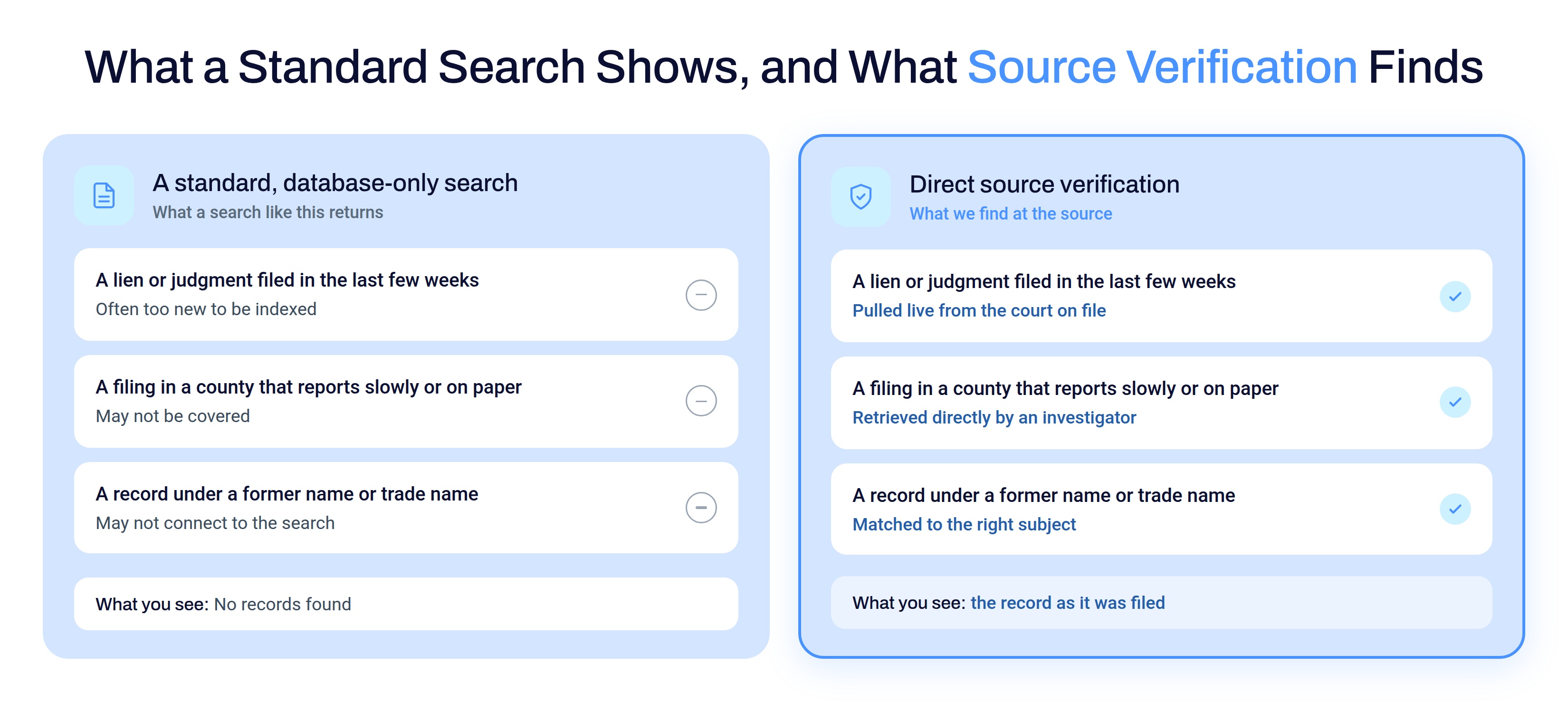
We watched this play out on a $500,000 loan a private lender was about to fund. The borrower looked spotless in the usual screening, but the number was big enough to justify a second look, so the lender had our investigators verify it at the source before wiring anything. Pulling straight from county and state records, the team turned up more than $1 million in tax liens filed in the previous 60 days. All of it real. None of it old enough to have reached a database. The first search was not wrong, it was early, and on that deal the gap between early and accurate was a million dollars.
Timing is the main culprit, but not the only one. A record filed under a former name or a trade name can slip past the search entirely, which is why business identity verification matters as much as running the search in the first place. Closing these gaps is the whole point of direct source verification. Our investigators go to the courts and registries themselves, on the day a record was filed, rather than relying solely on whatever has already worked its way into the databases.
None of this makes a fast, database-driven search the wrong tool, and it does not mean every blank result is hiding something. Plenty of the time, empty means clean. A company with a long, quiet record and nothing recent comes back clear on a business background check because there is nothing to find, and for routine, lower-stakes relationships that is not corner-cutting. It is the right amount of diligence. Paying for more would mean buying confirmation of something you can already reasonably conclude, and we would rather tell you that than sell you a deeper report you do not need.
The lag only earns your attention in a narrower set of cases. It matters when the dollar figure is large enough that one missed filing changes the decision, when the timeline is short enough that a too-new-to-see filing is plausible, and when the counterparty is one you cannot easily walk away from later. Those are the high-stakes transactions worth confirming at the source. Everywhere else, the standard search is doing exactly what it should.

So the point is not that database searches cannot be trusted, or that every counterparty needs an investigator. It is that an empty result has a shelf life and a stake attached. How far you can lean on it depends on how recently a problem could have appeared and how much is riding on the answer. On a small, routine account, a clean due diligence company check is usually the end of it. On a large deal closing quickly, the same clean result is worth confirming at the source before you sign.
We offer diligence at a range of depths, from fast database screening to investigator work verified at the source, so the level can match the deal in front of you. If you want help deciding what a specific counterparty calls for, fill out the form below and our team will talk it through with you.






.png)
