



Winning a judgment settles who owes what, but it does not tell you whether there is anything to collect. That answer sits in the public record, and an asset search, sometimes called an asset investigation, is how you read it before you spend more on enforcement. A good one shows what the debtor owns, what is already pledged to someone else, and which creditors stand ahead of you, which is usually enough to decide whether collection is worth pursuing.
What follows covers where those records live, how to read them, and where a public-records search runs out. It is a records guide rather than advice on how to collect a judgment, and the enforcement steps themselves are a question for your counsel.
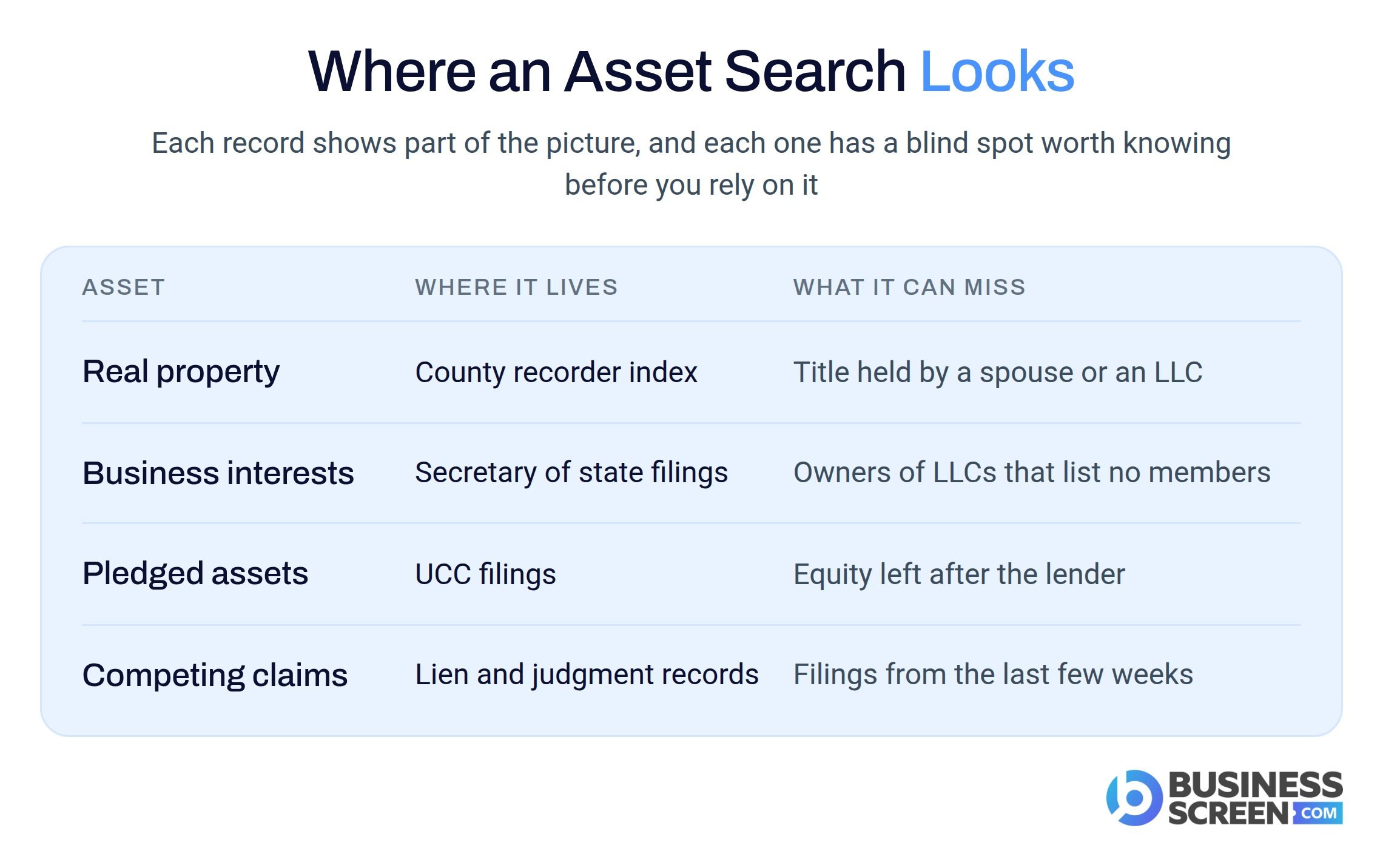
Real estate is the asset most likely to be both valuable and visible. Deeds are recorded at the county level and indexed by the names of the buyer and seller, so searching the debtor's name as grantee shows what they have acquired, and searching it as grantor shows what they have sold or handed off. A national property database is a fast first pass across counties, although the county recorder's own index is where a recent deed tends to appear first.
Two patterns deserve more attention than the rest. Property is often titled to a spouse, a trust, or a limited liability company (LLC) the debtor controls, so a search on the debtor's name alone can come back thin while the family home sits one name over. A transfer to a relative or a new entity around the time of the lawsuit is also worth recording with its date, because the timing is what your counsel will want to see.
Finding a property is not the same as finding equity. The assessed value says nothing about the mortgage behind it, which is why the lien side of a property search matters as much as the deed. In many states, recording the judgment in the county where the debtor owns real estate is what turns it into a lien on that property, so knowing which counties hold property tells you where that step applies.
A debtor who owns a business may hold their most valuable asset inside it. Secretary of state records show where the debtor appears as an officer, manager, organizer, or registered agent, and the search is worth running in each state where they have lived or done business rather than only the one where you sued.
The catch is that many states do not require an LLC to list its members, so a filing can show the debtor running a company without showing that they own it. Ownership usually has to be pieced together from officer roles, shared addresses, and related entities, which is the point where beneficial ownership records stop being much help. Mapping the companies tied to a debtor is the same work as screening the principals behind a business, and it is often what surfaces the entity that actually holds the property.
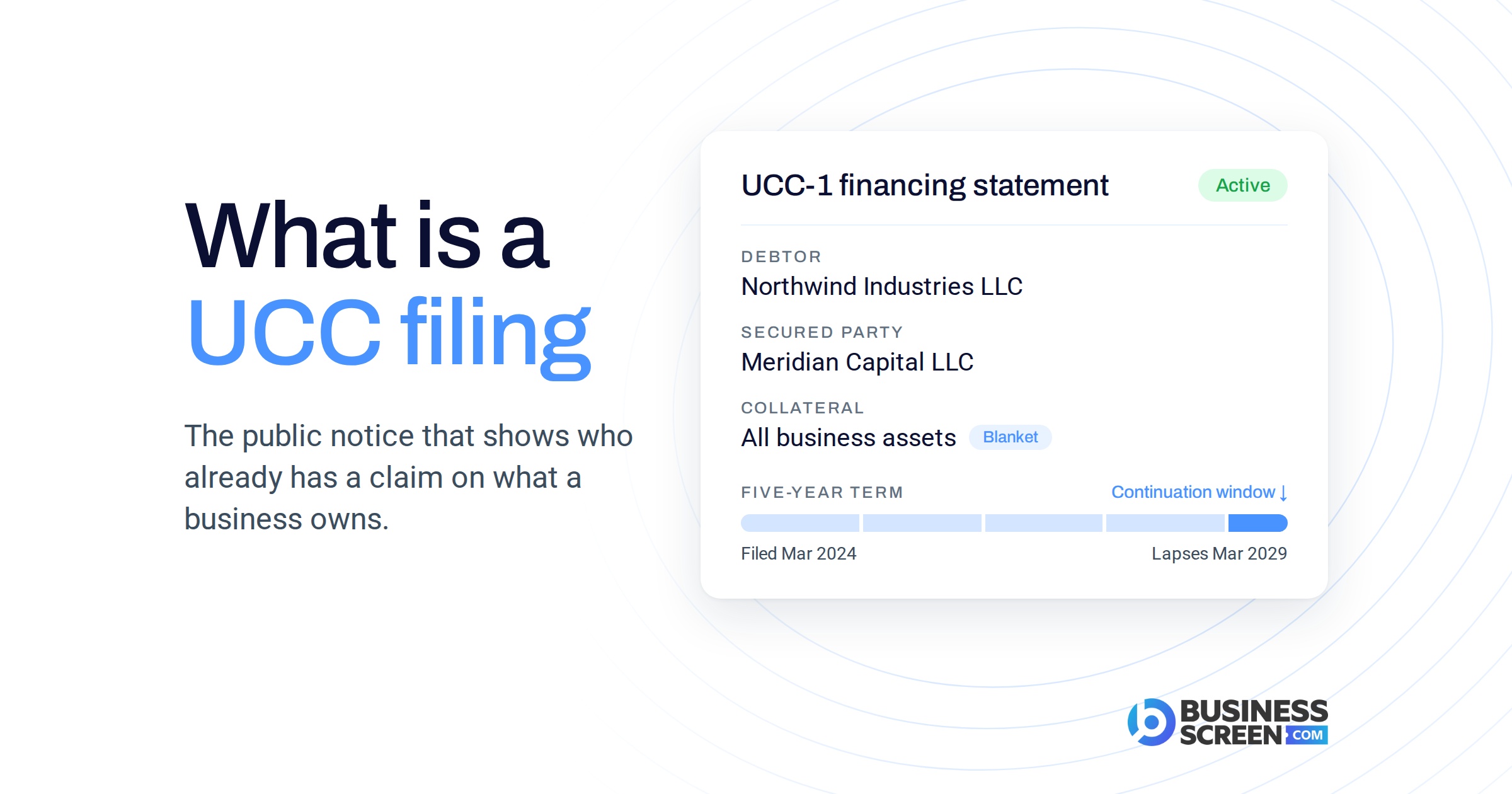
Uniform Commercial Code (UCC) filings are easy to misread as a list of assets, when they are closer to the opposite. A UCC financing statement records that a lender has taken a security interest in equipment, inventory, receivables, or other business property, so the assets it describes are already promised to someone else. A blanket lien on everything a debtor's company owns tells you a secured lender would be paid from those assets before you are. The basics of how a UCC filing works explain why the filing itself is not proof of a default.
The filing still carries useful information. It names the secured party, which is often a bank or equipment lender, and that tells you where the debtor has a financing relationship. It also dates the debt, and a cluster of new filings shortly before your judgment reads very differently from one long-standing equipment loan.
Before you count an asset, count the claims against it. Mortgages, earlier judgment liens, and tax liens can all come ahead of yours, and while liens are generally paid in the order they attached, certain tax liens and purchase-money mortgages are common exceptions whose rules vary by state and lien type.
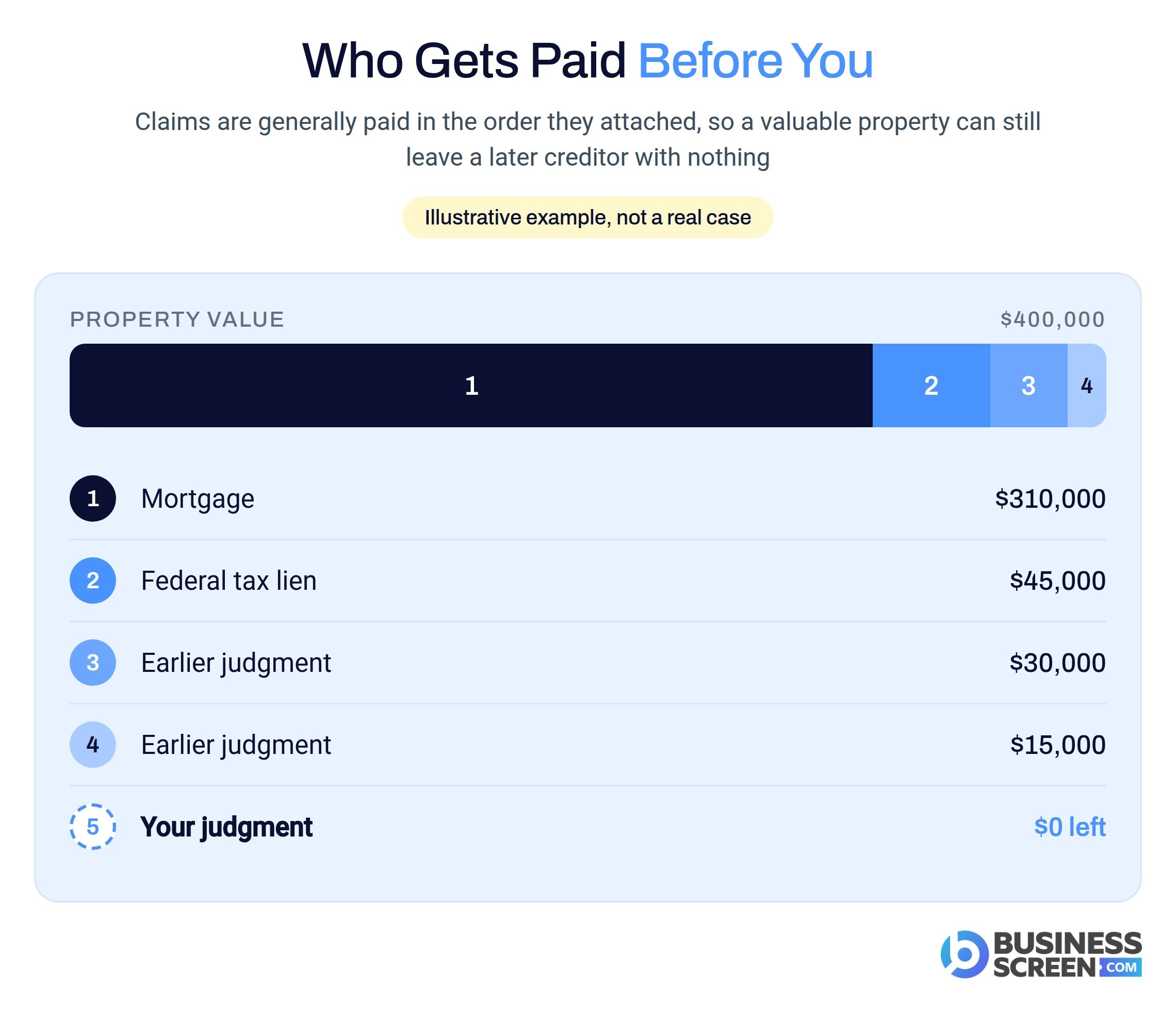
Our own screening points the same way. When a search turns up a judgment against a business or a person, a lien turns up alongside it far more often than it does for subjects with no judgment on record, so it is safer to assume you are not the only creditor until the search shows otherwise.
State exemptions add another layer. Homestead protections and similar rules shield some or all of a debtor's equity in a primary residence, and the amounts vary widely from state to state. A lien search, read the way a diligence team reads liens and judgments, tells you who is ahead of you, while the exemption question belongs with your counsel.
Recent filings are the weak spot. A lien recorded last month may not have reached an aggregated database yet, which is why a tax lien can exist before anyone can find it, so a live pull at the county and state level is worth the extra time when a specific asset matters.
Some higher-value assets sit in federal registries. The Federal Aviation Administration (FAA) publishes aircraft registration records that can be searched by owner name, and the U.S. Coast Guard maintains documentation records for many larger vessels. Motor vehicle records work differently, since federal privacy law restricts access to them, and a public-records asset search does not include them.
Bank accounts, brokerage holdings, and cash are not in the public record, and no public-records search will show balances. Those usually come out through post-judgment discovery, such as a debtor examination or written interrogatories, which your counsel can pursue once the public record has shown whether the effort is worth it.
Assets titled to people outside the debtor's visible circle, such as a friend or an unrelated entity, will not show up under the debtor's name. Out-of-state property is easy to miss when the search only covers where the debtor lives now. And anything recorded in the last several weeks may not be indexed yet, whichever source you use.
The right depth depends on the size of the judgment and what the first pass turns up. A Preliminary Report searches the national lien, judgment, bankruptcy, and UCC databases, and any adverse hit is reviewed by a licensed investigator before it reaches you, which is often enough to show whether there is anything worth pursuing. Property records can be added to any report.
When the first pass points to real property or a business with value, an Advanced report adds live federal, state, and county lien searches, with investigators confirming each hit belongs to the debtor and returning source documents within two business days. A Deep Dive goes further for larger judgments or debtors with holdings across several states, adding state and county UCC records, up to three jurisdictions, name variations, a twenty-year lookback, and related-business mapping on an individual debtor, within three business days. Deciding when that escalation earns its cost is most of the judgment call, and investigative records pulled at the source are what make the findings defensible if they end up in front of a court.
Firms that deliver results to a client can have reports carry their own branding, which is how many legal services teams use the lien and financial searches behind an asset search.
An asset search will not collect anything on its own, but it tells you whether judgment collection has something to aim at. A debtor with unencumbered property in two counties is a different case from one whose only visible asset carries three liens, and knowing which one you have is worth more than an early motion.
If you have a judgment in hand and want to see what the public record shows before deciding how far to take enforcement, hit Get Started below and our team can help you choose the right depth for the search.






.png)
