



A counterparty clears your first screen and the report comes back with a few records attached to the name. The hard part is not finding records, it is telling the difference between a finding that should change your decision and the ordinary paper trail any business accumulates as it gets older. Here are the due diligence red flags we think are worth a closer look, what each one signals, and whether it tends to sit with the business itself or with the people behind it.
Not every record that turns up is a red flag. What matters is whether it changes the risk of the deal in front of you. Active matters more than settled, a pattern matters more than a single filing, and unpaid matters more than satisfied.
Two things worth holding onto before the list. Weighing a specific finding once you have it is its own skill, and we cover that in three findings misread in a business background check. And an empty screen is not always the same as a clean counterparty, for reasons we lay out in what a clean due diligence check can still miss.
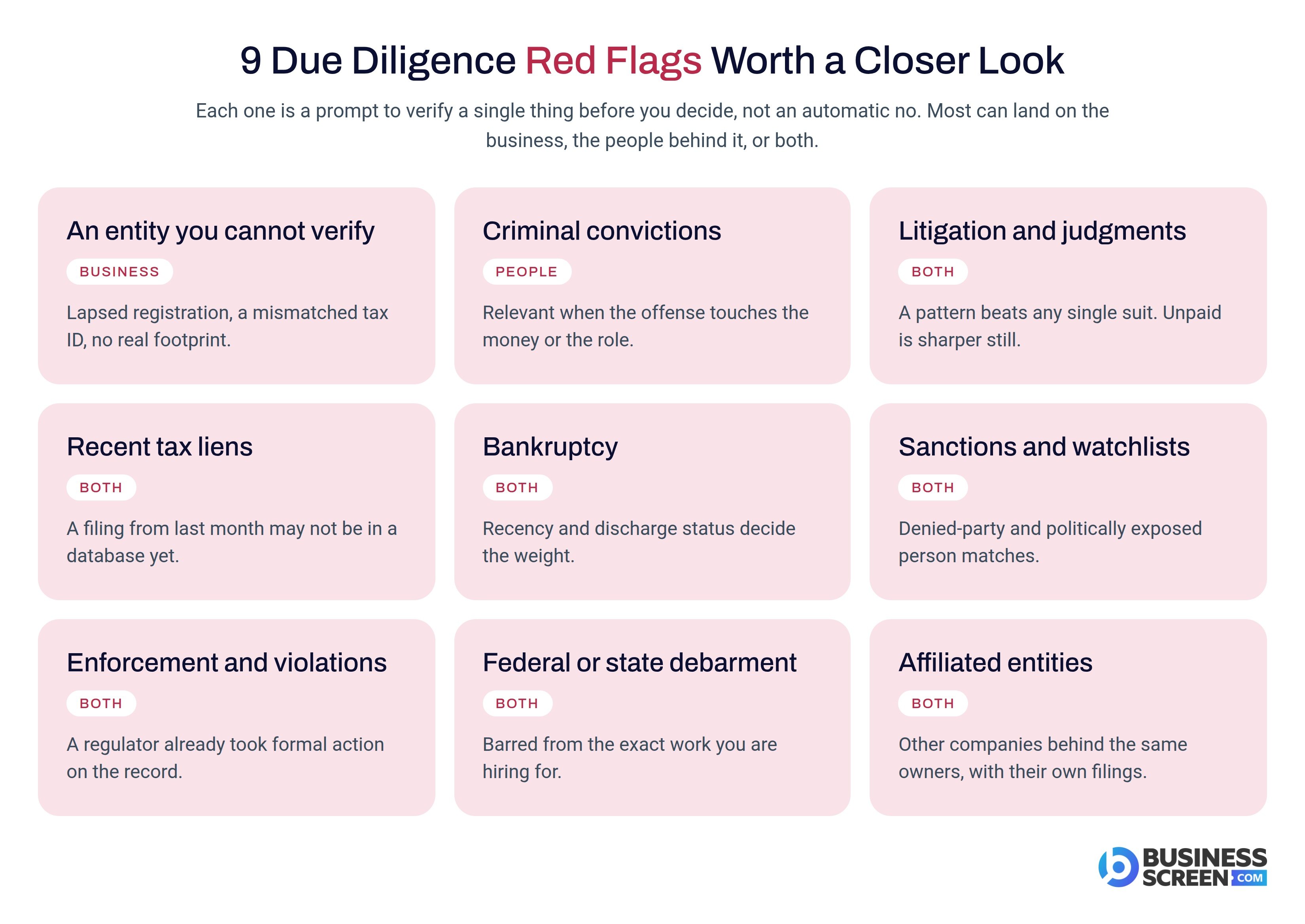
1. An entity you cannot verify (business)
Registration lapsed or not in good standing, a tax identification number that does not match the legal name, or no real footprint behind the website. This one comes first because it governs everything after it. If you cannot confirm the entity is what it claims to be, no other finding can be attributed to it with confidence. It is also the flag most often skipped, because a company with a working website and a tidy invoice template looks real enough to move past. More on that in why business verification should be four checks, not one.
2. Criminal convictions on the people behind the business (people)
Relevant when the offense touches money, fraud, or the role the person will actually play. A decades-old conviction unrelated to the work rarely belongs in a commercial decision, and treating every record as disqualifying will cost you good counterparties. The question is the fit between what happened and what you are trusting them to do.
3. Civil litigation and unpaid judgments (both)
One lawsuit is how commerce works, and an established company will have a few. The signal is a pattern of the same kind of dispute, or an active suit large enough to affect whether they can perform. An unpaid judgment is sharper still, because a court already resolved the matter against them and they still have not paid, which tells you something about capacity and about follow-through. See reading liens and judgments in due diligence on a company.
4. Recent tax liens (both)
Timing is the catch. A lien filed last month may not have reached an aggregated database yet, so a screen can come back clean on a counterparty whose position changed weeks ago. One private lender stepped away from a five hundred thousand dollar loan after our investigators found more than a million dollars in liens filed in the previous sixty days, too new for any database to have captured. The same gap applies to a vendor contract or a subcontractor you are about to put on site, and it is the clearest example of where a database screen and an investigator-led one diverge.
5. Bankruptcy (both)
Not disqualifying on its own, and plenty of sound operators have one in their history. Recency and discharge status decide the weight. A filing from a decade ago that was discharged is context; an open filing during the deal you are evaluating is the version to slow down on. Worth checking at both levels, since a business can be solvent while an owner is not, and the reverse.
6. Sanctions and watchlist hits (both)
Screening against global sanctions and watchlist bodies is where denied-party and politically exposed person matches surface. These carry a weight the others do not, because transacting with a sanctioned party is a compliance problem on its own terms, regardless of how the deal otherwise looks. What sanctions screening actually verifies on a business covers what that confirms and where it stops, and what AML screening covers sets out who needs to run it.
7. Enforcement actions and regulatory violations (both)
An enforcement actions search asks whether a regulator or agency has taken formal action, which is different from general negative press and should be weighed differently. Violations matter most when they sit on the license or permit the business actually runs on: a contractor's license, a safety record for a company whose work happens in the field, a permit it is operating without. For the press side, see adverse media screening, separating signal from noise.
8. Federal or state debarment (both)
A debarment check confirms whether a company or one of its owners sits on a government exclusion list, barred from federal contracts, grants, or a regulated activity. It is narrow but decisive. When the work you are hiring for is the work someone has been barred from doing, that finding usually settles the question by itself. It carries the most weight if you are a public agency, a grant-maker, or a prime contractor passing obligations down to subcontractors.
9. Affiliated entities carrying their own problems (both)
The other companies behind the same owners, each with its own liens, suits, or filings. Databases rarely connect them back to your subject, which is why a counterparty can look clean while the operator's other ventures do not. This is the pattern behind a business that winds down and reopens under a new name with the same people, and it only surfaces if you screen the people first and then look at what else they are attached to.
None of these nine due diligence red flags is a verdict. Each is a prompt to verify one thing before you move.
How much any one of them should move you depends on the size of the deal and on the size of your own business. A fifty thousand dollar vendor contract and a five million dollar loan do not warrant the same response to the same lien. A company that can absorb one bad counterparty can take a risk that a smaller one, where a single default is material, cannot. The same finding is reasonably a note in the file for one buyer and a reason to walk for another, and neither is wrong.
A business can screen completely clean while an owner carries an unpaid judgment, an open bankruptcy, or a debarment that would have changed the decision. That is the case for screening the people alongside the company, and for going a step past the database result when the deal warrants it, since a database can confirm a record exists without confirming whose it is.
If you run into one of these and are not sure how much weight it deserves, click the Get Started button below and fill out the form. Our investigators can help you think it through, including when the answer is that a lighter check is enough.







.png)
