



Yieldi is an asset based private lender writing short term, business purpose loans secured by real estate. They fund acquisitions, refinances, bridge deals, fix and flip, and ground up construction, in almost every state, against a book of about 130 active loans and $260M in outstanding principal. They close 5 to 7 loans a month, averaging around $1.5M, though the range is wide. $200K files at one end, $35M ground up construction at the other. Over the past year they funded roughly $52M.
Being asset based changes what diligence is for. Yieldi looks harder at the real estate than the credit file, and while credit matters, it is not the deciding input. That shapes who comes through the door.
Three years ago they changed how they screen the people behind those loans, and the change started with a number that did not look right.
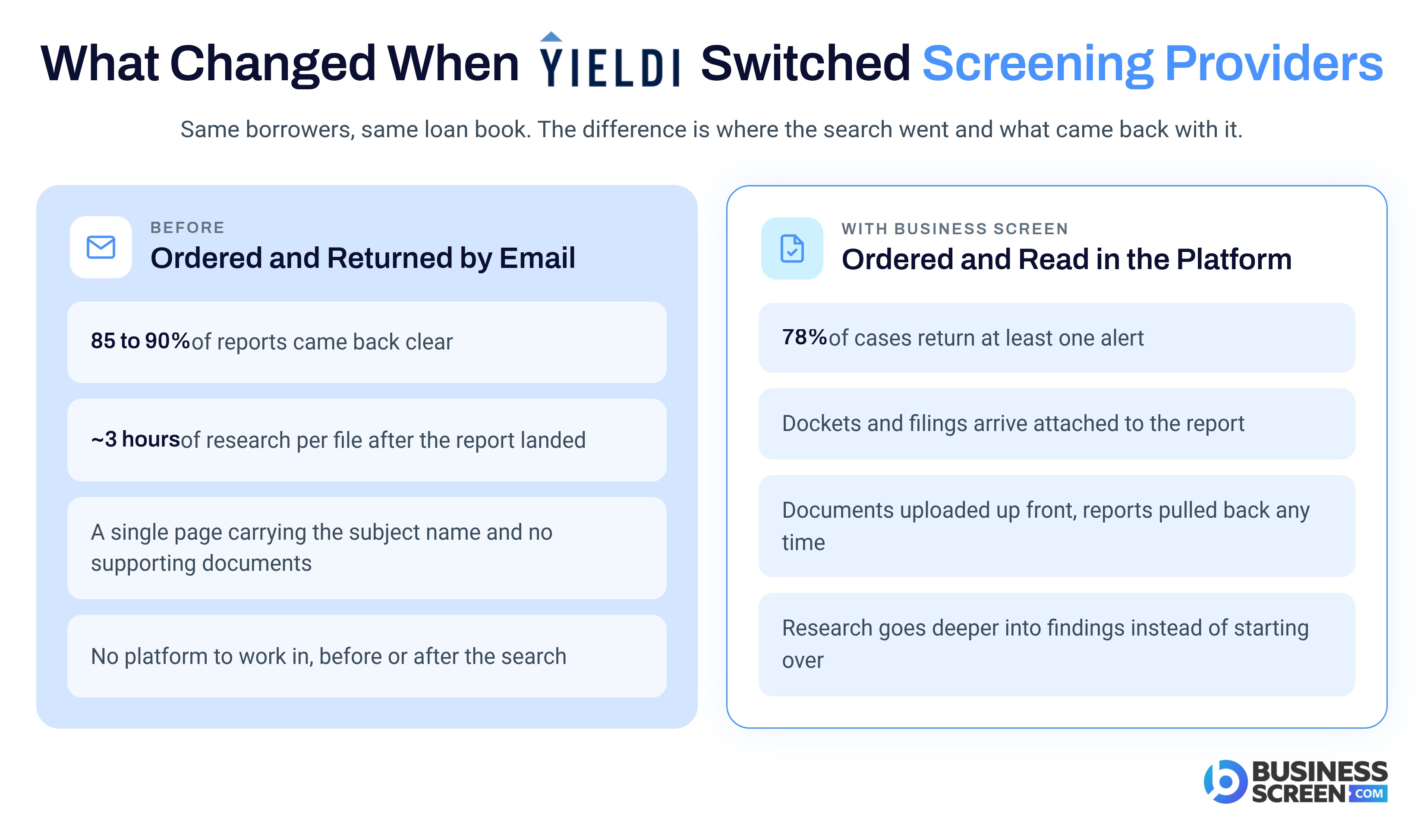
Under their previous provider, ordering a report meant sending an email.
There was no platform behind it. Nowhere to upload a driver's license, an operating agreement, or the entity documents that would have helped the search, and nothing to log back into once a request was out.
What came back was also email. A single page, the entity or guarantor name at the top, a line, and the words nothing found. No supporting documents behind it.
When that page came back empty, the work moved in house.
"I would start digging myself, looking in local real estate records, looking at local court systems, just Google itself. And I was finding things that the background company wasn't finding."
Heather W., Closing Coordinator, Yieldi
What she turned up was judgments, liens, and pending matters the report had not carried, most of it sitting in public dockets and property records open to anyone who went looking.
Between 85 and 90% of those reports came back clear.
That number is the whole issue. Their closing coordinator came to Yieldi from a law firm, where she had spent her days as a foreclosure paralegal reading title and judgment records. She knew what a stack of files like this should look like, and it was not this.
"People who can go get a bank loan don't come to us. I expect every borrower to have something, something somewhere."
A near universal clean rate on that book is not reassurance. It is a question about the search, and the answer was costing time as well as money. A standard Yieldi file is one entity and two guarantors, which ran roughly $1,500, and every empty page cost about 3 hours on top of it.
"We can't pay $1,500 for a background check and have it come back clear, and then I spend three hours and find ten issues."
Three problems stacked on each other. The results did not match what the files should have contained. The cost was real money for a page with no documentation behind it. And the rework landed on the person whose job was supposed to begin where screening ended.
Aggregated data is genuinely fine for a lot of routine work, and plenty of lenders are well served by it. But a clean result is not the same as an absence of risk, and the gap usually sits in how the search was run rather than in what exists on record. On a book with a high base rate of findings, that gap is not a close call.
Three years in, 78% of Yieldi's cases return at least one alert. That figure comes from our own screening records for their account.
The findings matter most, but they are not the only thing that changed.
There is a platform. Yieldi fills out the screens, uploads the license and the organization documents, and pulls the finished report directly. It stays there if she needs to go back to it.
The documents come attached. When active litigation surfaces, the docket arrives with the report, and so do the filings behind it. That is the difference between being told a lawsuit exists and being able to read the complaint before a call.
The remaining manual work is the right manual work. Yieldi still digs, but only into what the report surfaced and only where the answer changes the decision. The parallel searching to check the provider's work is gone.
Diligence at Yieldi runs in two stages with a clean handoff.
Originations works the front end. They look at the collateral, and where the property is income producing, the borrower's financials, against a target loan to value ratio of 65% or lower. Once the term sheet and loan commitment letter are signed, the file moves to closing, and the subject becomes the borrower rather than the building.
Two structural details make that work. The authorization language from our background consent form is built into Yieldi's term sheet, so permission is captured in the deal document rather than chased separately later. And anyone holding at least 20% of the borrowing entity is added as a guarantor, which makes the guarantee threshold the screening threshold. That is the same reasoning behind screening principals alongside the business, drawn at a line their loan documents already set.
Advanced is the default order. Deep Dive comes out when the ownership runs through other entities rather than individuals.
"When I start seeing a chain of entities in that ownership, that's when I want the Deep Dive, to see what other entities are out there that may be connected and would also need to be searched."
On a book where nearly four in five files return something, Advanced is a sound default. A lighter start makes more sense where the base rate is lower, which is why the level of diligence should track the stakes of the decision rather than being set once for everything.
Most files clear without a conversation. The ones that go to the principals share a profile: financially related litigation, judgments and liens, patterns of multiple lawsuits rather than a single matter, repeated creditor issues, undisclosed judgment liens, and anything conflicting with what the borrower said or did not say up front.
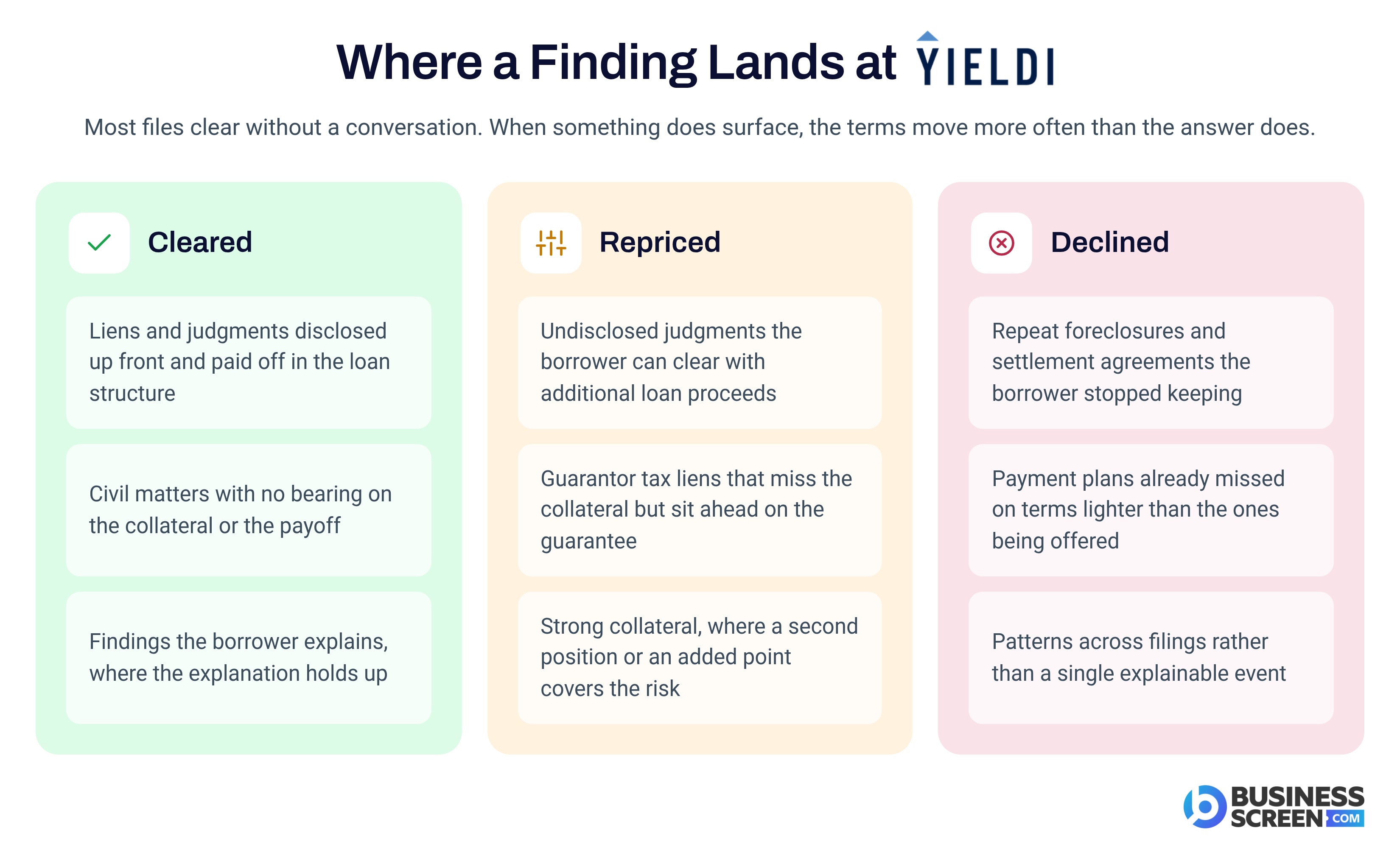
Undisclosed findings carry the most weight. A borrower disclosing $100K in tax liens to be cleared at closing is doing normal business. A borrower who discloses that, and whose report returns a $1.6M IRS lien nobody mentioned, has changed the question.
Litigation still has to be read rather than counted. A personal injury suit against a borrower may have no bearing on the loan at all. A foreclosure usually does, and so does a dispute among members of an entity over who controls the property it owns. Two lawsuits can look identical in a summary line and mean entirely different things.
The same care applies to liens that look like someone else's problem. If the collateral sits in a real estate entity and the tax liens are against the guarantors personally, they do not attach to entity owned property, so they do not sit ahead of the mortgage in a foreclosure. They do sit ahead of Yieldi on the personal guarantee, which makes them debt that still has to be paid and risk that still has to be priced.
"A single lawsuit or lien can have a reasonable explanation, but patterns are important."
A commercial loan of roughly $5M, a few months back, is the clearest version of that. The financials were good and the collateral put it inside their 65% target. Then the report came back on the loans Yieldi was being asked to pay off: repeat foreclosures, settlement agreements, modifications on record. The docket showed the borrower had stopped making the payments under those plans.
"If a borrower can't follow through with a current payment plan, and the payment is less than what we're offering, it's very likely they're going to default on our payments too."
They turned it down that day. Over three years, Yieldi has declined roughly ten deals on the strength of a report, worth somewhere near $25M in principal, or about one to two a quarter.
A finding more often changes the terms than the answer. When the collateral is strong and the issue does not touch the loan, Yieldi may raise the loan amount so the borrower can clear undisclosed judgments at closing, take a second position on a guarantor's primary residence, or add a point to the rate or the origination fee for the added exposure.
Yieldi's advice to a lender standing up a diligence process comes down to four things.
The screening cost is small against the loss. It is easy to focus on the property and the numbers, which is what their originations team is there to do.
"The cost of the screening is insignificant compared to the size of the loans that we're making and the loss that we would experience if we get the borrower wrong."
Do not make exceptions for a good looking deal. Not for an exceptional property, not for a referral, and not for who the borrower is.
"Don't make exceptions just because a deal looks good, or the borrower is a friend of a friend, or an athlete. We've had athletes come to us as borrowers and get turned down because of what we found on the background check."
Screen the entity and everyone behind it. If an entity is owned by another entity, keep tracing the chain until you reach individuals.
"You could find out that your guarantor owns eight other entities that have them in civil litigation for financial concerns, or liens and judgments against them."
Treat patterns differently than incidents. One lien can have an explanation. Five is a different signal.
"If something looks off, you need to dig into it and don't just mark it off. Especially when you're getting into these higher principal balance loans."
Underneath all four is the reason Yieldi split the process in two. Originations values the asset. Closing reads the borrower.
"Knowing who you're lending to is just as important as what you're going to get on the back end."
Verifying the person behind the deal is a different job than valuing what secures it, and it needs its own step.
To learn more about how our due diligence process would fit into your workflow, hit Get Started below and fill out the form.







.png)
